[News] Sam Altman Says Local AI Wastes Memory: Who Should Actually Care?
Article last updated: 2026-11-02



What happened
Sam Altman, OpenAI’s CEO, suggested that running AI models locally is a waste of memory. Two independent outlets reported the remarks: PCMag and dataswamp.org. The PCMag headline frames it plainly — Altman “suggests running AI locally is a waste of memory.”
That is the whole of the news. No product launched. No price changed. No model was released. A CEO gave an opinion, and two outlets wrote it up.
So why does it matter? Because the sentence sits on top of a real split in how people use AI right now, and because Altman has a commercial interest in which side wins.
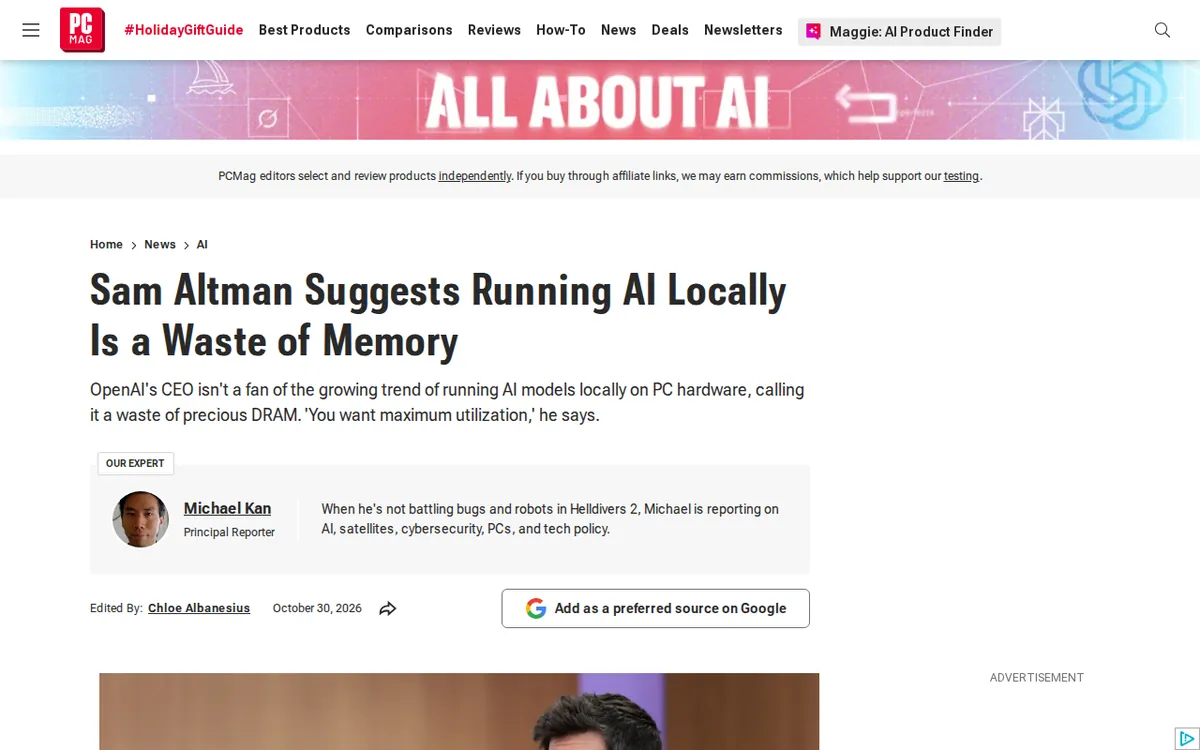
Figure: pcmag.com source page, captured 2026-11-02.
How AMPM sees it
Start with what “running AI locally” means. A local model runs on your own machine — your laptop, your desktop, a small box in the corner — instead of on a company’s servers. Nothing you type leaves your device. You do not pay per use. You do not need an internet connection. The trade is that you supply the hardware, and the hardware has to be good enough.
Altman’s argument, as reported, is about memory. Large models need a lot of it. A model that answers questions well enough to be useful takes up space in RAM — the fast working memory a computer uses while it is running — and on most consumer laptops that space is already spoken for.
That part is not controversial. It is arithmetic. A mid-range laptop does not have the memory headroom to run a strong model and everything else you are doing at the same time.
What is worth separating out is the word “waste.”
Inference: “Waste” is a judgment, not a measurement. The same memory could be described as “spent” or “allocated.” Calling it wasted implies the memory has a better use, and for OpenAI the better use is obvious: your machine stays light, and the heavy work happens on servers you rent access to by the token — a token being a small chunk of text the model reads or writes.
That is not an accusation. It is the business model. OpenAI sells API access, where API means a programmatic door into the model that other software calls. Every argument that pushes work off your device and onto a server pushes work toward that door.
The honest version of Altman’s point is narrower than the headline: for most office workers, running a strong model locally today is impractical. That is true. It has been true for a while. It will probably stop being true at some point, and the interesting question is when.
Here is where the two camps actually sit.
Local models win on three things. Privacy, because nothing leaves the machine. Cost predictability, because there is no meter running. And offline access, because the model is already there.
Cloud models win on three things. Capability, because the biggest models do not fit on a laptop. Maintenance, because someone else handles updates and uptime. And startup cost, because you do not buy hardware to begin with.
For a general office worker answering email and drafting documents, the cloud side wins on every axis that matters day to day. Altman is right about that reader.
For a lawyer, a doctor, a journalist with a sensitive source, or anyone at a company with strict data rules, the privacy column is not a nice-to-have. It is the entire decision. Those readers should treat a CEO’s opinion about memory as irrelevant to their problem. Their problem is not memory. Their problem is whether the text can leave the building at all.
There is a third group the headline flattens: people who already run local models and are happy. They are not wasting anything. They made a trade and they know what they gave up. A statement like this is not aimed at them.
Inference: The timing is worth noticing. Remarks like this tend to surface when a company wants to shape how buyers think about the next purchase. If you are weighing a new laptop, “local AI is a waste” is a nudge toward buying less machine and more subscription. That may be correct advice. It is still advice from an interested party.
What to watch next:
- Whether OpenAI or its rivals ship a genuinely small model that runs well on ordinary hardware. If that happens, the “waste” framing gets harder to hold.
- Whether device makers keep marketing local AI as a feature. If they do, the two stories will collide in public.
- Whether privacy rules in major markets tighten. Regulation, not memory, is what usually moves this debate.
One more thing. This story has nothing to do with any tool we track. It is a general industry argument. Readers who came here looking for a product decision should not read a CEO quote as one.
🔍 AMPM exclusive check: related tool pick
Related tool pick: if the reason you were reading about local AI is that you want meeting notes to stay private, Fireflies.ai is the kind of tool that sits on the other side of that line — it is a meeting recorder that joins video calls and produces transcripts and summaries. It helps with the part most people actually struggle with: turning a recorded conversation into something searchable and shareable. Its limits are the usual ones for this category. The free tier’s AI summaries are limited rather than unlimited, and downloading transcripts is not part of the free tier. Storage is capped, and it is a shared total rather than something that resets each month, so old meetings have to be cleared before new ones fit. Anyone whose real requirement is that nothing leaves their own hardware should understand that this class of tool does not meet it.
Verdict: who should use it, who should skip it
This is not a product verdict, so read it as a decision about the argument.
Take Altman’s point seriously if you are an ordinary office worker buying a laptop this year and wondering whether you need top-tier memory for AI. You probably do not. Cloud tools will do more for less hassle.
Ignore it if your work involves material that cannot leave your control. Your constraint is not memory. It is confidentiality, and no server-side tool solves that no matter how good it is.
Ignore it if you already run local models and they do the job. You are not the audience for this remark.
Watch it if you are deciding where to build. The line between what runs on a device and what runs in a data center is the most consequential split in this industry right now, and every CEO quote is a small push on it.
Sources
- PCMag: https://www.pcmag.com/news/sam-altman-suggests-running-ai-locally-is-a-waste-of-memory
- dataswamp.org (second independent report)
Written: 2026-11-02 Price last verified: 2026-11-01 Tool last health-checked: 2026-11-02
🐾 Meet the cats: AMO and PIMI

AMPM is a Taiwan-based AI-tool pricing watchdog. Our motto: ask before you subscribe. Two cats argue every tool from two sides:
- ☀️ AMO — the budget-minded cat. Always asks: is the free tier enough, and is paying actually worth it?
- 🌙 PIMI — the performance-minded cat. Cares about whether it works well, fast, and gets your job done.

When they are done arguing, you know whether to pay. Every number is checked by us, with the verification date at the end.