Ask Cat › AI Tool Summary › Anijam
[Review] Anijam Pricing: The US$25-a-Month Plan Vendors Quote as US$16
- Free tier: There is
- Cheapest paid plan: US$25/mo and up
- Free quota: A free plan exists, but the official pricing page does not list its …
- Last checked: 2026-10-05
Article last updated: 2026-10-07



Anijam’s cheapest animation plan isn’t actually US$16 a month
Anijam turns text or a single image into a short animated video. It has a free tier, and most of its marketing around the paid “Beginner” plan leads with a dollar figure that creates confusion: US$25 a month. But look closer at Anijam’s own pricing page, and the plan is also shown at US$16 — a number that belongs to annual billing, not the monthly price. Readers searching for Anijam pricing or trying to figure out if the free tier is worth paying for deserve the plain version: both numbers are real, they apply to different billing choices, and conflating them is an easy way to end up surprised on your credit card statement.

Illustration: The seemingly low monthly rate actually requires purchasing a whole year upfront rather than paying per month.
We read Anijam’s pricing page and FAQ directly, cross-checked them against the plan structure, and pulled out what actually changes between free and paid, and between monthly and annual billing. Here’s the breakdown AMO (budget-focused) and PIMI (performance-focused) worked from.
What the free tier actually gives you
Anijam’s pricing page doesn’t publish a specific credit number for free users — no “100 free credits” or “5 free generations” stated anywhere we could find. What it does spell out, in its FAQ, are the restrictions: free users download and export content with watermarks, full stop, and anything you make under the free plan is for non-commercial use only. Commercial rights are reserved for paid subscribers.
The free credits themselves don’t come from a flat monthly allowance. They come from promotional grants, each with its own short clock: a signup bonus that expires in 31 days, a daily check-in bonus that expires in 7 days, and a referral bonus that also expires in 7 days. Miss the window and the credits are gone, used or not. Anijam’s FAQ doesn’t publish what export resolution free users get either — for comparison, the cheapest paid tier caps out at 720P, and only Creator and above unlock 1080P.
The four paid plans, monthly vs. annual
Anijam runs a straightforward subscription model with four tiers, each listed at a monthly “list” price with a discounted annual price sitting next to it:
- Beginner: US$25/month, 3,000 credits/month, 720P export, no watermark, commercial use allowed. Billed annually, the total is US$192/year — which averages to US$16/month, not a separate monthly rate.
- Creator: US$50/month, 6,000 credits/month, adds 1080P export. Annual billing totals US$312/year, averaging US$26/month.
- Master: US$100/month, 16,000 credits/month. Annual billing totals US$696/year, averaging US$58/month.
- Master Pro: US$300/month, 50,000 credits/month. Annual billing totals US$1,992/year, averaging US$166/month.
None of these are limited-time promo codes — it’s a standing structure where every plan shows a struck-through monthly price alongside the annual-equivalent monthly figure. There’s a real mechanical catch buried in the FAQ that matters more than the headline prices: plan credits get issued at the start of each billing cycle and only last that cycle — unused credits do not roll over. If you buy extra credits on top of a plan, those add-on packs are only available to subscribers and last 365 days, a much longer runway than the plan credits they supplement.
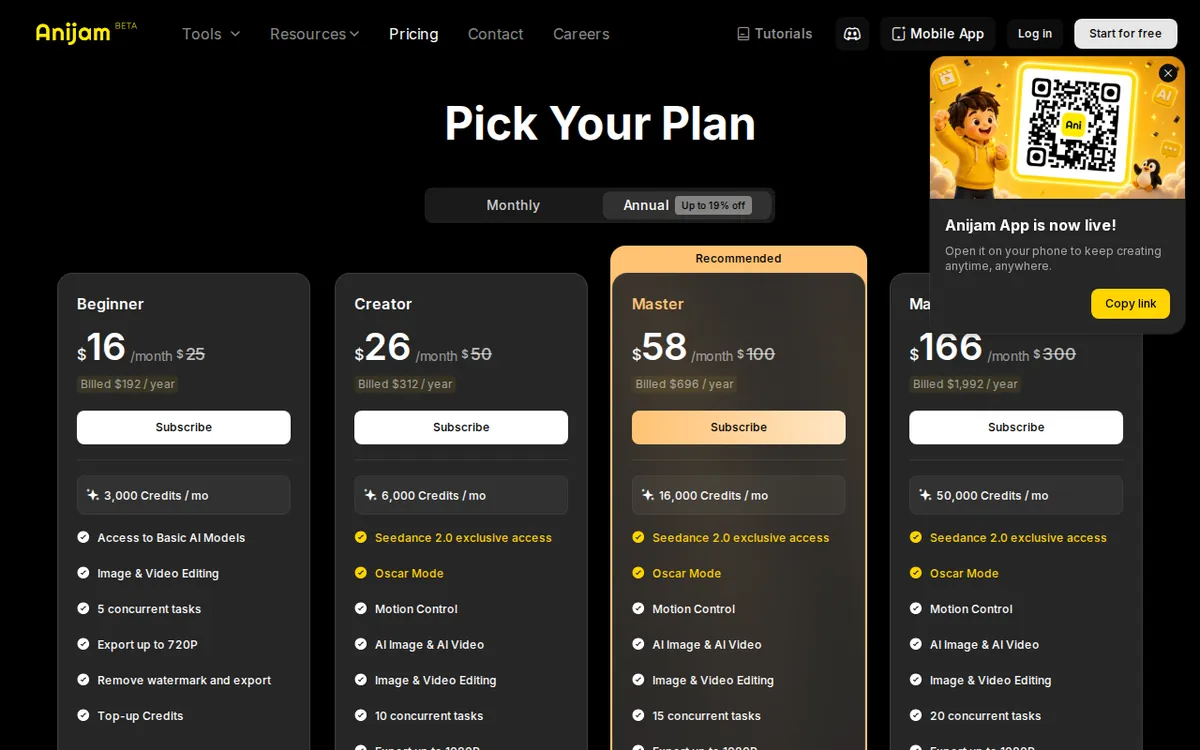
Figure: anijam.ai official pricing page, captured 2026-10-07.
🔍 AMPM exclusive check
Here’s where our read of the pricing page differs from how the numbers tend to get repeated elsewhere. Anijam’s own page displays two dollar figures per plan — the standard monthly price (US$25, US$50, US$100, US$300) and an annual-billing monthly average (US$16, US$26, US$58, US$166) — both labeled in a way that makes them look like alternative monthly rates rather than two different billing commitments. Third-party listings regularly pick up the lower number and present it as “Anijam’s monthly price,” which it is not: US$16/month only applies if you pay US$192 upfront for a year. We’re flagging this explicitly because it’s the single easiest way to misquote this tool’s cost, and the vendor’s own page layout invites the mistake rather than correcting it.
Beyond that mix-up, there’s a second gap worth naming: Anijam never states a specific free-tier credit allowance anywhere on its pricing or FAQ pages. Every other detail about the free plan — watermarks, non-commercial restriction, the 7-to-31-day expiry windows on promotional credits — is spelled out in plain language. The actual quantity of free credits a new user gets simply isn’t published. We checked for it specifically and came up empty, so we’re reporting that absence rather than guessing a number. Every other figure in this piece — the four monthly prices, the four annual totals, the credit allotments per plan, and the resolution caps — matches Anijam’s pricing and FAQ pages as last checked on 2026-10-05, with no changes found across routine rechecks since 2026-08-09.
☀️ AMO, the budget-minded cat

I went straight to the free plan question: is it actually usable, or is it a locked demo? The honest answer is “usable, but narrowly.” You can generate and download animations for free, but every single export carries a watermark and you’re barred from using the output commercially — so if you’re making anything for a client, a brand, or a monetized channel, the free tier isn’t an option no matter how many credits you have. It’s built for personal experimentation only.
The bigger budget trap is the billing structure itself. If you only need Anijam occasionally, the real cost is US$25 for a single month — not US$16. The US$16 figure requires committing US$192 upfront for a full year, and Anijam’s plan credits don’t roll over between cycles, so paying annually doesn’t bank unused credits either; you still only get 3,000 credits per cycle, cycle after cycle. That makes the annual discount a bet on steady, ongoing use, not a hedge against light use.
For anyone testing the water, the free tier’s expiring credit grants are the real constraint: a 31-day signup bonus and 7-day daily/referral bonuses mean you can’t stockpile free credits for a big project later — use them or lose them. If your output needs to be commercial or watermark-free even once, you’re paying at least US$25 for that month, full price, with no cheaper monthly on-ramp. Compared to the jump straight to Creator at US$50/month for 1080P, Beginner at US$25/month for 720P is the only entry point that doesn’t require a year-long commitment to reach the lower per-month number advertised.
🌙 PIMI, the performance-minded cat

My question is whether the output quality and credit math hold up once you’re actually paying. Resolution is the clearest signal: Beginner tops out at 720P, and you need Creator (US$50/month) or higher just to get 1080P. If the finished video matters — anything meant to look sharp on a modern screen — Beginner’s 720P ceiling is a real limitation, not a formality.
Credit scaling across tiers is roughly linear with price at the lower end (3,000 credits at US$25, 6,000 at US$50) but accelerates at the top: Master jumps to 16,000 credits for US$100, and Master Pro reaches 50,000 credits for US$300. That’s a meaningfully better credits-per-dollar ratio at Master and above, which matters if you’re producing volume — more clips per cycle for proportionally less per-credit cost than the entry tiers.
The operational detail I’d flag for any production workflow is that plan credits reset every billing cycle and don’t carry over. If your output is bursty — a heavy month followed by a quiet one — you’re not storing value for the slow month; it just evaporates. Add-on credit packs solve that, lasting 365 days, but they’re subscriber-only, meaning you still need to be paying for a plan to buy the cushion in the first place. For teams with steady, predictable output, the non-rollover structure is a non-issue. For anyone with lumpy demand, it’s a quiet tax on the plan price you already committed to.
Verdict: who should use it, who should skip it
Anijam makes sense for someone who will use it regularly enough to justify annual billing, needs commercial rights or watermark-free exports from day one, and can live with 720P at the entry tier or is ready to pay for Creator’s 1080P. It also fits anyone with high, steady volume, where Master or Master Pro’s credit-per-dollar ratio pays off.
Skip it, or stay on the free tier only for personal, non-commercial testing, if you need commercial output occasionally rather than constantly — the US$25 single-month price applies regardless, and the discounted US$16 figure is not a real monthly rate you can get without an annual commitment. Anyone with unpredictable, bursty workloads should also budget for the fact that unused plan credits disappear every cycle, annual billing or not.
Written: 2026-10-07 Price last verified: 2026-10-05 Tool last health-checked: 2026-10-07
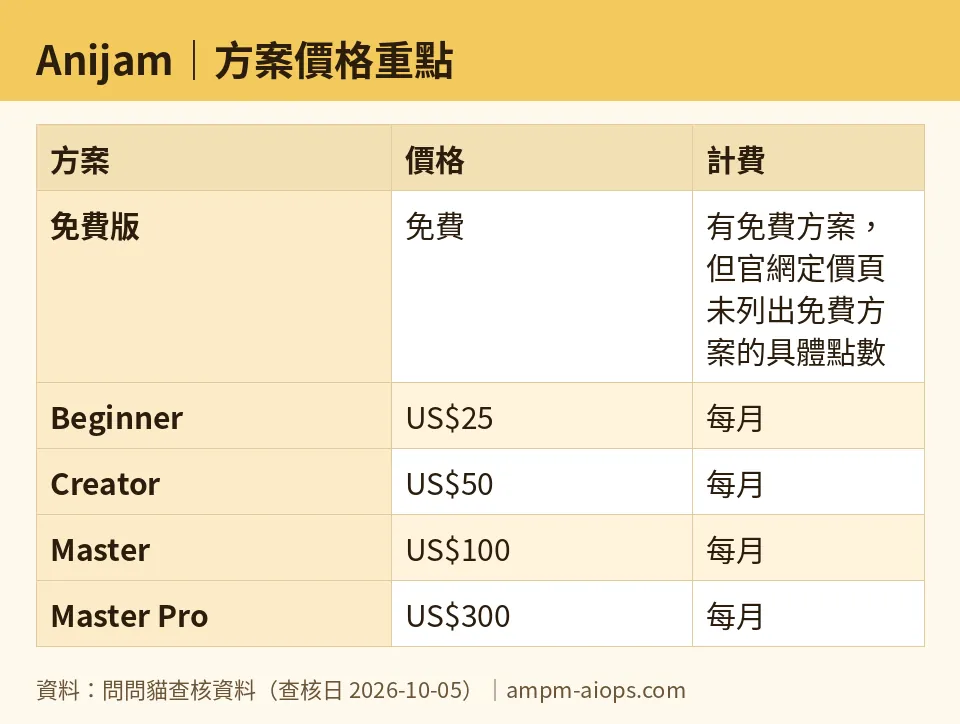
Figure: compiled by AMPM from its verified data (last verified 2026-10-05).
🔗 Related on AMPM
📎 Sources
All prices and quotas in this article come from AMPM’s verified dataset for Anijam (last verified 2026-10-05); primary sources:
🐾 Meet the cats: AMO and PIMI

AMPM is a Taiwan-based AI-tool pricing watchdog. Our motto: ask before you subscribe. Two cats argue every tool from two sides:
- ☀️ AMO — the budget-minded cat. Always asks: is the free tier enough, and is paying actually worth it?
- 🌙 PIMI — the performance-minded cat. Cares about whether it works well, fast, and gets your job done.

When they are done arguing, you know whether to pay. Every number is checked by us, with the verification date at the end.
🐾 Our sister sites also checked
Let's take a look at these
- Anijam Comprehensive Introduction: Pricing, Features, and Actual Limitations
- Anijam Is the free quota enough?
- Anijam Alternatives
- Comprehensive Free Quota List for All Tools