[How-to] Anyword Pricing 2026: Which Plan Lets You Edit and Still See the Score?
- Free tier: No
- Cheapest paid plan: US$49/mo and up
- Free quota: No permanent free plan, offers a 7‑day free trial (limited to 2,500 …
- Last checked: 2026-11-02
Article last updated: 2026-10-30


Anyword has no permanent free plan. That surprises people who expect one. What you get is a short trial, and then you choose between two paid plans that differ in one way that matters: how the performance score behaves while you edit.
This guide is for beginners. I’ll show how to start, what the trial can and can’t do, and where new users get stuck. My angle is simple: work out which plan matches how you actually write, before you pay for the wrong one.
Anyword is a marketing copy tool. It writes ads, emails and landing-page text, then gives each draft a predicted performance score. That score is a model’s guess at how well the copy will work with an audience. It is not a measured result.
What you get without paying
There is no free tier. The official page offers a 7-day free trial, capped at 2,500 words of generated text.
A word cap is the limit to watch. Marketing copy is short, so 2,500 words goes further than it sounds. But if you generate several variations of every headline, you can burn through it in a day or two. Treat the trial as a test of one real project, not a place to browse.
Our data does not say whether the predictive score is switched on during the trial, or how many scores you get. Check the trial screen on sign-up before you plan around it.
Prices can vary by country. We checked from Taiwan.
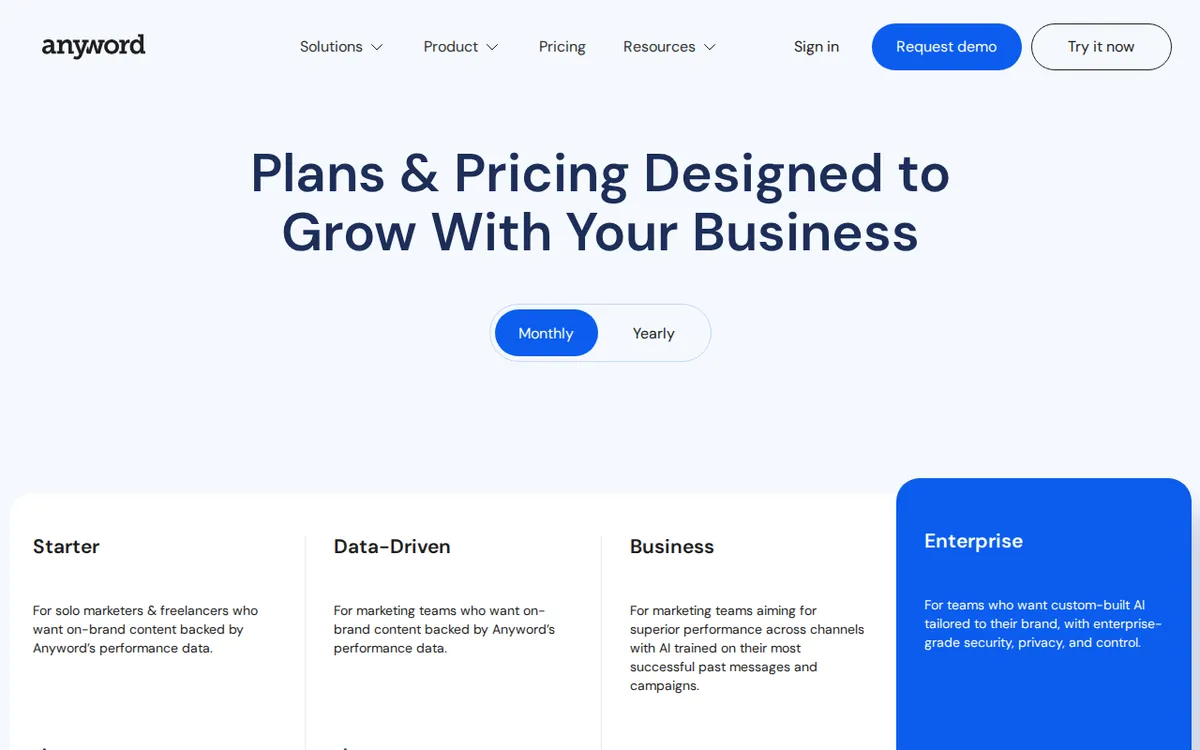
Figure: anyword.com official pricing page, captured 2026-10-30.
Your first session: a step-by-step plan
You have seven days and a word cap, so go in with a plan.
- Pick one real job. A product description, an ad set, or an email subject line list. Something you would actually publish.
- Write down your audience in one sentence. Anyword’s pitch is audience data, so give it something to work with.
- Start from a template. The Starter plan lists 100+ marketing templates. Use one rather than a blank page. Templates are pre-built layouts for common copy types.
- Generate a small batch. Do not ask for twenty versions. Ask for a handful, compare, then refine. This protects your 2,500-word allowance.
- Look at the scores. Note which drafts score higher and ask yourself whether you agree. That tells you quickly if the score is useful for your kind of writing.
- Edit one draft by hand. This is the key test. Change a few words and see whether the score updates as you type. This is where the plans split, as the next section explains.
Where the two plans really differ
Both paid plans offer unlimited text generation. The difference is in scoring, seats and analysis.
Starter is US$49 per month on monthly billing, or US$39 per month when billed yearly. It is priced per seat. A seat is one person’s login. It includes:
- 1 seat
- unlimited text generation
- 1 brand voice model (a saved profile of your tone and style)
- 50 predictive performance scores per month
- 100+ marketing templates
Data-Driven is US$99 per month on monthly billing, or US$79 per month when billed yearly. It includes:
- 3 seats
- unlimited text generation
- real-time predictive performance score on manual edits
- advanced data row analysis
Extra seats cost US$59 per month each.
Our data has no separate yearly total for either plan, only the monthly-equivalent figure for yearly billing. So we won’t give you an annual sum. Check the pricing page for what you’d be charged up front.
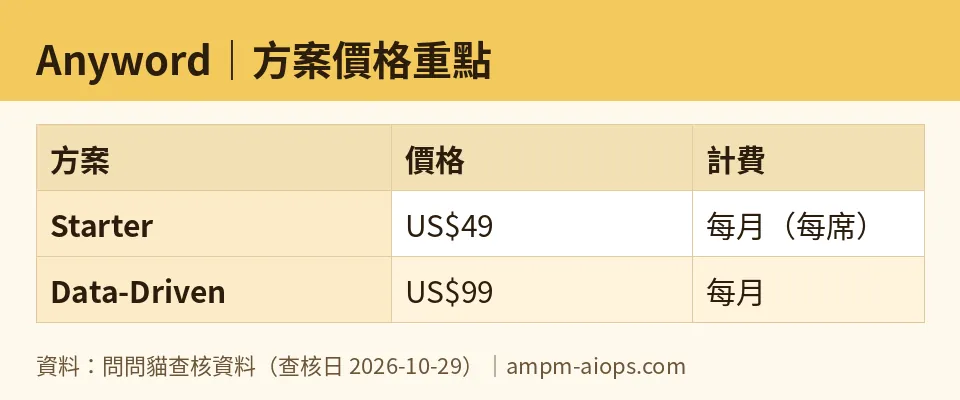
Figure: compiled by AMPM from its verified data (last verified 2026-10-29).
Common blockers and fixes
The trial word cap runs out early. Generate fewer variations and edit more. Save the cap for your real project.
You hit the score limit on Starter. You get 50 scores per month. If you score every draft and every tweak, that goes fast. Fix: generate freely, but only score your two or three best candidates.
You edit a draft and the score doesn’t move. On our data, live re-scoring while you edit by hand is a Data-Driven feature. Starter’s allowance is a count of scores, not a live meter. If your workflow is “tweak, check, tweak, check,” Starter will feel tight.
A teammate needs access. Starter has 1 seat. Data-Driven includes 3. Beyond that, each extra seat is US$59 per month.
You expect one brand voice per client. Starter includes 1 brand voice model. If you write for several brands, this may bind. Our data doesn’t state the voice-model count for Data-Driven, so check before you commit.
🔍 AMPM exclusive check
Nothing differed from the official page this time; every number here matches it, checked 2026-10-29.
One caution on our side. This tool entered our database as a challenger candidate, and the data has had one verification round. It has not been cross-checked by three separate people, as our established entries have. We have not confirmed the trial’s commercial-use terms, and we have not confirmed whether scoring works inside the trial. Read the live pricing page before you pay.
☀️ AMO, the budget-minded cat

Is free enough? There is no permanent free plan, so the honest answer is no. The trial gives you 7 days and 2,500 words. That is enough to judge whether you like the output. It is not enough to run a campaign.
Is paying worth it? Start with the question of what you’d use the score for. Starter at US$49 monthly (US$39 per month on yearly billing) gives you 1 seat, unlimited generation and 50 scores a month. If you write a modest amount of copy and score only your finalists, 50 can be plenty. You pay for the writing engine and treat scoring as a spot check.
Data-Driven at US$99 monthly (US$79 per month on yearly billing) is a different kind of spend. You pay for live scoring while you edit, deeper data analysis, and 3 seats. For a solo writer, those 3 seats may be wasted money. For a small team, they are the real value: extra seats cost US$59 per month each, so having 3 included matters.
My budget advice: begin on Starter if you work alone and write in bursts. Move up only if you notice yourself wishing the score would update as you type. Do not pay for yearly billing until you have used the monthly plan long enough to trust the tool. Our data gives no yearly lump sum, so you’d be committing without a clear total in front of you.
🌙 PIMI, the performance-minded cat

Does it work well? The core idea is strong for a beginner: instead of guessing which headline is better, you get a score. That shortens the loop. But remember it is a prediction, not data from your own campaign. Use it to rank drafts, then let real results decide.
Speed is where the plans separate. On Starter, you have 50 scores a month. That pushes you into a slower rhythm: write, pick finalists, score them. On Data-Driven, the score responds to your manual edits in real time. You change a phrase and see the effect. For anyone refining ad copy line by line, that is the faster way to work.
Both plans offer unlimited text generation, so you will not stall on output. Starter includes 100+ templates and 1 brand voice model, which gets a solo marketer moving quickly. Data-Driven adds advanced data row analysis, aimed at people who want to dig into audience numbers rather than just draft text.
If you want tight, repeated edit-and-check cycles, go straight to Data-Driven. If you mostly generate and pick, Starter does the job. Use the trial to test the edit loop on one real draft before you decide.
Verdict: who should use it, who should skip it
Use Starter if you are a solo marketer or freelancer, you write in batches, and you only need to score a handful of finalists each month. It has 1 seat, so it fits one person.
Use Data-Driven if you edit by hand a lot and want the score to move as you do, or if a small team shares the account. Three seats are included, and extra ones cost US$59 per month each.
Skip Anyword if you need a permanent free plan. There isn’t one. The trial is 7 days and 2,500 words, then you pay.
Skip it for now if you can’t confirm the commercial terms. Our check was a single round, so read the official terms yourself.
Written: 2026-10-30 Price last verified: 2026-10-29 Tool last health-checked: 2026-10-30
🔗 Related on AMPM
📎 Sources
All prices and quotas in this article come from AMPM’s verified dataset for Anyword (last verified 2026-10-29); primary sources:
🐾 Meet the cats: AMO and PIMI

AMPM is a Taiwan-based AI-tool pricing watchdog. Our motto: ask before you subscribe. Two cats argue every tool from two sides:
- ☀️ AMO — the budget-minded cat. Always asks: is the free tier enough, and is paying actually worth it?
- 🌙 PIMI — the performance-minded cat. Cares about whether it works well, fast, and gets your job done.
When they are done arguing, you know whether to pay. Every number is checked by us, with the verification date at the end.
🐾 Our sister sites also checked
Read next
- Anyword Full breakdown: pricing, features and real-world limits
- Anyword Is the free quota enough?
- Anyword Alternatives
- Free plan limits for every AI tool we track