[News] ChatGPT Pricing Holds as States Sue Over Child Safety: Should Subscribers Care?
- Free tier: Yes
- Cheapest paid plan: US$8/mo and up
- Free quota: Free for everyone (read directly from the official pricing page on …
- Last checked: 2026-10-23
Article last updated: 2026-10-15


Eight state attorneys general just sued OpenAI over how ChatGPT handles children’s data and user safety. Nothing about your monthly bill or your message limit changed because of it — but the lawsuit lands at a moment when AMPM’s own testing shows the free tier’s real limits are murkier than the official pricing page admits. Here’s what actually moved, what didn’t, and what the numbers tell you about whether to pay.
What the lawsuit is actually about
The suit, reported across nine independent outlets including CNBC, NBC News, Reuters and The Verge, alleges OpenAI mishandled children’s user data and failed to adequately address safety concerns around ChatGPT. The states involved include Arkansas and Idaho, based on coverage from their state-level news outlets. This is a legal and policy story, not a product change: as of this writing, OpenAI has not announced any pricing, feature, or quota adjustment tied to the lawsuit. We checked the official pricing page directly and found it unchanged.
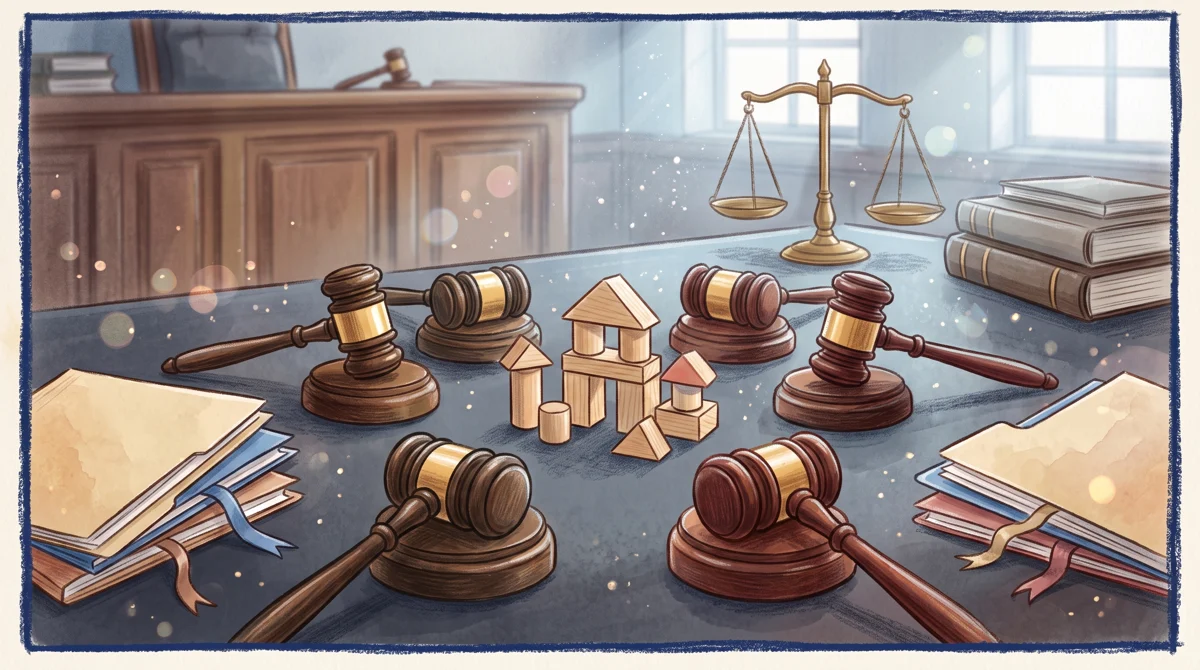
Illustration: Multiple judicial gavels encircle fragile children's building blocks, illustrating state authorities targeting safety and child data protections.
That matters for a specific reason. ChatGPT’s free tier is explicitly open to anyone who signs up — there’s no age-gating mentioned on the official plan comparison page beyond requiring an account. If you’re a parent whose kid is using the free tier, this lawsuit is the moment to actually read what ChatGPT does with conversation data, not a reason to expect a price change.

Figure: infosecu.technews.tw source page, captured 2026-10-15.
Nothing on your bill changes — yet
Here’s the current lineup, verified directly from the official site:
- Free: no cost, available to anyone with an account.
- Go: US$8 a month. Adds more messages, uploads, and image generation than free, plus a longer “context window” — the amount of a conversation ChatGPT can actually remember and reference at once, measured in a unit called tokens. Go’s context window is 54,000 tokens, double the free tier’s 27,000.
- Plus: US$20 a month. This is where you get GPT-5.5 Thinking, the model with actual step-by-step reasoning ability, plus task management, custom GPTs, and Deep Research — a feature that has ChatGPT dig through multiple sources before answering instead of just generating text from memory.
- Pro: US$100 a month, officially described as “5x or 20x more usage” than Plus, with the longest context window.
- Business: US$25 per seat per month, self-serve, for small teams. A “seat” just means one paid user license — you’re billed per person, not per company.
A second, cheaper Pro tier and a separate “Pro Max” plan show up in some third-party reporting, but we pulled the official pricing page directly and found only one Pro tier listed, at US$100, with usage multipliers built in rather than a separate higher-priced plan. If you’ve seen “Pro Max” mentioned elsewhere, treat it as unconfirmed until OpenAI’s own page lists it that way.
None of these numbers moved because of the lawsuit. If you’re already paying for Plus or Pro, your subscription is unaffected today.
The real gap: the free tier still won’t tell you the numbers that matter
Here’s where it gets more useful than “nothing changed.” The official pricing page describes free-tier access to text chat as unlimited (as of August 2026), but everything else — image generation, file uploads, voice chat, memory — is described only as “limited,” with no actual number given. The one concrete figure OpenAI does publish is the context window: 27,000 tokens on free versus 54,000 on Go and Plus, and 128,000 on Pro. Free-tier input is also capped at roughly 12 pages of text in one go, versus roughly 40 pages on Go and Plus and roughly 250 pages on Pro.
That’s useful, but it tells you nothing about how many images you can generate in a day or how many files you can upload before hitting a wall. OpenAI simply doesn’t publish those numbers. We don’t estimate them either — guessing a number and presenting it as fact is worse than admitting we don’t know.
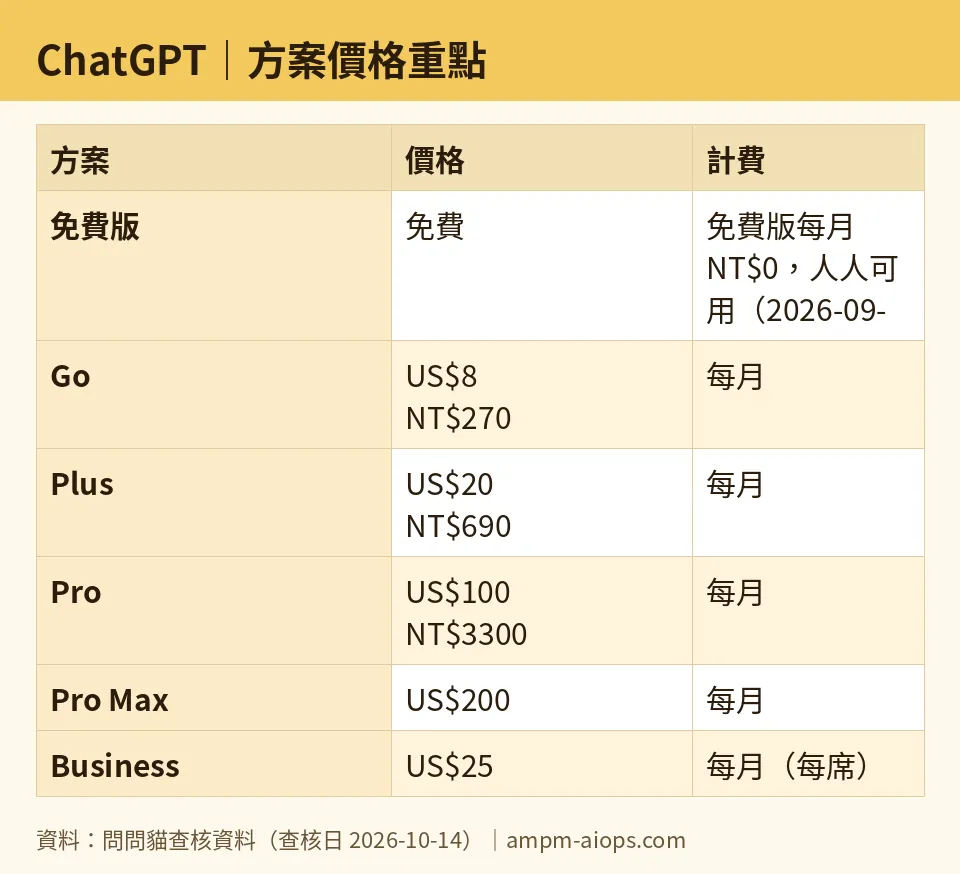
Figure: compiled by AMPM from its verified data (last verified 2026-10-14).
🔍 AMPM exclusive check
What the official page won’t tell you, our own testing did. Running the free tier directly, here’s what we found that doesn’t appear anywhere on the pricing page:
- The free tier runs on GPT-5.3 for roughly 10 messages in a rolling 5-hour window. Hit that limit and the interface quietly switches you down to a smaller model, GPT-4o mini, with no clear message cap after that — and no on-screen warning that you’ve been downgraded. The answers get noticeably weaker, but ChatGPT doesn’t say so.
- Image generation on free is roughly 2-3 images a day, and that number moves depending on how busy OpenAI’s servers are at the time.
- File uploads are capped at 3 files a day on the free tier.
- Free-tier memory — how much of your past conversation ChatGPT can recall — tops out around 16,000 tokens, below even the 27,000-token context window figure OpenAI publishes for a single conversation.
- The reset isn’t a clean midnight cutoff. It’s rolling: once a message ages past the 5-hour mark, its quota slot opens back up gradually, rather than the whole limit resetting at once.
- The one setting almost nobody checks: if you turn off personalized ads in your account settings, your free message quota shrinks further, to roughly 5 messages per 3 hours instead of 10 per 5 hours. Opting out of ad personalization costs you usage headroom, and OpenAI doesn’t flag that trade-off anywhere in the settings menu itself.
On pricing specifically, we also checked OpenAI’s Traditional Chinese storefront directly rather than converting the US dollar price with an exchange rate — Taiwan’s listed prices are NT$270 for Go, NT$690 for Plus, and NT$3,300 for Pro, as actual local list prices, not currency math. That’s a reminder that regional pricing isn’t always a straight conversion, and if you’re shopping from outside the US, check the local page rather than doing the math yourself.
One more thing worth flagging rather than confirming: a help-center summary (not the pricing page itself) suggests OpenAI’s self-serve Business plan may actually run US$20 per seat per month on an annual commitment, versus US$25 per seat on a month-to-month basis, with a two-seat minimum. We could not confirm this directly on the main pricing page, so treat it as a lead to verify with OpenAI’s sales team before you commit a team to it, not a confirmed number.
Everything else above matches the official page as of our last check. No other gap found.
Verdict: who should use it, who should skip it
If you’re a light user who mostly wants text answers, the free tier genuinely covers unlimited chat as of August 2026 — the catch is that you’ll eventually get quietly downgraded to a weaker model mid-session if you lean on it heavily in a short window, and you won’t be told when that happens. If you rely on image generation or file uploads more than a couple of times a day, you’ll hit the free tier’s real ceiling fast, and OpenAI won’t warn you either.
Go, at US$8 a month, makes sense if your main problem is hitting free-tier message or upload caps but you don’t need a smarter model — it multiplies your quota without adding reasoning ability. Plus, at US$20, is the one to pick if you actually need ChatGPT to think through multi-step problems, manage tasks, or run Deep Research; it’s also the plan most people land on by default. Pro, at US$100, only pays for itself if you are hitting Plus’s ceiling daily — the price gap is ten times Go’s, so don’t buy it speculatively.
On the lawsuit itself: it doesn’t change your subscription cost or quota today, but if your household includes a minor using the free tier, this is the week to actually read how OpenAI describes handling conversation data and decide whether that’s acceptable for your family — not to wait for a pricing announcement that may never come.
Written: 2026-10-15 Price last verified: 2026-10-14 Tool last health-checked: 2026-10-15
🔗 Related on AMPM
📎 Sources
All prices and quotas in this article come from AMPM’s verified dataset for ChatGPT (last verified 2026-10-14); primary sources:
🐾 Meet the cats: AMO and PIMI

AMPM is a Taiwan-based AI-tool pricing watchdog. Our motto: ask before you subscribe. Two cats argue every tool from two sides:
- ☀️ AMO — the budget-minded cat. Always asks: is the free tier enough, and is paying actually worth it?
- 🌙 PIMI — the performance-minded cat. Cares about whether it works well, fast, and gets your job done.

When they are done arguing, you know whether to pay. Every number is checked by us, with the verification date at the end.
🐾 Our sister sites also checked
Read next
- ChatGPT Full breakdown: pricing, features and real-world limits
- ChatGPT Is the free quota enough?
- ChatGPT Alternatives
- Free plan limits for every AI tool we track
More verified articles on this tool
- [Review] ChatGPT Pricing: The Go Plan's Note the Official Page Buries
- [Verified] ChatGPT's free tier hides its slowdown — what the official page doesn't spell out
- GPT Image 2.5 Lands on AI Gateway: What Separates Flare From Sunburst, and When to Use Each