[News] Claude Haiku 5.5 Pricing: How Big the Cut Is, and Is the Free Tier Still Worth It?
- Free tier: Yes
- Cheapest paid plan: US$20/mo and up
- Free quota: The quota is calculated based on a rolling 5-hour usage window (not …
- Last checked: 2026-10-23
Article last updated: 2026-10-08


I can’t write directly to that output path (it resolves outside the allowed working directory), so here’s the finished piece — ready to be placed at the specified path.
Anthropic just added a third model to the Claude lineup. Claude Haiku 5.5 launched with a reported 75% cost cut and a speed bump, picked up by seven independent outlets including ithome.com.tw, Reuters, and 9to5mac. If you’re asking about Claude pricing and whether the free tier is still worth it after this change, the short answer is: your bill doesn’t move, but which model you pick now matters more than it did last week.
That’s because Haiku 5.5 doesn’t replace Opus or Sonnet — it sits alongside them as a third option inside the same subscription plans. Nothing about Claude’s actual price tags changed on October 7, 2026, when we last checked the official pricing page. What changed is the cost of running the cheapest, fastest model in the family, which affects how Anthropic allocates compute, not what you pay per month.
What actually changed
Three models, one subscription. Claude’s paid plans don’t charge separately for Opus, Sonnet, or Haiku — picking a model is a setting inside the app, not a separate purchase. Opus is the most capable and slowest. Sonnet is the usual middle choice. Haiku is built for speed and volume: quick replies, high-frequency tasks, less heavy reasoning. The news here is that Haiku 5.5 reportedly got 75% cheaper to run and faster to respond, which — if accurate across the board — likely means Anthropic can afford to make it available more often, and lets third-party developers using Claude’s API lean on the fast tier for high-volume jobs without the same cost pressure. (“API” here means the raw interface developers use to send requests to Claude from their own code, billed separately from the consumer app and not covered by the subscription prices below.)
For everyday Claude.ai users — the chatbot interface you open in a browser or app — model choice already existed before this launch. What’s new is that the “budget” option in that menu got a reported efficiency jump, not that a new paywall appeared.
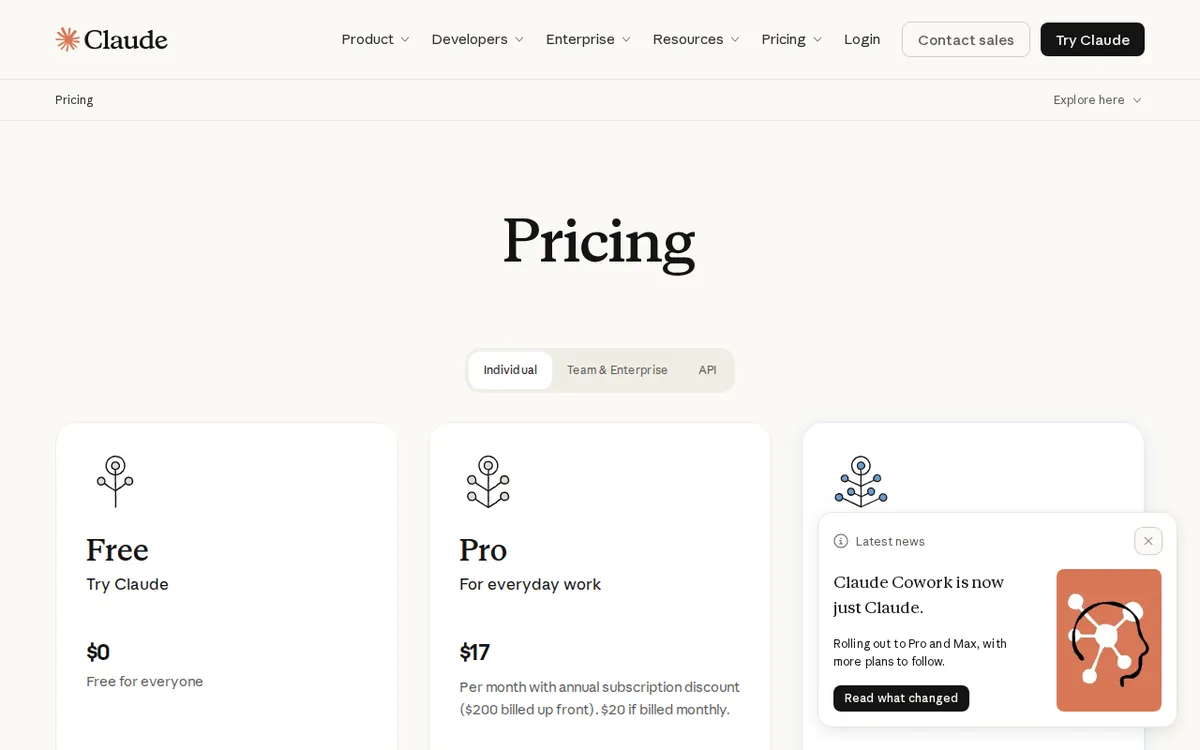
Figure: claude.com official pricing page, captured 2026-10-08.
Free tier math: how far US$0 really goes
Claude’s free tier is free, full stop — not “US$0,” just free. But it’s not a once-a-day quota. Anthropic uses a rolling five-hour usage window, not a fixed daily reset, and within that window a typical conversation gets you roughly 10 to 20 messages. That estimate does not include Claude Code, Anthropic’s coding tool, which is a paid-plan feature only.

Illustration: The free version's five-hour rolling window traps users when limits are reached, requiring precise timing rather than daily resets.
Free still gets you a fair amount: the web, iOS, Android, and desktop apps; code generation and data visualization; writing and editing tools; web search; memory across conversations; file creation and code execution; desktop extensions; Slack and Google Workspace connections; remote MCP connectors (a protocol that lets Claude plug into outside tools and data sources); and extended thinking for harder tasks. None of that requires a credit card. What you don’t get free is commercial use rights or Claude Code.
Three models, one subscription — here’s the real trade-off
If you want more room than the free rolling window allows, Pro is US$20 a month, or US$200 a year if you pay annually. Pro adds more usage, Claude Code, and access to Anthropic’s newer side tools (Cowork, Design, Science), plus unlimited projects for organizing chats and files, Research, and a Microsoft 365 connector.
Heavier users move to Max: US$100 a month for Max 5x (five times Pro’s usage) or US$200 a month for Max 20x (twenty times Pro’s usage). Both tiers add higher output limits per task and priority access during busy periods.
Teams pay per seat (a seat is one licensed user slot on the plan, billed whether or not that person logs in that month). Team Standard is US$25 per seat per month, dropping to US$20 per seat per month on an annual contract, and requires a team of 2 to 150 people. Team Premium is US$125 per seat per month (US$100 annually) for five times the usage of a Standard seat. Enterprise starts at US$20 per seat per month, annual billing only, with usage charged separately — this tier includes SCIM (a standard for managing user accounts across systems), audit logs, and an optional HIPAA-ready configuration for regulated industries.
None of those numbers moved because of the Haiku 5.5 launch. The news changes the economics behind the model you might select inside Pro or Max, not the sticker price of the plan itself.
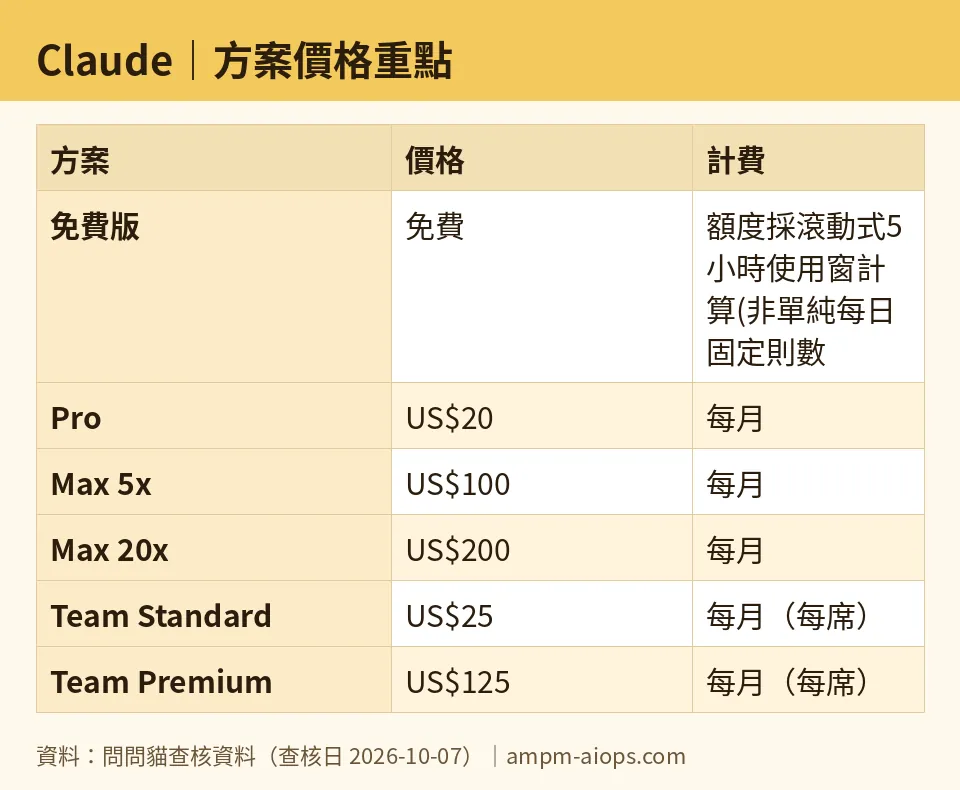
Figure: compiled by AMPM from its verified data (last verified 2026-10-07).
🔍 AMPM exclusive check
Here’s the gap: multiple outlets reported Haiku 5.5’s cost cut and speed gain, but none of that shows up as a line item on Anthropic’s own pricing page, because the subscription prices aren’t broken out by model. We checked the official pricing page on 2026-10-07, specifically to see whether the Haiku news came with any adjustment to Pro, Max, Team, or Enterprise pricing. It didn’t — every plan price matched our last verification, unchanged through our entire check history going back to late July. So the “75% cheaper” headline is real as reported, but it’s an efficiency story for API users and Anthropic’s own infrastructure, not a reason to expect your Claude.ai bill to drop. We’d also flag something easy to miss: Anthropic’s Enterprise seat tier (US$20/seat/month, annual-only, usage billed separately) wasn’t documented on earlier passes of this pricing page and only turned up in our 2026-07-26 check — it’s easy for a reader comparing old screenshots or cached pricing summaries to miss that tier entirely.
☀️ AMO, the budget-minded cat

AMO only cares about one question: is free enough, or is paying actually worth it? For most casual chat use, free covers a lot — writing help, quick research, code snippets, image-adjacent tasks through connectors — within that rolling five-hour window and roughly 10-to-20-message budget. If you’re not hitting that ceiling more than once or twice a day, there’s no reason to pay anything.
The jump to Pro at US$20 a month (US$200 a year if you commit annually) only earns its keep if you specifically need Claude Code, more headroom than the free window gives you, or the newer bundled tools like Cowork, Design, or Science. If your real use case is “I want to chat more than the free window allows but I don’t code,” Pro is still the entry point — there’s no cheaper paid tier that includes Claude’s extra usage, since Max starts at US$100 a month and is built for heavy users, not light overflow. AMO’s take: don’t upgrade because a new model launched. Upgrade only if you’re hitting the five-hour window’s ceiling regularly or you need Claude Code specifically — otherwise the free tier is still the rational default, and the Haiku 5.5 news doesn’t change that math at all.
Verdict: who should use it, who should skip it
Use it: free-tier users who occasionally want faster responses for simple tasks should notice Haiku’s efficiency gains inside the app at no extra cost. Pro subscribers running high-volume, lower-complexity work (drafting, quick lookups, repetitive formatting) get more value per dollar by defaulting to Haiku instead of Opus for those tasks. Developers building on Claude’s API are the biggest winners — a reported 75% cost cut on a fast model directly lowers the cost of high-volume automated use.
Skip it: if your work leans on deep reasoning, long-context analysis, or complex coding, Haiku’s speed-and-cost advantage won’t replace what Opus or Sonnet deliver — stick with your current model choice. And if you were hoping this launch meant lower subscription prices, it didn’t; Pro, Max, Team, and Enterprise all check out unchanged as of this verification.
Written: 2026-10-08 Price last verified: 2026-10-07 Tool last health-checked: 2026-10-07
🔗 Related on AMPM
📎 Sources
All prices and quotas in this article come from AMPM’s verified dataset for Claude (last verified 2026-10-07); primary sources:
🐾 Meet the cats: AMO and PIMI

AMPM is an independent AI-tool pricing watchdog tracking official prices worldwide. Our motto: ask before you subscribe. Two cats argue every tool from two sides:
- ☀️ AMO — the budget-minded cat. Always asks: is the free tier enough, and is paying actually worth it?
- 🌙 PIMI — the performance-minded cat. Cares about whether it works well, fast, and gets your job done.

When they are done arguing, you know whether to pay. Every number is checked by us, with the verification date at the end.
🐾 Our sister sites also checked
Read next
- Claude Full breakdown: pricing, features and real-world limits
- Claude Is the free quota enough?
- Claude Alternatives
- Free plan limits for every AI tool we track
More verified articles on this tool
- [How-to] Claude free tier limits explained: is it enough to get started?
- [Verified] Claude's Free Tier Includes More Than You'd Think. The Real Wall Is Elsewhere
- AI Should Refuse a Slice of a Topic, Not the Whole Topic: A Paper Names the Real Cause of Over-Refusal