[Picks] Codex free vs paid: Which ChatGPT Plan Actually Unlocks It?
- Free tier: Yes
- Cheapest paid plan: US$8/mo and up
- Free quota: A free ChatGPT account can use Codex, but with Limited access; the CLI …
- Last checked: 2026-10-20
Article last updated: 2026-10-16



Codex doesn’t have its own price tag. OpenAI’s coding agent — software that can carry out multi-step engineering tasks on its own, like writing code, fixing bugs, or refactoring a file, rather than just answering chat questions — only exists inside a ChatGPT subscription. So “how much does Codex cost” is the wrong question. The real question is which ChatGPT tier gives you enough Codex to actually use it, and that’s what this piece is here to sort out.
Codex runs in the cloud and shows up across a command-line tool (CLI, a text-based way to run software without a graphical interface), a web version, a desktop app, and integrations inside VS Code, JetBrains, and Xcode. It’s built for one job: handing off software engineering work — writing, debugging, restructuring code — to an agent instead of doing it line by line yourself. Where you access it changes nothing. What changes is how much of it you get, and that depends entirely on which ChatGPT plan you’re paying for.
Codex has no price tag of its own
There is no “Codex Plus US$15/month” option sitting next to ChatGPT’s own plans. Codex access is a feature switch inside ChatGPT Go, ChatGPT Plus, and ChatGPT Pro. A free ChatGPT account does get some Codex access, but it’s described plainly as “Limited” — restricted, not full-featured. If you want real usage, you’re paying for ChatGPT itself, and Codex rides along.
There’s one workaround worth knowing: the CLI version of Codex can run on your own API key — a personal credential that lets you call OpenAI’s models directly and pay per request, instead of paying a flat monthly fee. That path is billed strictly by how much you use it, separate from any ChatGPT subscription tier.
Three tiers, three very different amounts of Codex
Here’s where the plan comparison actually happens:
ChatGPT Go — US$8/month. Codex is listed as “Limited” here too, even though you’re paying. This tier is aimed at light users, and OpenAI’s own plan menu groups it with basic Codex functions only — no expanded usage, no bigger quota.
ChatGPT Plus — US$20/month. This is where Codex opens up to what’s described as “Expanded usage” — full functional access, aimed at a general developer rather than someone just poking around.
ChatGPT Pro — US$100/month or US$200/month. This is the heavy-use tier, split into two sub-levels. The US$100/month option gives 5 times the Plus-tier quota. The US$200/month option gives 20 times the Plus-tier quota. There’s no flat “unlimited” claim here — it’s quota multiples, and which multiple you get depends on which of the two Pro prices you pay.
None of these numbers should be treated as guesswork on our part — but one of them comes with a caveat, which is covered next.
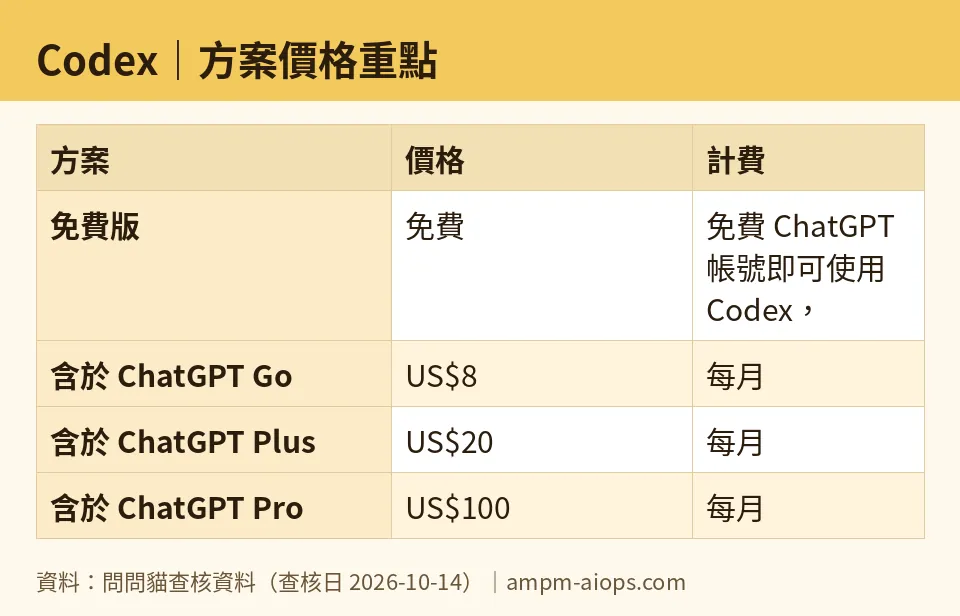
Figure: compiled by AMPM from its verified data (last verified 2026-10-14).
The CLI’s escape hatch: pay only for what you use
If none of the three subscription tiers fit — say you only need Codex occasionally, or you want to avoid committing to a monthly plan — the CLI route lets you bring your own API key and get billed by usage instead. There’s no flat monthly number attached to this path in the verified data; it’s pay-as-you-go against whatever you actually run. That makes it a genuinely different option from the three ChatGPT tiers above, not just a cheaper version of them.

Illustration: The tool sits nested inside tiered subscription containers alongside an entirely separate metered pipeline route.
Commercial use is allowed across the board, and Codex output doesn’t carry a watermark — relevant if you’re worried about using it in client-facing or shipped code.
🔍 AMPM exclusive check
Here’s the one spot where our verification didn’t go cleanly. On 2026-08-11, we tried to re-confirm the Pro-tier numbers (the US$100/month = 5x and US$200/month = 20x figures) directly from OpenAI’s own pages. All four official entry points we checked — openai.com/codex/, openai.com/chatgpt/pricing/, chatgpt.com/pricing/, and help.openai.com — returned HTTP 403, meaning the request was blocked, not that the page doesn’t exist. We tried multiple paths into each and couldn’t get a direct read any of those times.
Because of that block, the 5x/20x Pro-tier multiples in this piece come from cross-checking several independent third-party sources, not from a first-party OpenAI page we read ourselves at that moment. Everything else in this piece — the US$8 Go price, the US$20 Plus price, the “Limited” vs “Expanded usage” labels, the free-tier description, the commercial-use and no-watermark details — was confirmed against OpenAI’s own Codex page and matched again on our most recent check, 2026-10-14. If OpenAI updates the Pro-tier multiples before we can get a direct read of their page again, treat that specific figure as the one to double-check against OpenAI’s own current announcement.
🌙 PIMI, the performance-minded cat

PIMI cares about one thing: does it actually work well, fast, and do the job you need done. On that front, Codex’s tier structure is actually fairly honest about where the ceiling sits. The free and Go-tier “Limited” label isn’t vague marketing — it’s the same word used twice, for two different price points (free and US$8), which tells you plainly that paying US$8 for Go doesn’t buy you more Codex headroom than the free tier, just a different ChatGPT experience wrapped around it. If your goal is actually running Codex for real engineering work, Go is not the plan that gets you there — it still says Limited.
Plus, at US$20, is where the quota-conscious user should be looking first. “Expanded usage” is a meaningfully different label from “Limited,” and it’s the first tier where Codex stops being a side feature and starts being something you can lean on for day-to-day coding tasks. For a solo developer or someone testing whether an AI coding agent fits their workflow, this is the realistic starting point — not the free tier, which exists more to let you confirm Codex is there than to let you use it properly.
The Pro tiers are where things get genuinely performance-oriented, but also where the decision gets more complicated, because two different price points — US$100 and US$200 — map to two very different quota multiples, 5x and 20x Plus respectively. That’s a wide gap for the same tier name. A team or individual running Codex against large codebases or frequent agent runs needs to work out which multiple actually covers their usage pattern before picking one, because jumping straight to US$200 for 20x quota when 5x would have covered it is real money left on the table, and dropping to US$100 when you actually need 20x means hitting limits mid-project. The CLI-with-your-own-API-key option is the most “performance-minded” choice in a narrow sense: you pay exactly for what you run, nothing wasted on unused quota, nothing capped by a tier ceiling — but it demands you already know how to manage API usage and costs yourself, which is a different kind of commitment than picking a flat subscription.
Verdict: who should use it, who should skip it
If you’re just curious what Codex can do, the free tier — Limited access on a free ChatGPT account — is enough to find out, at no cost. Don’t expect to get real work done on it.
If you’re a working developer who wants Codex as an actual daily tool, ChatGPT Plus at US$20/month is the realistic entry point. It’s the first tier where “Expanded usage” replaces “Limited,” and for most individual coding workflows that’s the plan worth paying for.
Skip ChatGPT Go if Codex is your reason for subscribing — at US$8/month you’re still capped at Limited access, the same label the free tier carries. Go makes sense for other ChatGPT features, not for Codex specifically.
If you’re running Codex against serious, high-volume engineering work — large codebases, frequent agent runs, a team relying on it daily — look at ChatGPT Pro, but decide between US$100/month (5x Plus quota) and US$200/month (20x Plus quota) based on an honest estimate of your actual usage, not just picking the bigger number by default.
And if your Codex usage is occasional or unpredictable, the CLI path with your own API key avoids committing to any of the three subscription tiers — you’re billed only for what you run, which can be cheaper or more expensive depending on how much you actually use it, but at least it scales with real usage instead of a flat monthly number.
Written: 2026-10-16 Price last verified: 2026-10-14 Tool last health-checked: 2026-10-16
🔗 Related on AMPM
📎 Sources
All prices and quotas in this article come from AMPM’s verified dataset for Codex (last verified 2026-10-14); primary sources:
🐾 Meet the cats: AMO and PIMI

AMPM is a Taiwan-based AI-tool pricing watchdog. Our motto: ask before you subscribe. Two cats argue every tool from two sides:
- ☀️ AMO — the budget-minded cat. Always asks: is the free tier enough, and is paying actually worth it?
- 🌙 PIMI — the performance-minded cat. Cares about whether it works well, fast, and gets your job done.

When they are done arguing, you know whether to pay. Every number is checked by us, with the verification date at the end.
🐾 Our sister sites also checked
Read next
- Codex Full breakdown: pricing, features and real-world limits
- Codex Is the free quota enough?
- Codex Alternatives
- Free plan limits for every AI tool we track
More verified articles on this tool
- [FAQ] Codex Free Tier and Pricing: Is Paying for Go, Plus or Pro Worth It?
- [Review] Codex Free Tier Works, but Why Can't Four Official Pages Agree on Pro Pricing?
- [Verified] Codex Pricing 2026: Which ChatGPT Plan Do You Actually Need?