[News] Context.dev Reshuffles Its Pricing: Which Plans Got Cheaper, and the New Tier
- Free tier: Yes
- Cheapest paid plan: US$19/mo and up
- Free quota: Work email users: 500 API quota (30 requests/minute) + 10K Logo …
- Last checked: 2026-10-23
Article last updated: 2026-10-10


Context.dev just rewrote its pricing page, and the direction is down, not up. As of October 10, 2026, the company’s Developer plan dropped from US$25 a month to US$19, Pro fell from US$149 to US$99, and a brand-new Growth tier slotted in at US$299 a month between Pro and the existing Scale plan. If you’re already paying for this web-scraping API and wondering whether the new pricing is worth it, or whether the free tier is still enough to avoid paying at all, here’s what actually moved and what didn’t.
Context.dev sells access to a single API that turns webpages into clean data: feed it a URL, and it hands back Markdown or HTML stripped of ads and navigation, or pulls out structured JSON, or looks up a company’s brand details like its logo. It’s built for developers and AI agents that need to read the web programmatically rather than through a browser. “API” here just means a way for one piece of software to request data from another automatically, no clicking required. Usage is measured in “credits” — a one-time currency where scraping one ordinary page typically costs one credit.
What changed on the pricing page
Three things moved in this update. Developer, the entry paid plan, now costs US$19 a month instead of US$25, still for 7,500 credits a month. Pro went from US$149 to US$99 a month, still for 125,000 credits a month. And a new Growth plan appeared at US$299 a month, sitting between Pro and Scale, offering 500,000 credits a month. Scale itself didn’t move — it’s still US$499 a month for 1,000,000 credits. Enterprise remains custom-quoted, starting around 2 million credits with a 99.9% uptime guarantee attached.
So two existing plans got cheaper for the same credit allowance, and a new tier filled what used to be a big jump — from 125,000 credits on Pro straight to 1,000,000 on Scale. Growth’s 500,000 credits closes that gap.
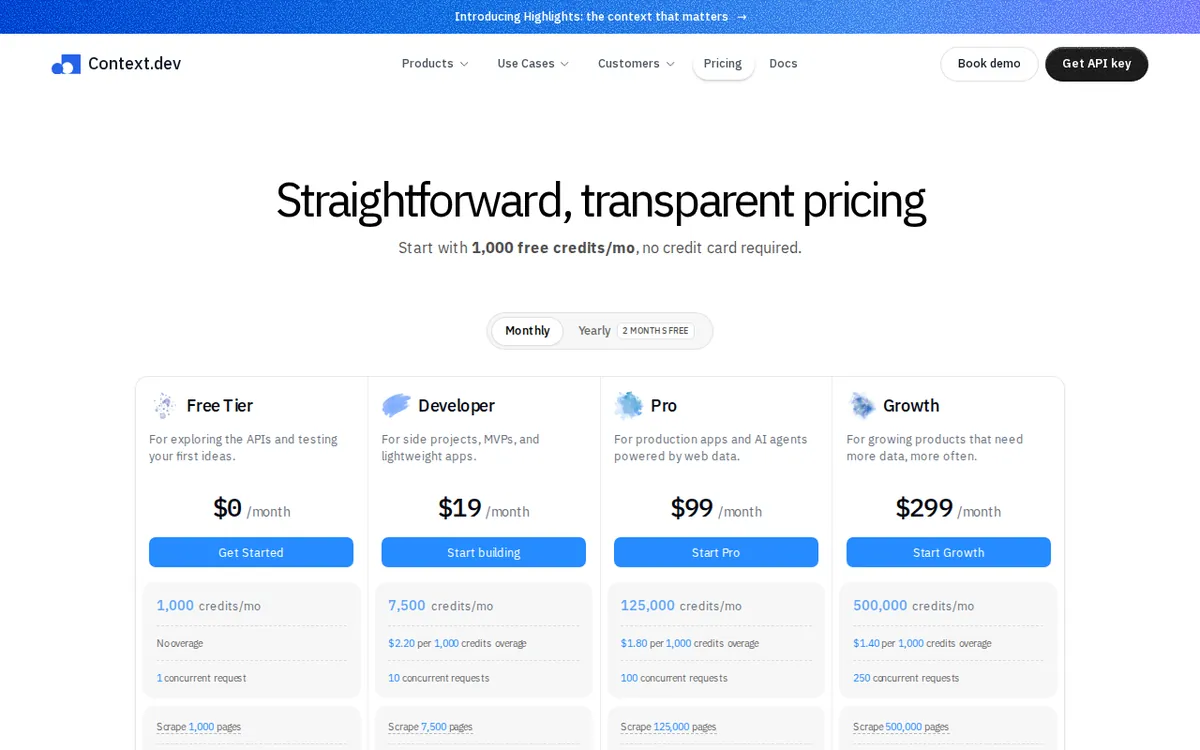
Figure: context.dev official pricing page, captured 2026-10-10.
What the new tiers actually buy you
Each plan also comes with overage pricing — what you pay per extra 1,000 credits once you blow through your monthly allowance — and that scales down as you pay more upfront. Developer’s overage is US$2.20 per 1,000 credits. Pro’s is US$1.80. Growth’s is US$1.40. Scale’s is US$1.00. Context.dev’s own site estimates Developer suits accounts scraping fewer than 50,000 pages a month if they’re buying overage credits, Pro suits 50,000 to 250,000 pages, the new Growth suits 250,000 to 650,000 pages, and Scale suits 650,000 to 2,000,000 pages. Those are the vendor’s own usage estimates, not independently verified volume tests, so treat them as a rough sizing guide rather than a guarantee.
Plan features also step up with price. Developer includes 100 “monitors” (saved pages Context.dev watches for changes) and 2 simultaneous batch jobs, with email support. Pro jumps to 1,000 monitors, 5 simultaneous batches, and adds Slack support plus spend controls. Growth goes to 5,000 monitors and priority support, still at 5 simultaneous batches. Scale tops out at 10,000 monitors, 20 simultaneous batches, and adds SSO/SAML login plus priority-and-Slack support together. Only Scale and Enterprise get single sign-on; only Enterprise gets the 99.9% uptime SLA.
The free tier hasn’t changed, and that’s worth flagging
While the paid plans moved, the free tier is untouched. Sign up with a work email domain (Gmail, Outlook, and similar personal addresses don’t count) and you get 500 API credits, rate-limited to 30 requests a minute, plus 10,000 free Logo Link requests for pulling company brand assets. Sign up with a personal email address and you get 250 credits at 10 requests a minute. Here’s the part that trips people up: those free credits are one-time. They don’t refill monthly like the paid plans do. Once you’ve used your 500 or 250 credits, you’re done — there’s no reduced free tier to fall back on, only an upgrade prompt.
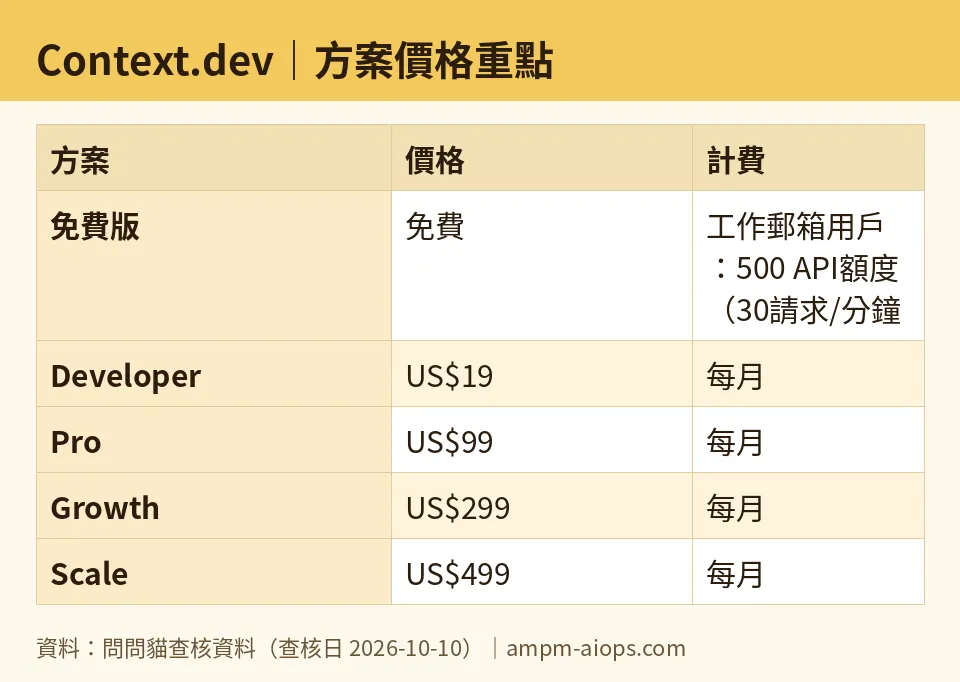
Figure: compiled by AMPM from its verified data (last verified 2026-10-10).
🔍 AMPM exclusive check
Context.dev’s pricing page isn’t the only thing we checked. Our monitoring caught this change through an automated price tracker, which flagged it for manual human review rather than publishing it automatically — the system treats price drops as unusual enough to need a second look before reporting them, since typos or page glitches on vendor sites happen. We then pulled the live pricing page three separate times — October 3, October 9, and October 10, 2026 — and all three pulls matched: Developer at US$19, Pro at US$99, Growth newly listed at US$299, Scale steady at US$499. That consistency across three independent reads is why we’re confident this is a real pricing change and not a temporary display error. One gap we noticed: Context.dev’s pricing page doesn’t spell out anywhere whether the one-time free credits apply differently for commercial versus personal projects — the company’s own documentation is silent on commercial-use terms for the free tier, so if you’re building something you plan to monetize, it’s worth emailing their support directly to confirm before you build on the free 500 or 250 credits.
☀️ AMO, the budget-minded cat

AMO wants to know: is the free tier still enough, or is it finally time to pay? For a work-email signup, 500 one-time credits at 30 requests a minute is enough to kick the tires on a small script or test a single integration — maybe scrape a few hundred pages to see if the Markdown output is clean enough for your use case. It is not enough to run anything ongoing, because there’s no monthly refill. The moment you need recurring scrapes — a daily price check, a weekly content pull — you’re on a paid plan, period. Given that, is US$19 a month for Developer worth it? For 7,500 credits a month, that’s a meaningful jump from “test it once” to “run a small real workflow,” and it’s US$6 cheaper than it was before this update. The bigger win is for anyone who outgrew Developer but found the old US$149 Pro plan too steep for 125,000 credits — Pro at US$99 is a US$50 monthly cut for the identical credit allowance, which changes the math on whether to upgrade. If your volume sits awkwardly between Pro and Scale, the new US$299 Growth plan with 500,000 credits is the one to check before assuming you need to jump straight to the US$499 Scale tier.
Verdict: who should use it, who should skip it
If you’re prototyping or running a small side project under roughly 50,000 pages a month, the cheaper US$19 Developer plan is a straightforward upgrade from the old US$25 price for identical credits — no reason to hesitate. If you were already paying US$149 for Pro, this update is free money: same 125,000 credits now cost US$99, so there’s nothing to evaluate, just confirm your next invoice reflects it. If your usage sits between Pro and Scale, size it against the new Growth plan’s 500,000 credits at US$299 before defaulting to Scale’s US$499. Skip paying altogether only if your entire need fits inside a one-time batch of 500 or 250 credits — anything recurring will burn through that free allowance fast, since it never refills.
Written: 2026-10-10 Price last verified: 2026-10-10 Tool last health-checked: 2026-10-10
🔗 Related on AMPM
📎 Sources
All prices and quotas in this article come from AMPM’s verified dataset for Context.dev (last verified 2026-10-10); primary sources:
🐾 Meet the cats: AMO and PIMI

AMPM is an independent AI-tool pricing watchdog tracking official prices worldwide. Our motto: ask before you subscribe. Two cats argue every tool from two sides:
- ☀️ AMO — the budget-minded cat. Always asks: is the free tier enough, and is paying actually worth it?
- 🌙 PIMI — the performance-minded cat. Cares about whether it works well, fast, and gets your job done.

When they are done arguing, you know whether to pay. Every number is checked by us, with the verification date at the end.
🐾 Our sister sites also checked
Read next
- Context.dev Full breakdown: pricing, features and real-world limits
- Context.dev Is the free quota enough?
- Context.dev Alternatives
- Free plan limits for every AI tool we track