Ask Cat › AI Tool Summary › Cursor
[Review] Cursor's Free Tier Limits: The Official Page Stopped Naming Numbers
- Free tier: There is
- Cheapest paid plan: US$20/mo and up
- Free quota: Hobby: 2000 times of completion + 50 times of slow progress …
- Last checked: 2026-10-05
Article last updated: 2026-10-07



Cursor is one of the most-used AI code editors among professional developers, and its free tier is the first thing most people try before paying anything. But if you go looking for the exact free tier limits on Cursor’s own pricing page today, you won’t find them. The specific numbers that used to be spelled out — 2,000 code completions and 50 “slow” premium requests per month — are gone from the official page. What’s left is a vaguer phrase: “limited” usage. That’s the starting point for this review.
What happened to the old free-tier numbers
As of our last direct check on 2026-07-26, Cursor’s own site no longer lists the free “Hobby” tier’s quota as a hard number. It used to say, in effect, that free users got 2,000 completions (the inline code suggestions Cursor shows as you type) plus 50 slow premium requests — “premium requests” being calls to Cursor’s more capable AI models, as opposed to the faster but more limited models used for basic autocomplete. “Slow” means those premium requests get queued behind paying users’ requests rather than answered instantly.

Illustration: While the official page cloaks free allowances in vague fog, the investigative cats dig up archived records to uncover the hidden limits.
That 2,000/50 figure still circulates, but now only through third-party and community sources, not the vendor itself. Because we can no longer confirm it on the official page, we’re keeping the number on record but downgrading our confidence in it to medium. If you’ve seen “2,000 completions, 50 premium requests” repeated in blog posts or forums, know that it traces back to an older version of Cursor’s pricing page, not what’s published today.

Figure: cursor.com official pricing page, captured 2026-10-07.
What you actually get for free today
What Cursor’s site does confirm, as of our 2026-10-05 verification: free users get access to “Agent” requests — Cursor’s mode where the AI can plan and execute multi-step coding tasks on its own, not just suggest the next line — but those are explicitly “limited.” Free users also get access to Composer, Cursor’s own frontier AI model built for multi-file editing. No credit card is required to start. That’s the complete, current, officially-stated picture of the free tier: access to the tools, with limits that Cursor no longer quantifies in public.
Four paid tiers, four different audiences
Once you’re ready to pay, Cursor has expanded its paid lineup to four plans, all billed monthly as subscriptions (a recurring charge, not a one-time purchase):
- Pro — US$20/month. Cursor’s own description targets this at people who are “agent-curious”: it includes extended limits on Agent requests, generous limits on Composer and other frontier models, access to Cursor’s AI tooling ecosystem (MCPs, skills, and hooks — ways to extend what the AI agent can plug into), cloud-based agents that can run tasks remotely, and Bugbot, Cursor’s automated bug-review tool, billed separately by usage.
- Pro+ — US$60/month. This is a newer addition sitting between Pro and Ultra, aimed at individual developers who outgrow Pro. Cursor’s own note describes it as roughly three times Pro’s usage quota — we’re repeating that as Cursor’s claim, not an independently verified multiplier.
- Ultra — US$200/month, aimed at what Cursor calls “agent power users” — heavy, continuous use of Cursor’s AI agents.
- Teams — US$40 per person per month for a standard seat (a “seat” is one licensed user account on a team plan), plus a Premium seat tier at US$120 per person per month. Teams adds shared billing and account management on top of the individual-plan features.
That’s a wide spread: US$20 to US$200 a month for individuals, and two different per-seat prices for teams. Nothing in Cursor’s published materials states an annual price for any of these — they’re month-to-month subscriptions as far as we can confirm.
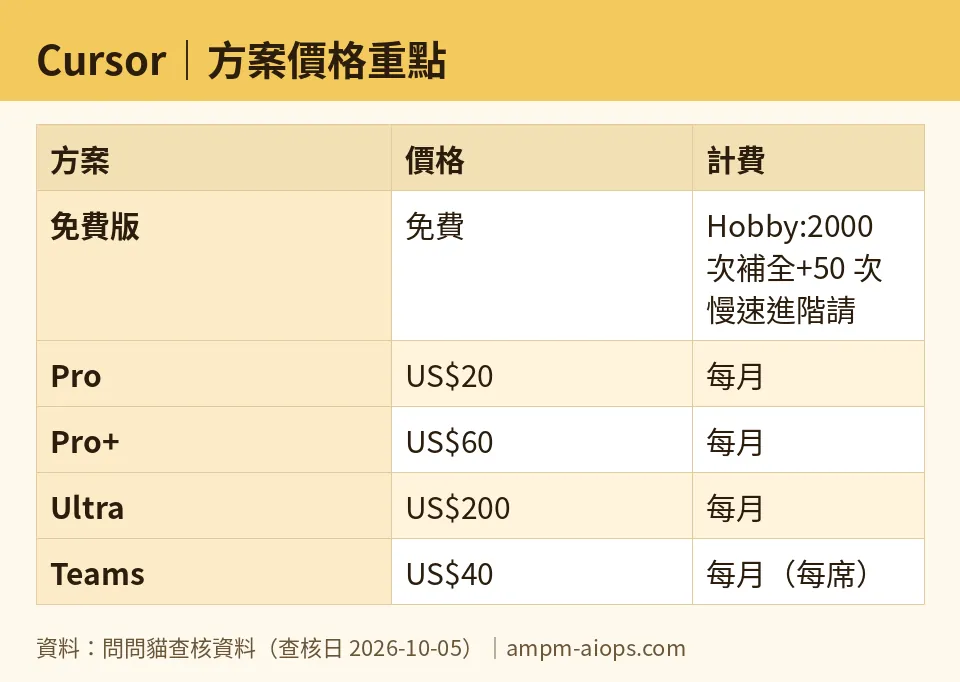
Figure: compiled by AMPM from its verified data (last verified 2026-10-05).
🔍 AMPM exclusive check
Here’s what we found that Cursor’s own pricing page doesn’t spell out: the disappearance of the specific free-tier numbers isn’t a one-time glitch — it’s held steady across five separate checks we ran on Cursor’s official site: 2026-07-25, 2026-09-08, 2026-09-24, 2026-10-02, and 2026-10-05. Every time, the free tier was described only as “limited” for Agent requests, with no completion count or premium-request count published. The 2,000-completions-plus-50-premium-requests figure that still gets quoted around the web traces back to before that July check, and Cursor has not restored it to the page in the two and a half months since. If you’re comparing Cursor’s free tier to a competitor using that 2,000/50 number, you’re comparing against a figure Cursor itself no longer backs on its own site.
☀️ AMO, the budget-minded cat

I went looking for a reason to stay free, and Cursor didn’t make that easy. You get Agent access and Composer access with no credit card needed — that part is real and confirmed as of 2026-10-05. But “limited” with no published ceiling means you can’t actually plan around it. You won’t know you’ve hit a wall until you hit it. Compare that to the paid Pro tier at US$20/month, which at least gives you a named set of benefits: extended Agent limits, generous Composer and frontier-model access, the MCP/skills/hooks ecosystem, cloud agents, and Bugbot. For a working developer, US$20/month is a small price for predictability, and it’s the cheapest of the four paid tiers by a wide margin — Pro+ is US$60, Ultra is US$200. If you’re coding occasionally and don’t mind unpredictable cutoffs, free still works. If Cursor is part of your actual job, I’d rather pay US$20 and know where I stand than guess at an unpublished “limited” quota.
🌙 PIMI, the performance-minded cat

The real question isn’t the price tag, it’s whether the free tier can actually carry serious work, and the honest answer is: not fully. Free gives you Agent requests and Composer, but Agent is explicitly capped, and without a published number, you can’t judge whether that cap survives a real coding session. If you want the “Extended limits on Agent” and “generous limits for Grok & Composer” that Cursor names as Pro-tier features, US$20/month gets you there, plus the MCP/skills/hooks ecosystem and cloud agents for running tasks outside your local machine. Power users who lean on Cursor’s agents constantly are Cursor’s own target for Ultra at US$200/month — that’s the tier Cursor pitches explicitly at “agent power users,” not casual coders. Pro+ at US$60/month, with roughly three times Pro’s usage room by Cursor’s own account, sits in between for people who’ve outgrown Pro’s caps but don’t need Ultra’s. For teams, the US$120/month Premium seat is the one to check if your team leans on Cursor’s heaviest agent features — the US$40 standard seat is built around the lighter Pro-equivalent feature set.
Verdict: who should use it, who should skip it
Use the free tier if you’re trying Cursor for the first time or coding lightly — it’s genuinely free, needs no credit card, and gives real access to Agent and Composer. Skip relying on it for daily professional work, because Cursor itself won’t tell you the free ceiling anymore, and that’s a real downgrade in transparency from the version of this page we could check in July. For actual daily use, Pro at US$20/month is the entry point that comes with named, confirmed features rather than an unquantified “limited.” Heavy agent users should look at Pro+ (US$60/month) or Ultra (US$200/month) depending on how much headroom they need beyond Pro. Teams should budget per seat carefully — US$40 standard versus US$120 Premium per person is a 3x jump, and which one you need depends on whether your team actually uses Cursor’s heaviest agent features or just the basics.
Written: 2026-10-07 Price last verified: 2026-10-05 Tool last health-checked: 2026-10-07
🔗 Related on AMPM
📎 Sources
All prices and quotas in this article come from AMPM’s verified dataset for Cursor (last verified 2026-10-05); primary sources:
🐾 Meet the cats: AMO and PIMI

AMPM is a Taiwan-based AI-tool pricing watchdog. Our motto: ask before you subscribe. Two cats argue every tool from two sides:
- ☀️ AMO — the budget-minded cat. Always asks: is the free tier enough, and is paying actually worth it?
- 🌙 PIMI — the performance-minded cat. Cares about whether it works well, fast, and gets your job done.

When they are done arguing, you know whether to pay. Every number is checked by us, with the verification date at the end.
🐾 Our sister sites also checked
Let's take a look at these
- Cursor Comprehensive Introduction: Pricing, Features, and Actual Limitations
- Cursor Is the free quota enough?
- Cursor Alternatives
- Comprehensive Free Quota List for All Tools
More verified articles on this tool
- Cursor Cloud Agents Without a Repo: Start From Scratch, Then Save It as a Repo Afterwards
- Cursor Agents Can Now Run on Your Own Machine — and Drive a Browser While They're There
- Cursor's Pricing Page Does Not Say How Much You Get: US$20 Buys an Unstated Allowance