[Use cases] DeepSeek Pricing: When the Free Web Chat Is Enough, and When the API Pays Off
- Free tier: Yes
- Cheapest paid plan: US$0/mo and up
- Free quota: The web version is basically free, but has peak traffic limits.
- Last checked: 2026-10-11
Article last updated: 2026-10-13


DeepSeek is the Chinese AI lab whose free web chatbot and dirt-cheap developer API keep making headlines. If you’re searching for DeepSeek pricing right now, here’s the short version: the web chat is free with rate limits at busy hours, and the API got cheaper again in September 2026. We checked the exact numbers so you don’t have to dig through two pricing pages in two languages.
This piece is a use-case breakdown — not a sales pitch. We’re asking who actually needs to pay, and who can get by on the free tier.
What changed in September 2026
DeepSeek runs two API models: Flash (cheap, fast) and Pro (smarter, pricier). On September 25, 2026, we read the official pricing page directly in both English and Chinese and found the Flash model had dropped its price. Back on September 4, DeepSeek was charging US$0.22 per million tokens for uncached input and US$0.66 per million tokens for output, off-peak. By late September, those rates fell to US$0.15 and US$0.60. A token is the small chunk of text — roughly a few characters — that AI models use to measure how much you’re feeding them or getting back, so “per million tokens” is really a measure of how much text you’re processing.
There’s a second layer: cached input. If the system recognizes text it has already processed (a “cache hit”), you pay far less — US$0.003 per million tokens off-peak for Flash, versus US$0.15 for new text (“cache miss”). Pro’s cache-hit rate is US$0.022 versus US$0.66 for a miss. This matters if your app repeats the same instructions or documents often — caching can cut costs dramatically.
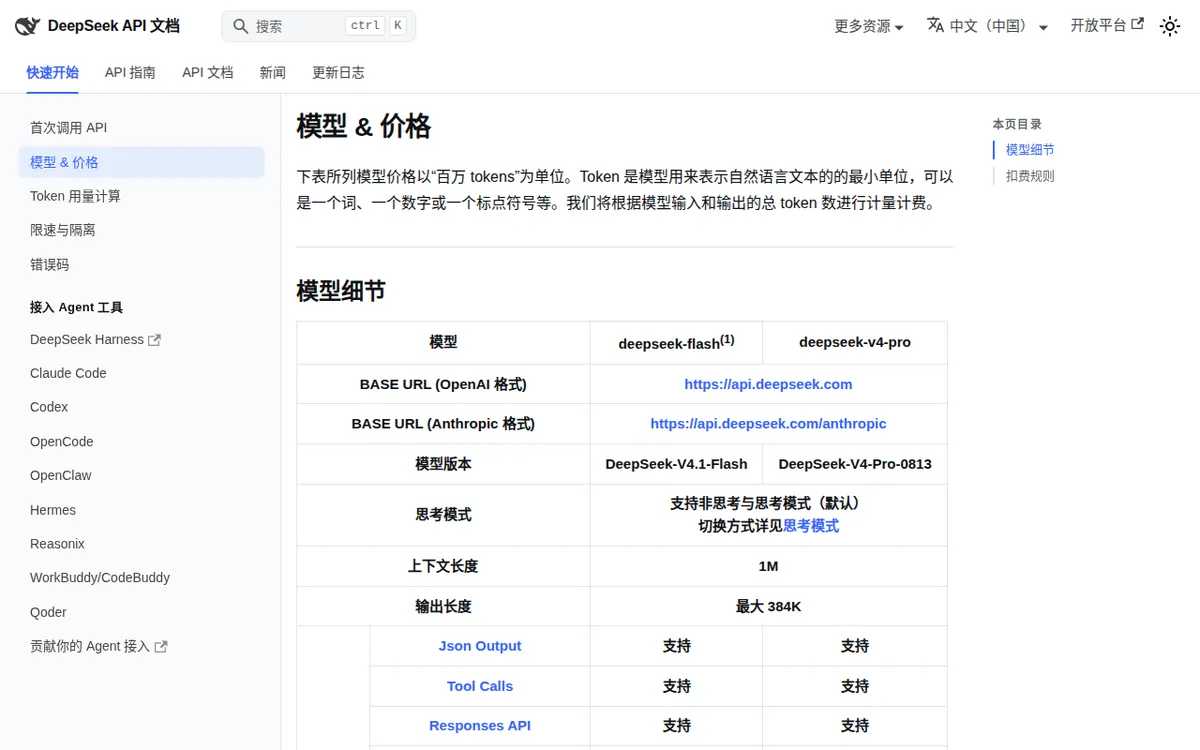
Figure: api-docs.deepseek.com official pricing page, captured 2026-10-13.
Peak pricing: a detail easy to miss
DeepSeek doubles its API prices during peak hours: Monday to Friday, 01:00–04:00 and 06:00–10:00 UTC, excluding Chinese public holidays. So Flash’s off-peak output price of US$0.60 per million tokens becomes US$1.20 at peak. Pro’s off-peak output price of US$1.98 becomes US$3.96. If your app runs on a schedule, timing your batch jobs outside those windows is a free way to cut your bill in half.
Free web chat vs paid API — two different systems
The free web version requires no sign-up, showed no region restriction when we used it from Taiwan, and supports both Chinese and English interfaces. It gets rate-limited during peak hours, but there’s no official published daily quota — DeepSeek doesn’t spell out exactly how strict that limiting gets. The API is a completely separate product: it’s how developers connect their own apps or tools to DeepSeek’s models, and you pay per token, with no monthly minimum or contract. Both models support up to 1 million tokens of context (how much text the model can “see” at once) and a maximum output of 384,000 tokens per response.
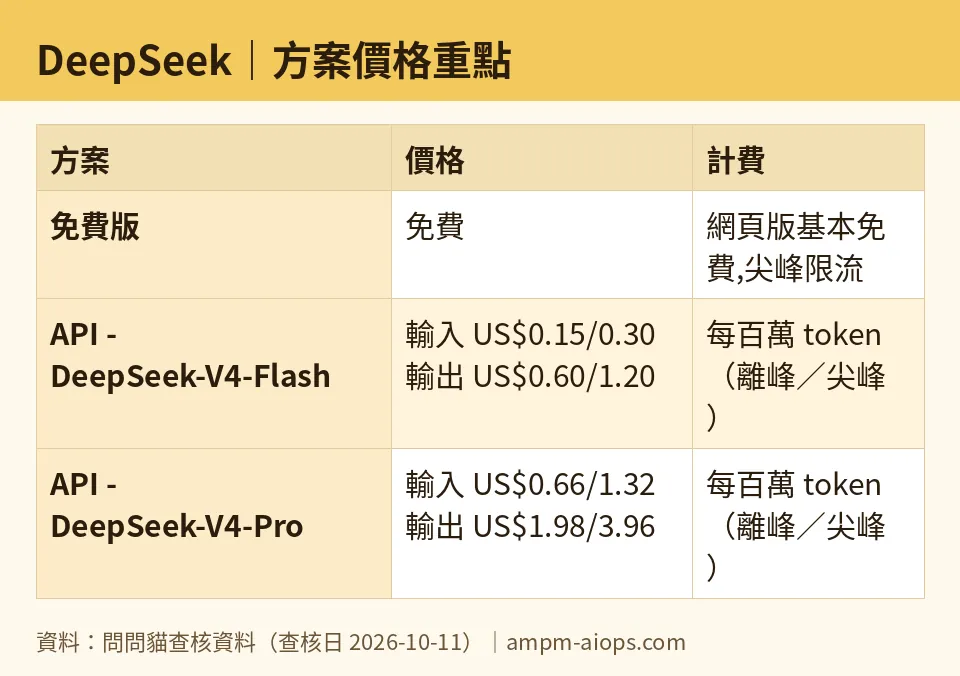
Figure: compiled by AMPM from its verified data (last verified 2026-10-11).
🔍 AMPM exclusive check
The official pricing page shows today’s rates but doesn’t show you where they came from. We tracked the change: on September 4, 2026, Flash’s off-peak input-miss price was US$0.22 and output was US$0.66. By September 25, reading the live English and Chinese pricing docs directly, those numbers had dropped to US$0.15 and US$0.60 — a real cut, not a typo or regional pricing difference. We also confirmed something the vendor page states but doesn’t emphasize: the 2x peak-hour multiplier applies automatically, with no toggle to avoid it except scheduling around the window. One more gap — DeepSeek never publishes a concrete daily quota for the free web chat, just “rate limiting during peak,” so budget-tier users have no hard number to plan around. As of October 11, 2026, all current rates (Flash and Pro, both tiers) matched the live docs with no further changes.
☀️ AMO, the budget-minded cat

For most people, DeepSeek’s free web version is already enough. No account needed, no region lock in our test, handles chat and coding — the only catch is slower responses during peak hours, and there’s no official number telling you exactly how limited that gets. If you don’t need to build anything, don’t pay anything.
Where it gets interesting is the API, because it’s genuinely cheap. Flash costs US$0.15 per million tokens of input (off-peak) and US$0.60 per million for output — and if your text repeats, cached input drops to just US$0.003 per million tokens. Compare that to Pro, where uncached input is US$0.66 per million and output is US$1.98 per million off-peak — more than 4x Flash’s price. For a student testing ideas or a freelancer running occasional scripts, Flash is the obvious pick: there’s no minimum spend, no contract, and you only pay for tokens actually used. The real cost depends entirely on how much text you send, and DeepSeek doesn’t publish a monthly plan price to quote — it’s pure usage billing. Avoid peak hours (weekday 01:00–04:00 and 06:00–10:00 UTC) and your bill stays at the lower, off-peak rate instead of doubling.
🌙 PIMI, the performance-minded cat

Price is only half the story — does it hold up under load? DeepSeek’s API specs are solid on paper: both Flash and Pro support up to 1 million tokens of context and up to 384,000 tokens of output, enough for long documents or multi-step coding tasks. Concurrency (how many requests can run at once) is where the models diverge: Flash allows up to 2,500 simultaneous calls, Pro only 500. That’s a real difference for a small team building a product with multiple users hitting the API at once — Flash is built to handle traffic spikes, Pro isn’t.
Pro costs more because it’s the stronger model: off-peak output runs US$1.98 per million tokens versus Flash’s US$0.60. If your use case needs sharper reasoning and you’re not running at massive scale, Pro’s 500-request ceiling probably won’t bite. But if you’re serving many users at once cheaply, Flash’s 2,500-request limit and lower per-token cost make it the safer technical choice, not just the cheaper one. One caution: API documentation leans Simplified Chinese first, and support is community-driven rather than a dedicated help desk — fine for experienced developers, less fine if you need hand-holding.
Verdict: who should use it, who should skip it
A student doing occasional homework help or code debugging: stick with the free web chat. No cost, no setup, and the context window (1M tokens) is bigger than you’ll likely ever use casually.
A freelancer building a small automated workflow — say, summarizing client documents or generating drafts via script: the Flash API is the right call. At US$0.15 per million tokens input and US$0.60 output (off-peak), costs stay low for moderate use, and caching repeated prompts pushes it lower still. Just watch the clock — running jobs during peak hours doubles those rates.
A small team building a product that needs to serve multiple users simultaneously: Flash’s 2,500-request concurrency limit matters more than the price tag. If the team needs stronger reasoning for complex tasks and traffic is modest, Pro’s 500-request ceiling and higher accuracy might be worth the roughly 3x higher output cost (US$1.98 vs US$0.60 per million tokens off-peak).
Who should skip it: anyone needing guaranteed uptime, dedicated support, or English-first documentation as a baseline — DeepSeek doesn’t promise any of that. The free tier also comes with no published quota, which makes it a poor fit for any workflow you actually depend on daily without a backup plan.
Written: 2026-10-13 Price last verified: 2026-10-11 Tool last health-checked: 2026-10-13
🔗 Related on AMPM
📎 Sources
All prices and quotas in this article come from AMPM’s verified dataset for DeepSeek (last verified 2026-10-11); primary sources:
🐾 Meet the cats: AMO and PIMI

AMPM is a Taiwan-based AI-tool pricing watchdog. Our motto: ask before you subscribe. Two cats argue every tool from two sides:
- ☀️ AMO — the budget-minded cat. Always asks: is the free tier enough, and is paying actually worth it?
- 🌙 PIMI — the performance-minded cat. Cares about whether it works well, fast, and gets your job done.

When they are done arguing, you know whether to pay. Every number is checked by us, with the verification date at the end.
🐾 Our sister sites also checked
Read next
- DeepSeek Full breakdown: pricing, features and real-world limits
- DeepSeek Is the free quota enough?
- DeepSeek Alternatives
- Free plan limits for every AI tool we track
More verified articles on this tool
- [Special] DeepSeek Pricing: The Web App Is Free, the API Isn't, and the Peak-Hour Catch
- [Pitfalls] DeepSeek Free Tier Limits and API Pricing: The Peak-Hour and Old-Model Billing Traps
- [Trends] DeepSeek Pricing Drops Again: What September's AI Tool Price-Change Records Reveal