[Special] DeepSeek Pricing: The Web App Is Free, the API Isn't, and the Peak-Hour Catch
- Free tier: Yes
- Cheapest paid plan: US$0/mo and up
- Free quota: The web version is basically free, but has peak traffic limits.
- Last checked: 2026-10-11
Article last updated: 2026-10-12


DeepSeek built its reputation on being the cheap, open alternative to Western AI labs — a free chatbot on the web and an API (the way other software connects to DeepSeek’s models and pays by usage, not through the chat window) that’s famously inexpensive. But “cheap” and “free” are doing different jobs here, and mixing them up is where people get surprised by a bill.
Here’s the split, checked directly against DeepSeek’s own pricing documentation on 2026-10-11: the web app has a free tier, and it’s real — no signup wall, no card required, no region lock in our test. The API has no free tier at all. Every token, from the first one, is billed. And if you’re calling that API during China’s weekday peak hours, you’re paying exactly double what you’d pay off-peak. None of that is hidden, but none of it is on the homepage either — you have to go digging in the pricing docs to find the full picture.
One brand, two totally different deals
The DeepSeek web chat — the thing most people mean when they say “I use DeepSeek” — is free to use. There’s no official published daily quota; the only documented constraint is that heavy traffic during peak hours gets throttled. DeepSeek doesn’t publish a reset schedule or a hard number of free messages per day, so there’s no official line to quote beyond “it’s free, and it slows down when everyone else is using it too.”
The API is the opposite experience. It’s built for developers integrating DeepSeek into their own apps, and it runs on straight usage-based billing — you pay per token (the small text chunks models bill by, roughly three-quarters of a word each) that goes in and out. There’s no free allotment, no trial credits mentioned in the pricing data, and no minimum spend. You’re billed from token one.
This is the core confusion in DeepSeek’s reputation: people hear “DeepSeek is basically free” because the chat app is, then go build something on the API and find a metered bill waiting for them. Both things are true. They’re just not the same product.
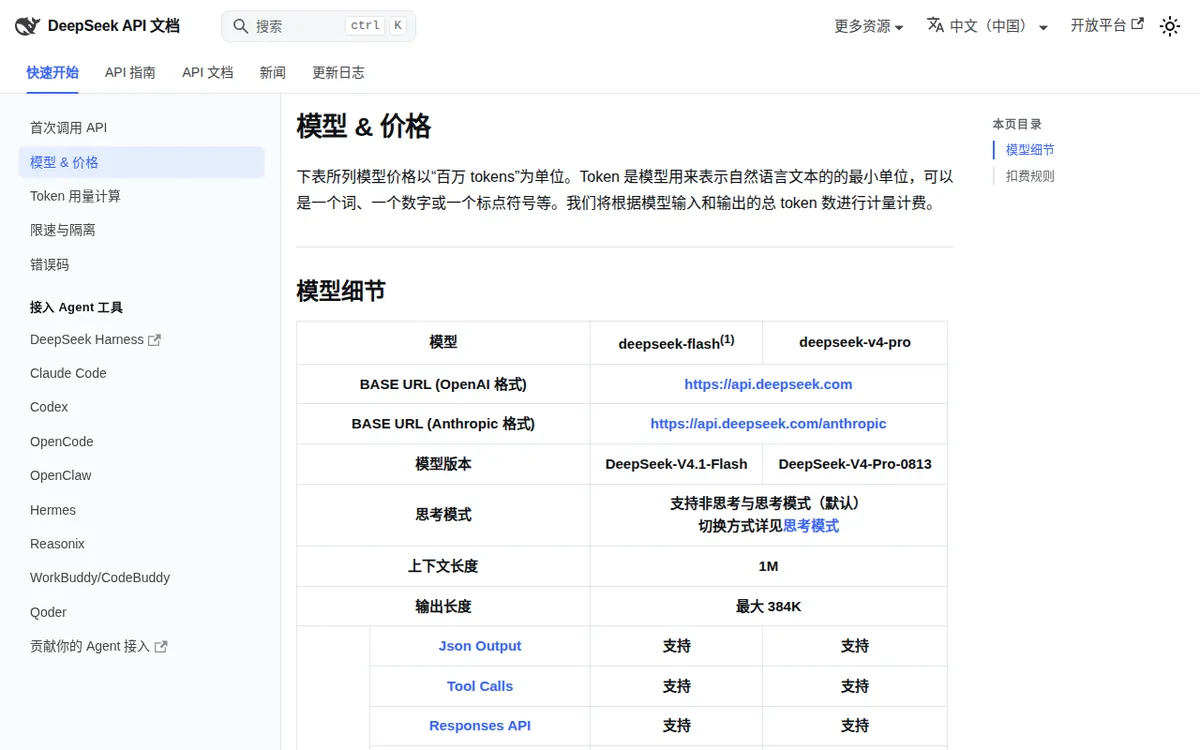
Figure: api-docs.deepseek.com official pricing page, captured 2026-10-12.
The API’s two models, and what they actually cost
DeepSeek’s API currently offers two tiers, and the price gap between them is large.
DeepSeek-V4-Flash (API model name deepseek-flash, running on DeepSeek-V4.1-Flash since it launched 2026-09-10) is the cheap option, priced per million tokens:
- Input, cache hit: US$0.003 off-peak / US$0.006 peak
- Input, cache miss: US$0.15 off-peak / US$0.30 peak
- Output: US$0.60 off-peak / US$1.20 peak
(“Cache hit” means you sent a prompt prefix DeepSeek has already processed recently, so it’s reused cheaply. “Cache miss” means it’s new to the system and gets processed — and billed — at full price.)
DeepSeek-V4-Pro (model version DeepSeek-V4-Pro-0813) costs considerably more:
- Input, cache hit: US$0.022 off-peak / US$0.044 peak
- Input, cache miss: US$0.66 off-peak / US$1.32 peak
- Output: US$1.98 off-peak / US$3.96 peak
Both models support context windows (how much text the model can hold in a single conversation) up to 1M tokens, with a maximum output of 384K tokens per response. The practical difference that matters if you’re building something real: Flash allows up to 2,500 concurrent requests, while Pro caps out at 500 — a concurrency limit is simply how many requests can run against the API at the same instant before it starts queuing or rejecting them.
Peak hours: the 2x nobody mentions until the invoice
Every price above has two numbers because DeepSeek runs dynamic peak pricing. Peak hours are Monday through Friday, 01:00–04:00 and 06:00–10:00 UTC, excluding Chinese public holidays. During those windows, every rate — input, cache hit or miss, output, on either model — is exactly double the off-peak price. Outside those hours, and on weekends, you pay the lower number.
For teams in UTC+8 time zones (such as Taiwan, Singapore or Hong Kong), those UTC windows land in the late-night to morning hours locally, so a lot of daytime API usage there is actually hitting DeepSeek’s off-peak pricing by default. But automated jobs, scheduled batch processing, or any system running on China-aligned business hours can walk straight into the 2x window without anyone noticing until the bill looks off.
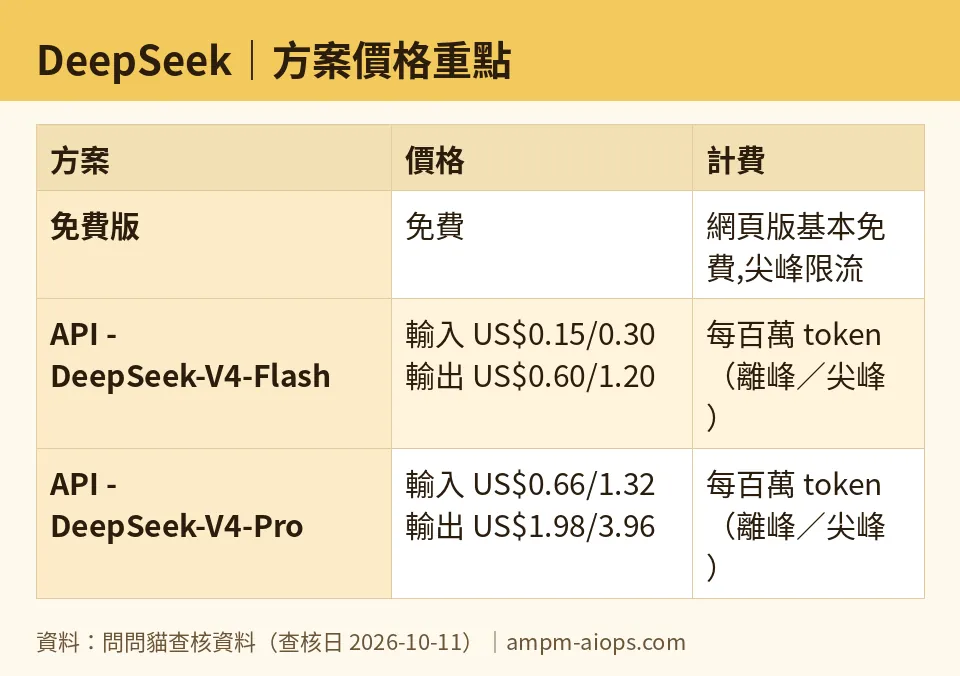
Figure: compiled by AMPM from its verified data (last verified 2026-10-11).
🔍 AMPM exclusive check
We went directly to DeepSeek’s live pricing documentation, in both English and Chinese, rather than relying on marketing copy. Two things stood out that the vendor’s public-facing pages don’t spell out clearly.
First, the pricing moved quietly. On 2026-09-04, DeepSeek’s documented off-peak rate for Flash-tier cache-miss input was US$0.22 and output was US$0.66. By the time we checked again on 2026-09-25, those had dropped to US$0.15 and US$0.60 respectively — a real cut, confirmed by re-reading the docs, with no prominent announcement attached to it. If you priced out a project against DeepSeek a few weeks before that window, your cost assumptions are already stale.
Second, the model naming is murkier than the pricing page suggests. The API model name deepseek-flash now maps to DeepSeek-V4.1-Flash, which went live 2026-09-10. The older names deepseek-v4-flash and deepseek-v4-flash-vision-exp still work if you call them, but requests are actually served by V4.1-Flash and billed at the same Flash-tier rates above. If you hardcoded an old model name into your integration months ago, you’re quietly running on newer infrastructure without having changed a line of code — which is usually good news, but it’s not something DeepSeek’s pricing page tells you plainly.
Beyond those two points, the Pro-tier pricing was unchanged between our 2026-09-25 and 2026-10-11 checks, and the peak-hour definition and 2x multiplier matched the documentation exactly both times.
☀️ AMO, the budget-minded cat

AMO only cares about one question: is the free version enough, and if not, is paying worth it? For DeepSeek, the answer splits cleanly down the middle. If all you want is a chatbot for writing, research, or code help, the web app’s free tier is genuinely enough — there’s no paywall, no forced upgrade, no card on file, and it works the same from Taiwan as anywhere else. The only cost is getting throttled if you hit it during peak traffic, and DeepSeek doesn’t publish exactly how strict that throttle is.
The moment the question becomes “I want to build something with this,” free stops being an option — the API has zero free tier, full stop. But the API’s floor price is remarkably low: Flash-tier output runs US$0.60 per million tokens off-peak, and input on a cache hit is just US$0.003 per million tokens. For a side project or a small tool, that’s cheap enough that AMO would call it worth paying for rather than wrestling with a free-tier workaround elsewhere. Pro tier is a different calculation — at US$1.98 per million output tokens off-peak, more than three times Flash’s rate, it’s only worth it if you specifically need the Pro model’s capability over Flash’s. AMO’s rule of thumb: start on Flash, off-peak, cache what you can, and only step up to Pro or into peak hours if you’ve actually confirmed you need to.
Verdict: who should use it, who should skip it
Use DeepSeek’s web app if you want a capable, no-cost chatbot and don’t need guaranteed uptime during China’s peak hours — there’s no catch beyond occasional slowdowns, and no official document promising otherwise. Use the API if you’re building a product and want the cheapest realistic token pricing available, especially on Flash tier and off-peak — but budget for real charges from the first request, since there’s no free quota to lean on.

Illustration: Peak hours double the request costs, stretching the resulting bill and expenses dramatically compared to quiet hours.
Skip the API if your workload runs on a schedule that lands inside the Monday–Friday UTC peak windows and you can’t shift it — you’ll be paying double by default. And skip assuming the web app’s free tier comes with any documented daily limit you can plan around; DeepSeek hasn’t published one, so treat “free” as “free until it’s busy,” not as a guaranteed quota.
Written: 2026-10-12 Price last verified: 2026-10-11 Tool last health-checked: 2026-10-12
🔗 Related on AMPM
📎 Sources
All prices and quotas in this article come from AMPM’s verified dataset for DeepSeek (last verified 2026-10-11); primary sources:
🐾 Meet the cats: AMO and PIMI

AMPM is an independent AI-tool pricing watchdog tracking official prices worldwide. Our motto: ask before you subscribe. Two cats argue every tool from two sides:
- ☀️ AMO — the budget-minded cat. Always asks: is the free tier enough, and is paying actually worth it?
- 🌙 PIMI — the performance-minded cat. Cares about whether it works well, fast, and gets your job done.

When they are done arguing, you know whether to pay. Every number is checked by us, with the verification date at the end.
🐾 Our sister sites also checked
Read next
- DeepSeek Full breakdown: pricing, features and real-world limits
- DeepSeek Is the free quota enough?
- DeepSeek Alternatives
- Free plan limits for every AI tool we track
More verified articles on this tool
- [Use cases] DeepSeek Pricing: When the Free Web Chat Is Enough, and When the API Pays Off
- [Pitfalls] DeepSeek Free Tier Limits and API Pricing: The Peak-Hour and Old-Model Billing Traps
- [Trends] DeepSeek Pricing Drops Again: What September's AI Tool Price-Change Records Reveal