Ask Cat › AI Tool Summary › Gamma
[Special] Gamma's Free Tier Gives 400 Credits Once — Not Monthly, Official Page Confirms
- Free tier: There is
- Cheapest paid plan: US$12/mo and up
- Free quota: Register to receive one-time points
- Last checked: 2026-09-27
Article last updated: 2026-10-07



Gamma lets you type an outline and get a full slide deck back, built by AI. The pitch is simple, the free tier sounds generous — 400 points just for signing up — and that’s exactly where people get tripped up. We checked Gamma’s own pricing and plan pages line by line, and the detail that matters most isn’t advertised anywhere near the signup button: those 400 points are a one-time grant. They do not refresh. Once you’ve spent them, the free tier is effectively over unless you go recruit friends.
That’s the free tier question most new users actually have — is Gamma’s free plan actually free to keep using, or is it a one-shot trial wearing a “free forever” sticker. Based on what Gamma states on its own site, it’s closer to the second.
Why 400 credits feels bigger than it is
Gamma runs on a points system it calls “credits” — a prepaid currency where different actions cost different amounts, the same way a phone plan might charge different “data” for a video call versus a text. According to Gamma’s own numbers, a 10-page presentation costs around 50 credits. Asking for a fancier AI-generated image inside that deck costs another 10 to 40 credits per image, on top of the base deck cost.
Do the arithmetic the way Gamma itself frames it, not the way marketing copy frames it: 400 one-time credits, at roughly 50 credits a deck, lands you at about 8 to 10 presentations — and that’s before you add any AI images, which eat into the same pool. Once that’s gone, Gamma’s own help documentation says plainly: it does not come back. The only way to add more without paying is to refer a friend, which adds 200 credits per successful referral, up to a cap of 2,000 credits total on the free tier. There’s no monthly top-up, no “resets on the 1st” grace period. This is the detail buried past the signup screen that actually decides whether Gamma is a real free tool or a test drive.
The free plan isn’t bare-bones otherwise — it supports basic AI generation of presentations, documents, web pages, social posts and images, can import PDF and PPTX files, and exports to PDF, PPTX, PNG and Google Slides. Each AI prompt is capped at 10 pages, and every free export carries a Gamma watermark.
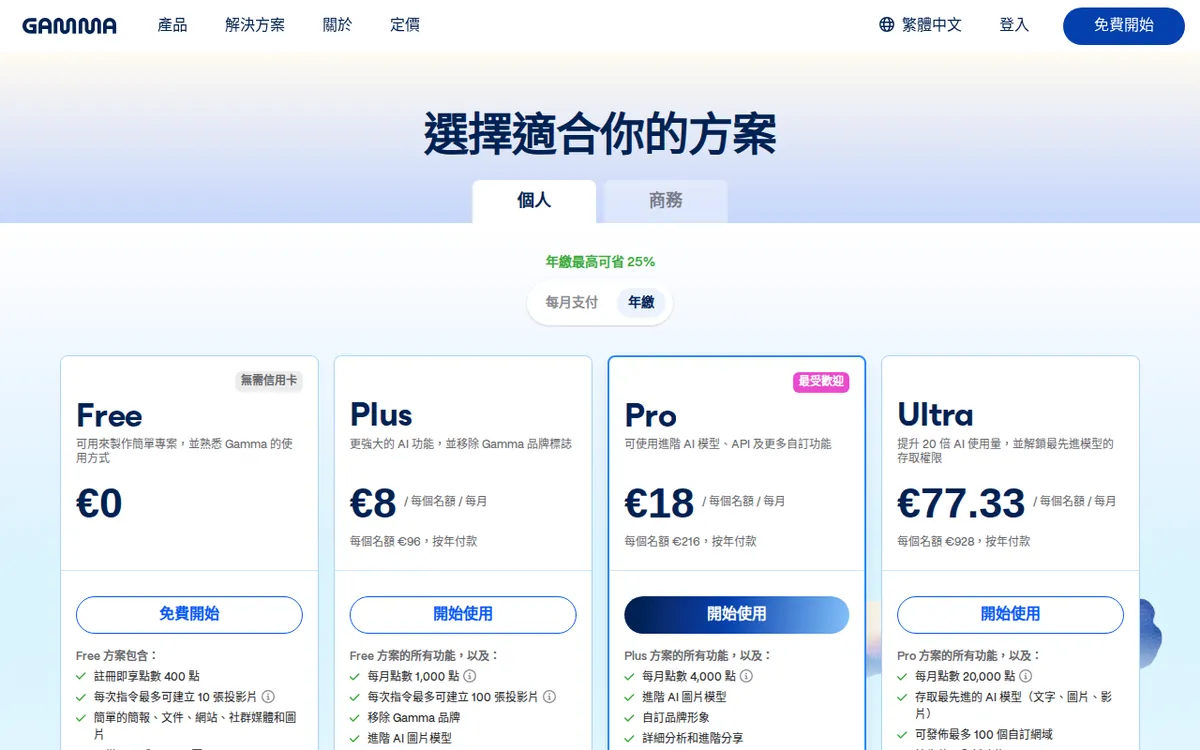
Figure: gamma.app official pricing page, captured 2026-10-07.
The August price jump, plan by plan
Gamma raised prices on 2026-08-22, and it didn’t hit every tier the same way. The Plus plan moved from US$10 to US$12 a month; paid yearly, it now works out to US$9 a month, or US$108 billed annually (up from roughly US$8 a month before the change). Pro moved from US$20 to US$25 a month; its annual rate held steady at US$18 a month, or US$216 a year — no change there despite the monthly hike. Gamma’s third tier, Ultra, launched at US$100 a month and has not changed since.
So the increase landed hardest on anyone paying Plus or Pro monthly rather than annually. Annual Pro subscribers, in particular, were insulated entirely from the August change.
What each paid tier actually unlocks
Credits are the obvious difference, but not the only one. Plus gives 1,000 credits a month, with unused credits allowed to roll over up to a cap of 2,000. It also raises the per-prompt limit to 20 pages, removes the Gamma watermark, and unlocks Gamma’s more advanced AI image models.
Pro gives 4,000 credits a month (rolling over up to 8,000), a 60-page-per-prompt limit, and Gamma’s premium AI image models — a step up from Plus’s “advanced” tier. Pro also adds custom branding and fonts, detailed sharing analytics, the ability to publish to up to 10 custom domains, access to Gamma’s API (a way for developers to connect their own software directly to Gamma instead of using the website), and workspace templates.
Ultra is the newest and largest plan: 20,000 credits a month, five times what Pro gives, using the same premium image models as Pro. Beyond the credit pool, Ultra’s main selling point is volume for heavy AI-image users or teams, not new features layered on top of Pro.
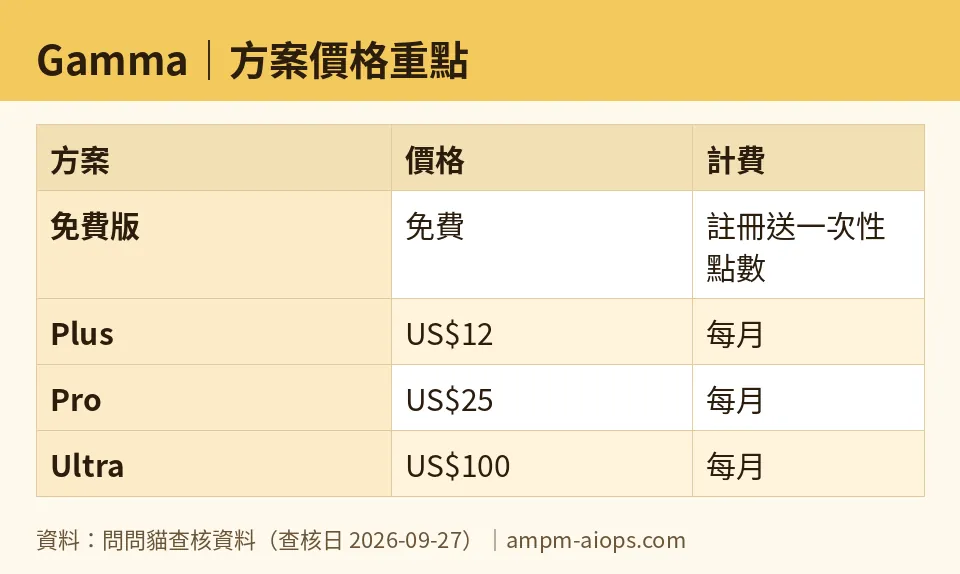
Figure: compiled by AMPM from its verified data (last verified 2026-09-27).
🔍 AMPM exclusive check
Here’s where Gamma’s own pages disagree with each other. The pricing table lists an annual rate for Ultra — US$90 a month, billed as US$1,080 a year. But Gamma’s plan-comparison page, describing Ultra directly, states the plan is “currently monthly billing only,” with no annual option, and calls the US$100-a-month rate a limited-time launch price with no stated end date. One official page shows an annual Ultra price; another official page says annual billing doesn’t exist yet for Ultra. We can’t resolve which one is current just by reading — it’s a real inconsistency on Gamma’s own site as of our 2026-09-27 check, not something we’re inferring. If you’re budgeting for Ultra annually, confirm at checkout before you commit, because the number you see on the pricing table may not be purchasable yet.
☀️ AMO, the budget-minded cat

AMO only cares about one thing: is free enough, or is paying actually worth it. For Gamma, the honest answer depends entirely on how often you build decks. Free gives you 400 credits, one time, which Gamma’s own math puts at about 8 to 10 presentations before you’re stuck — and “stuck” means watermarked decks and a hard stop, since the free pool never refills on its own. If you only need a handful of presentations ever, say for one semester or one job search, free genuinely covers it, referral bonuses included, up to the 2,000-credit ceiling. But if you’re making decks monthly for work, the free tier runs out fast, and there’s no cheap patch — the jump is straight to Plus at US$12 a month (US$9 a month if you commit to a year, US$108 total) for 1,000 fresh credits every month plus no watermark. That’s roughly double the per-deck budget of the free tier, recurring, forever, not once. AMO’s take: don’t pay before you’ve actually run out of your 400 starting credits and felt the wall yourself. But once you’re past the free credits and still need Gamma weekly, Plus’s monthly refill is the real product — the free tier was never built to be a permanent plan.
Verdict: who should use it, who should skip it
Gamma’s free tier is a legitimate way to test the tool and produce a handful of real decks — 8 to 10 by Gamma’s own credit math — but it is not a renewable free plan, and nothing on the signup page tells you that up front. If you need Gamma occasionally, free works until it doesn’t, and referrals can stretch it further. If you need it regularly, Plus is the realistic entry point at US$12 a month (US$9 annually), not a free tier that never asks for a card. Teams leaning on AI-generated images specifically should weigh Pro’s premium image models and 4,000 monthly credits against Ultra’s 20,000 — but check Ultra’s billing terms directly before assuming the annual rate on the pricing page is actually available at checkout.

Illustration: The starter credits do not refresh monthly, gradually draining from the sealed container as presentations are generated until empty.
Written: 2026-10-07 Price last verified: 2026-09-27 Tool last health-checked: 2026-10-07
🔗 Related on AMPM
📎 Sources
All prices and quotas in this article come from AMPM’s verified dataset for Gamma (last verified 2026-09-27); primary sources:
🐾 Meet the cats: AMO and PIMI

AMPM is a Taiwan-based AI-tool pricing watchdog. Our motto: ask before you subscribe. Two cats argue every tool from two sides:
- ☀️ AMO — the budget-minded cat. Always asks: is the free tier enough, and is paying actually worth it?
- 🌙 PIMI — the performance-minded cat. Cares about whether it works well, fast, and gets your job done.

When they are done arguing, you know whether to pay. Every number is checked by us, with the verification date at the end.
🐾 Our sister sites also checked
Let's take a look at these
- Gamma Comprehensive Introduction: Pricing, Features, and Actual Limitations
- Gamma Is the free quota enough?
- Gamma Alternatives
- Comprehensive Free Quota List for All Tools