[Review] Google AI Studio Free Usage Limits 2026: What the Daily Caps Actually Cost You
- Free tier: Yes
- Cheapest paid plan: US$0/mo and up
- Free quota: Development purposes are almost free with rate limits, and the exact …
- Last checked: 2026-10-10
Article last updated: 2026-10-16


Google AI Studio markets itself as the most generous free entry point into Google’s Gemini models — no credit card, no trial clock, test any model today. That pitch is mostly true. But “generous” hides a lot of variation once you look at which model you’re actually using, and the free tier comes with a condition most people skip past: Google can use your free-tier conversations to train its models. This review checks what the free quota really gives you, where it runs out fastest, and whether paying buys you something beyond “more requests.”
The free tier isn’t one number — it’s three very different ones
Google AI Studio doesn’t give every model the same allowance. The three main models we checked have wildly different daily caps:
- Gemini 2.5 Flash (the fast, lighter model): 1,500 requests per day, capped at 10 requests per minute and 250,000 tokens per minute. (A “token” is roughly a chunk of a word — the unit the model counts to measure how much text it’s processing.)
- Gemini 2.0 Flash: Google doesn’t publish an exact daily number for this one, but its per-minute allowance — 15 requests per minute and 1,000,000 tokens per minute — is the loosest of the three models we checked.
- Gemini 2.5 Pro (the strongest model in the lineup): just 50 requests per day, and only 5 per minute.
That gap matters. If you’re using the cheap, fast model, 1,500 requests a day is plenty for most casual use. If you want the strongest model for anything serious — coding help, long analysis, research — you’re working with 50 shots a day before you’re locked out until the next reset.
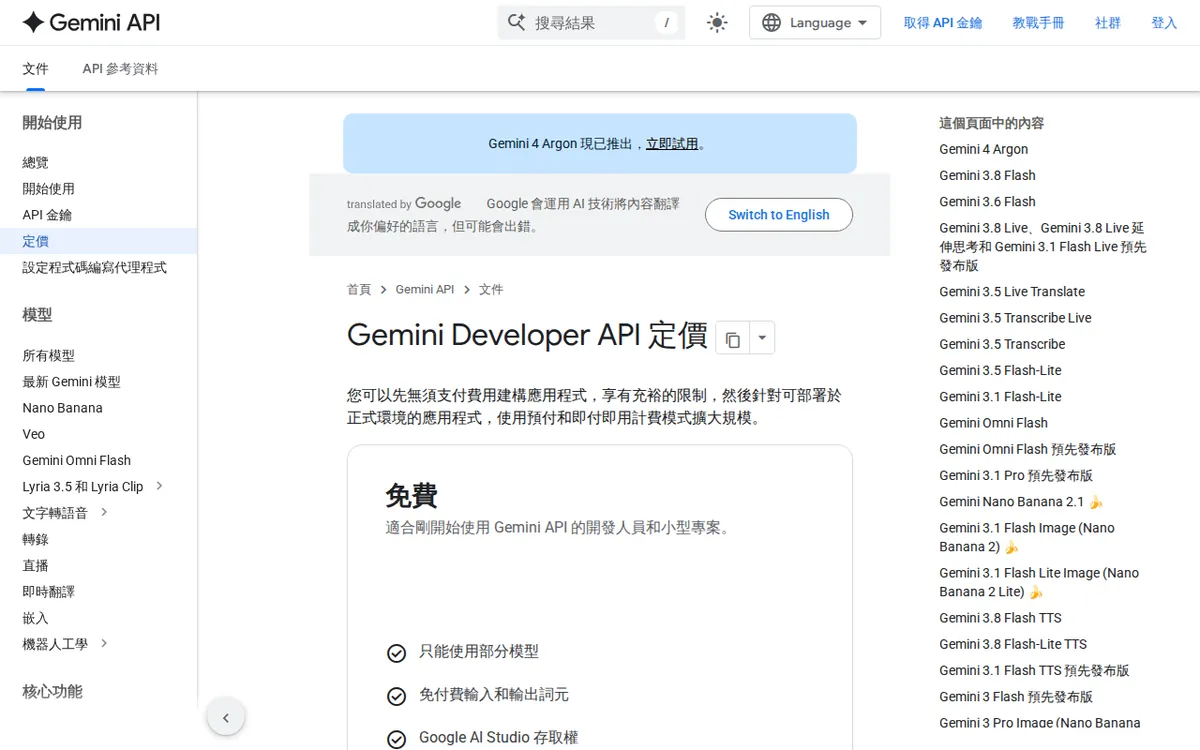
Figure: ai.google.dev official pricing page, captured 2026-10-16.
The reset clock and the no-expiry perk
The free quota resets daily at Pacific midnight. There’s no trial period attached to any of this — it’s not a 14-day free trial that quietly becomes a bill. Google AI Studio’s free tier has no expiration date. You also don’t need to hand over a credit card to get started, which removes the usual “oops, I forgot to cancel” risk that comes with most AI tool trials.
Commercial use is allowed on the free tier, and there’s no watermark stamped on outputs. On paper, that sounds like an unusually clean deal for a free product.
The quiet catch: your free data may train the model
Here’s the part the front page doesn’t lead with: content you send through the free tier may be used by Google to train its models. That’s standard for most “free” AI tools, but it’s an easy detail to miss when the headline message is “no card needed, use it forever.” If you’re testing prompts with anything sensitive — client data, internal documents, anything under an NDA — the free tier is not a safe place to put it. Paying removes that risk: on the usage-based paid plan, your data is not used for training.
There’s a second layer to this once you bring in Google’s search and maps features. Grounding — letting the model pull in live web or map results instead of only answering from what it was trained on — has its own separate free allowance. Gemini 2.5 models get 1,500 free grounding calls a day for both Search and Maps, though some other models in the lineup only get 500 free calls a day for the same features. Gemini 3 models work differently again: 5,000 free prompts per month, covering both Search and Maps grounding, before overage charges kick in.
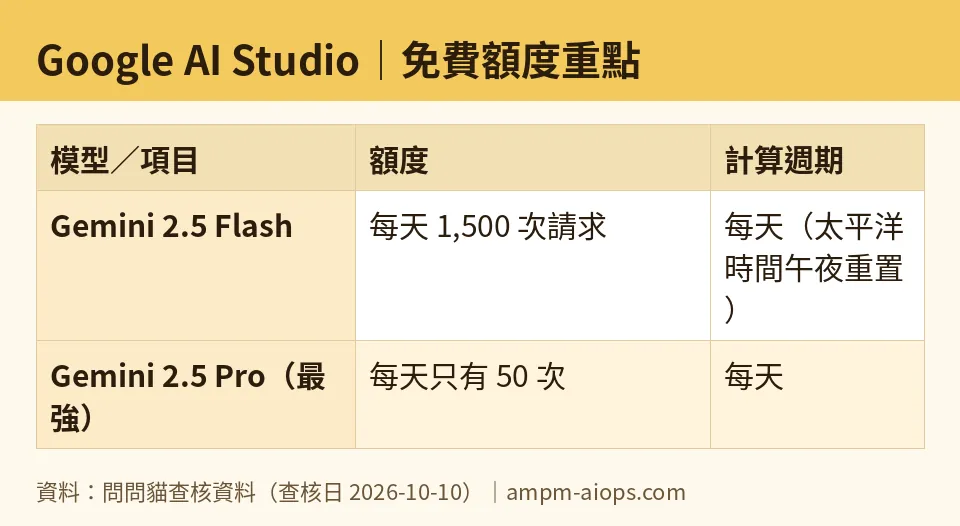
Figure: compiled by AMPM from its verified data (last verified 2026-10-10).
🔍 AMPM exclusive check
We went past the marketing page and checked Google’s own rate-limit documentation directly — the kind of page most users never open. Two things stood out that the pricing page doesn’t make obvious.
First: Search grounding and Maps grounding are both advertised as “1,500 free calls per day” for Gemini 2.5 models, which reads like they’re priced the same once you go over. They’re not. Overage for Search grounding is US$35 per 1,000 calls; overage for Maps grounding is US$25 per 1,000 calls. We confirmed that gap directly against the official pricing page on 2026-07-27 — the same number shown for the free quota hides a real difference in what happens after you exceed it.
Second: we re-checked every number in this piece — the 1,500/50-request daily caps, the per-minute limits, the grounding allowances — across more than ten separate verification passes between July and October 2026, most recently on October 10. Nothing moved. If you’ve seen older complaints online that Google quietly tightened the Gemini 2.5 Pro cap, we found no evidence of that happening in this window; 50 requests a day has held steady throughout.
Nothing else differed from what the official page states. Every number above matches Google’s own documentation as of our October 10, 2026 check.
☀️ AMO, the budget-minded cat

For anyone who just wants to try Gemini without spending a cent, this is about as low-friction as free AI tools get. No credit card means no surprise charge sitting on your statement three months from now. No expiry date means you’re not racing a countdown — the free tier is the actual product for casual users, not a sales funnel.
The math that matters: 1,500 requests a day on Gemini 2.5 Flash is enough for daily brainstorming, drafting, or light coding questions without ever touching your wallet. Even the grounding features — pulling in live search or map results — give you 1,500 free calls a day on the newer models. Commercial use is allowed on the free tier too, so a solo freelancer testing outputs for client work isn’t automatically breaking the rules by staying on the free plan.
Where it gets uncomfortable is Gemini 2.5 Pro’s 50-requests-a-day ceiling. If your work genuinely needs the strongest model, 50 a day runs out before lunch on a busy day, and there’s no way to buy a bigger free bucket — you either switch to a lesser model or pay. And the free tier’s training clause is the real cost most budget users ignore: if you’re pasting in anything you wouldn’t want seen by a stranger, free isn’t actually free. Paying to keep your data out of training is the first real reason to upgrade, not raw request counts.
🌙 PIMI, the performance-minded cat

Judged on whether the free tier lets you actually get work done with the best model available, the answer is: not really, not daily. Gemini 2.5 Pro — the model built for harder tasks — is capped at 50 requests and 5 per minute on the free tier. That’s not a quota for serious throughput. It’s a quota for occasional spot-checks. Anyone running real workloads through Gemini 2.5 Pro will hit the wall fast and need the usage-based paid plan, which removes the daily caps and bills by token instead.
The lighter models fare better on raw speed allowances. Gemini 2.0 Flash’s 15 requests and 1,000,000 tokens per minute is a genuinely fast ceiling for a free product — plenty of throughput for scripted, high-frequency tasks that don’t need the heaviest model. Gemini 2.5 Flash’s 250,000 tokens per minute is more modest but still workable for most single-user workflows.
The grounding pricing split is the detail worth flagging for anyone building something that leans on live search or maps results. Search grounding overage costs US$35 per 1,000 calls, Maps grounding costs US$25 per 1,000 — a 40% difference that changes which feature is cheaper to scale once you’re past the free 1,500-a-day mark. If your product leans heavily on one or the other, that gap belongs in your cost planning, not an afterthought.
Bottom line on performance: the free tier is a legitimate way to evaluate whether Gemini’s output quality fits your use case. It is not a free substitute for production-grade Gemini 2.5 Pro access. The paid plan’s real value isn’t more requests — it’s that your traffic is unlimited-by-day and your data stays out of training, which matters as much for compliance as for speed.
Verdict: who should use it, who should skip it
Use it if: you’re a student, hobbyist, or solo builder who wants to test Gemini models without commitment. No card, no expiry, and 1,500 daily requests on the fast model covers most casual needs comfortably. Light users of Search or Maps grounding also get a genuinely free 1,500-call daily cushion.
Skip the free tier (or pay up front) if: you need Gemini 2.5 Pro for daily, serious work — 50 requests a day is not enough once you’re past the testing phase. Also skip free if you’re handling sensitive, client, or confidential material; the training clause is a real business risk, not fine print to ignore. And if your product scales on search or maps grounding, model the US$35-versus-US$25-per-1,000 overage gap before you commit to one feature over the other — it’s a cost difference that compounds at volume.
Written: 2026-10-16 Price last verified: 2026-10-10 Tool last health-checked: 2026-10-16
🔗 Related on AMPM
📎 Sources
All prices and quotas in this article come from AMPM’s verified dataset for Google AI Studio (last verified 2026-10-10); primary sources:
🐾 Meet the cats: AMO and PIMI

AMPM is a Taiwan-based AI-tool pricing watchdog. Our motto: ask before you subscribe. Two cats argue every tool from two sides:
- ☀️ AMO — the budget-minded cat. Always asks: is the free tier enough, and is paying actually worth it?
- 🌙 PIMI — the performance-minded cat. Cares about whether it works well, fast, and gets your job done.

When they are done arguing, you know whether to pay. Every number is checked by us, with the verification date at the end.
🐾 Our sister sites also checked
Read next
- Google AI Studio Full breakdown: pricing, features and real-world limits
- Google AI Studio Is the free quota enough?
- Google AI Studio Alternatives
- Free plan limits for every AI tool we track
More verified articles on this tool
- [Use cases] Google AI Studio Free Tier: Where Gemini 2.5 Pro Runs Out, by Use Case
- [Pricing] Google AI Studio's Free Tier Is Real, but Gemini 2.5 Pro Has a Daily Ceiling
- The Real Price of Free Gemini: What Google's Own Price List Says About Your Data (2026)