[Use cases] Google AI Studio Free Tier: Where Gemini 2.5 Pro Runs Out, by Use Case
- Free tier: Yes
- Cheapest paid plan: US$0/mo and up
- Free quota: Development purposes are almost free with rate limits, and the exact …
- Last checked: 2026-10-10
Article last updated: 2026-10-12


Google AI Studio is Google’s free playground for the newest Gemini models, and it has one of the most generous free tiers in the industry. No credit card, no trial countdown — just rate limits (how many requests you can send per minute or per day) that vary by model. This piece checks what the free tier actually covers and matches it to three real readers: a student, a freelancer, and a small team, so you can tell whether the free tier is enough or whether paying makes sense.
What you actually get for free
The free tier isn’t one number — it’s a different allowance per model. Gemini 2.5 Flash gives you 1,500 requests a day, reset daily at Pacific midnight (07:00–08:00 UTC, depending on daylight saving). Gemini 2.0 Flash has a looser cap — Google describes it as “a large daily allowance” without publishing an exact daily request number, but its per-minute limit is 15 requests and 1 million tokens (tokens are the chunks of text an AI model reads and writes — more tokens per minute means faster, longer replies). Gemini 2.5 Pro, the strongest model, only gives you 50 requests a day and 5 requests a minute. That’s a steep drop for the model most people actually want to use.
There’s also “grounding” — letting the model pull live Search or Maps results instead of guessing from training data. For Gemini 2.5 models, Search grounding is free up to 1,500 queries a day, with overage billed at US$35 per 1,000 queries. Maps grounding is also free up to 1,500 queries a day, but overage is billed differently — US$25 per 1,000 queries. Some other models cap Search/Maps grounding at 500 free queries a day. Gemini 3 series models work on a different clock entirely: 5,000 free prompts per month (not per day) covering both Search and Maps, with overage at US$14 per 1,000 queries after that.
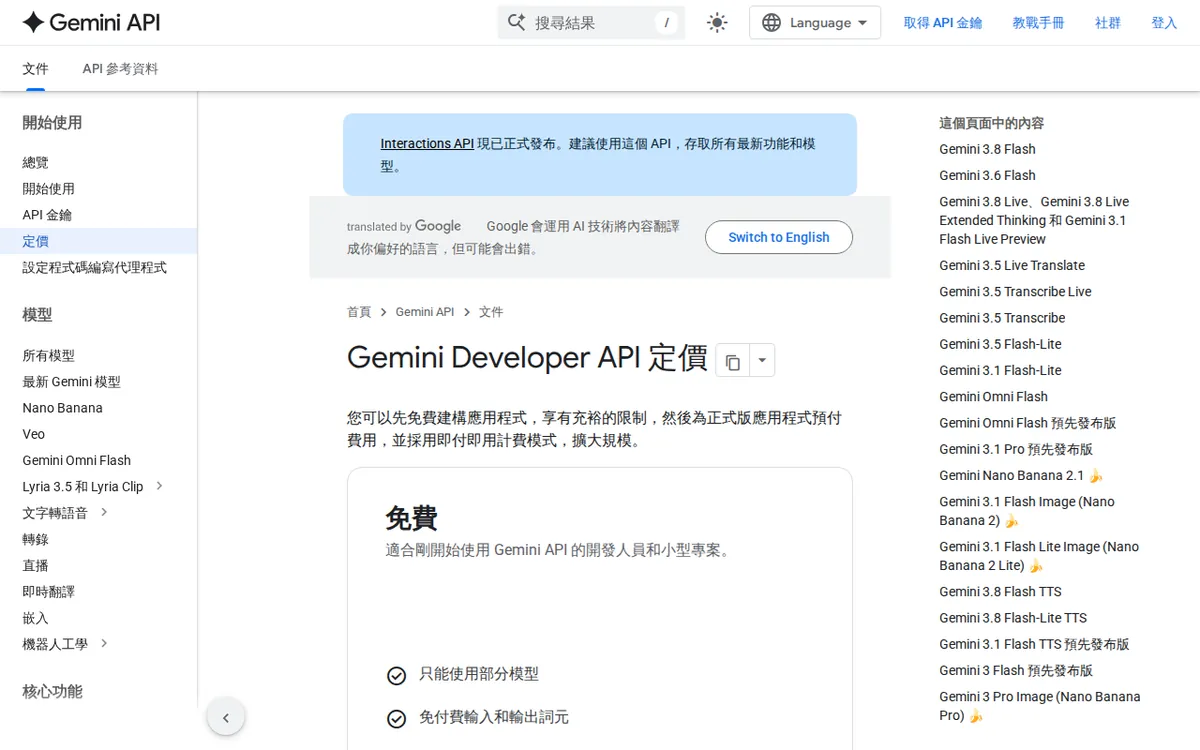
Figure: ai.google.dev official pricing page, captured 2026-10-12.
Free tier isn’t free of strings
The free tier has no expiry date — this isn’t a 14-day trial, it’s permanent. But Google states that conversations on the free tier may be used to train its models. If you’re testing ideas for a school project, that’s a non-issue. If you’re running client data or anything confidential through it, that’s a real consideration — which is exactly why the paid, pay-as-you-go API tier exists: same models, but your data isn’t used for training, and rate limits go up.
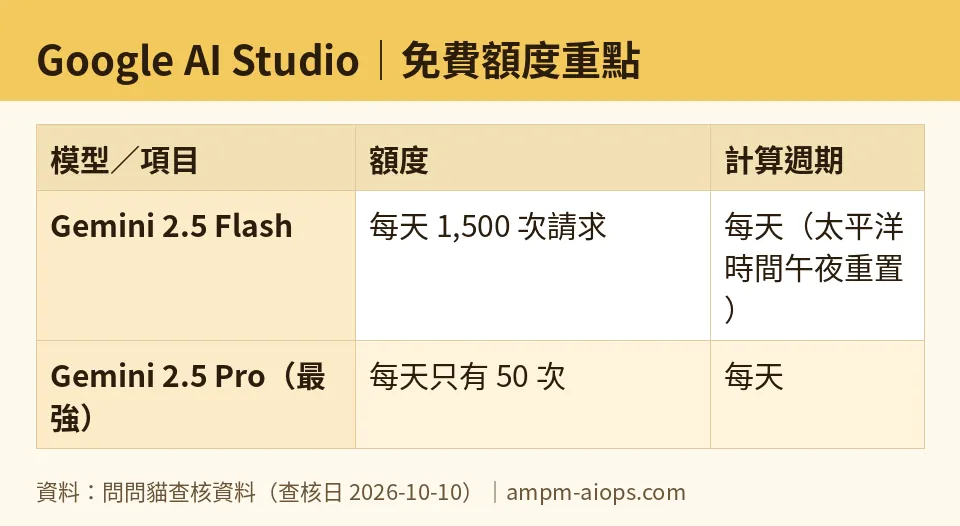
Figure: compiled by AMPM from its verified data (last verified 2026-10-10).
🔍 AMPM exclusive check
Here’s what the official pricing page doesn’t spell out clearly in one place: Gemini 2.5 and Gemini 3 don’t use the same grounding math, and they don’t even run on the same calendar.
For Gemini 2.5 models, Search grounding overage costs US$35 per 1,000 queries, while Maps grounding overage costs US$25 per 1,000 queries — two different rates for two features that sit on the same free daily cap of 1,500 queries. We confirmed this gap directly on the official site on 2026-07-27; it’s easy to assume both cost the same since they share a free quota, but they don’t.
The bigger trap is the calendar switch. Gemini 2.5 and most other models reset their free quota every single day at Pacific midnight. Gemini 3 models instead track a monthly quota — 5,000 free prompts per month. If you’re planning usage around “resets daily” logic because that’s how every other Gemini model works, and you’re on Gemini 3, you’ll miscalculate badly. This daily-vs-monthly split isn’t flagged as a quirk anywhere obvious on the pricing page — you only catch it by reading each model’s row separately, which we did on 2026-10-10 and again at our 2026-10-12 health check. Everything else matched the official numbers with no discrepancies.
☀️ AMO, the budget-minded cat

For most people asking “is the free tier enough,” the answer is yes, especially if you’re a student or just experimenting. Gemini 2.5 Flash’s 1,500 requests a day is more than enough for coding homework, drafting text, or testing prompts — you’d have to be running serious batch jobs to hit that ceiling. Gemini 2.0 Flash’s limits are even looser at 15 requests and 1 million tokens per minute, so it’s the one to reach for if you’re doing heavier back-and-forth work without paying anything. The catch is Gemini 2.5 Pro — the actual strongest model — only gives you 50 requests a day and 5 a minute. That’s thin if you want to lean on the best model daily. My advice: stick to Flash models for free, and only consider the paid API if you specifically need Pro at volume, or if you’re handling anything you don’t want used for training. For a student or hobbyist, paying is simply not necessary — the free tier isn’t a teaser, it’s a real long-term option with no expiry and no card on file.
🌙 PIMI, the performance-minded cat

Does it actually perform under real use? Depends which model you pick, and that’s the catch non-technical users miss. Gemini 2.5 Pro is the model that actually produces the strongest output, but 50 requests a day and 5 per minute will throttle anyone doing real development work — you’ll hit the wall by lunchtime on a busy coding day. Flash models are fast and the limits are generous, but they’re not the top-tier reasoning model. If your work depends on grounding — pulling live Search or Maps data into answers — know that Gemini 2.5’s overage pricing is split: US$35 per 1,000 for Search, US$25 per 1,000 for Maps, both after a shared 1,500/day free cap. Gemini 3 instead runs on a flat US$14 per 1,000 after 5,000 free prompts a month, which is simpler to track but measured monthly, not daily — a different rhythm to plan around. For freelancers or teams building anything production-facing, the free tier’s rate limits (especially on Pro) will get in the way fast. The paid API tier removes that ceiling and stops your prompts being used for training, which matters once you’re working with real client material.
Verdict: who should use it, who should skip it
A student doing coursework or learning to code: the free tier is plenty. Stick to Gemini 2.5 Flash or Gemini 2.0 Flash, skip paying entirely. No credit card needed, no expiry to worry about.
A freelancer handling client work: the free tier works for personal testing, but once real client content enters the picture, move to the pay-as-you-go API tier so data isn’t used for training. Watch the grounding overage split if you use Search or Maps features — US$35 per 1,000 for Search versus US$25 per 1,000 for Maps on Gemini 2.5, or US$14 per 1,000 flat on Gemini 3 after its monthly 5,000-prompt allowance.
A small team shipping a product: you’ll likely blow past Gemini 2.5 Pro’s 50-requests-a-day cap quickly, and training-data exposure on the free tier is a real risk for anything client-facing. Move to the pay-as-you-go API tier. There’s no flat monthly plan price published — cost scales with token usage and grounding queries, so your bill depends entirely on volume. AMPM can’t sum that into one number without inventing a figure that isn’t in Google’s pricing data, and neither should you trust any guide that does.
Written: 2026-10-12 Price last verified: 2026-10-10 Tool last health-checked: 2026-10-12
🔗 Related on AMPM
📎 Sources
All prices and quotas in this article come from AMPM’s verified dataset for Google AI Studio (last verified 2026-10-10); primary sources:
🐾 Meet the cats: AMO and PIMI

AMPM is an independent AI-tool pricing watchdog tracking official prices worldwide. Our motto: ask before you subscribe. Two cats argue every tool from two sides:
- ☀️ AMO — the budget-minded cat. Always asks: is the free tier enough, and is paying actually worth it?
- 🌙 PIMI — the performance-minded cat. Cares about whether it works well, fast, and gets your job done.

When they are done arguing, you know whether to pay. Every number is checked by us, with the verification date at the end.
🐾 Our sister sites also checked
Read next
- Google AI Studio Full breakdown: pricing, features and real-world limits
- Google AI Studio Is the free quota enough?
- Google AI Studio Alternatives
- Free plan limits for every AI tool we track
More verified articles on this tool
- [Review] Google AI Studio Free Usage Limits 2026: What the Daily Caps Actually Cost You
- [Pricing] Google AI Studio's Free Tier Is Real, but Gemini 2.5 Pro Has a Daily Ceiling
- The Real Price of Free Gemini: What Google's Own Price List Says About Your Data (2026)