[FAQ] Groq Free Tier Limits: Why the Model You Pick Changes Your Daily Allowance So Much
- Free tier: There is
- Cheapest paid plan: US$0/mo and up
- Free quota: The Free Plan needs no card and each model has its own per-minute and …
- Last checked: 2026-10-14
Article last updated: 2026-10-13



Groq sells speed, not low prices. It runs open-source models like Llama and GPT OSS on its own chips (called LPUs, built just for running AI models fast) and the free tier is real — no credit card needed to get an API key (the access code developers use to call a model programmatically). But the Groq free tier limits are not one number. They’re a different number for every model, and the pricing page doesn’t list them. You have to dig into the developer docs to find out. This FAQ answers the questions people actually type before signing up: what’s free, what resets, what it costs once you outgrow it, and whether it’s worth paying for.
Do I need a credit card to try Groq, and can I use it commercially?
No card required. Sign up, get an API key, start calling models. Groq’s own data confirms commercial use is allowed on the free tier, and there’s no watermark on outputs. That’s more generous than a lot of “free trial” AI tools that quietly restrict free usage to personal projects. If you’re building a side project or even a small commercial tool, the free tier is a legitimate starting point, not just a demo.
Figure: groq.com official page, captured 2026-10-13.
How many requests do I actually get per day?
This is where it gets messy, and it’s the whole reason this piece exists. Every model on Groq has its own separate daily and per-minute cap, straight from Groq’s rate-limit documentation:
- Llama 3.1 8B Instant: 30 requests per minute, 14,400 requests per day, 6,000 tokens per minute, 500,000 tokens per day. (A token is roughly a chunk of a word — it’s the unit models process text in, and the unit usage-based pricing is billed on.)
- Llama 3.3 70B Versatile: 30 requests per minute, but only 1,000 requests per day. Token caps: 12,000 per minute, 100,000 per day.
- GPT OSS 120B and GPT OSS 20B: 30 requests per minute, 1,000 per day, 8,000 tokens per minute, 200,000 tokens per day.
- Groq Compound: 30 requests per minute, just 250 per day, 70,000 tokens per minute.
- Whisper Large V3 (speech-to-text): 20 requests per minute, 2,000 per day, 7,200 audio-seconds per hour, 28,800 audio-seconds per day.
So the small, fast Llama 3.1 8B model gives you over 14 times more daily requests than the bigger, smarter Llama 3.3 70B model. If you pick a model based on quality alone and don’t check the request cap, you can burn through your daily allowance on the 70B model in a fraction of the time it’d take on the 8B model.
What happens when I hit the limit?
You get an HTTP 429 response — an error code that just means “too many requests, you’ve hit your cap.” It’s not a soft warning, it’s a hard stop until the window resets. One thing that works in your favor: tokens served from cache (meaning the model already processed that exact input recently and reused the result) don’t count against your limit. That matters if your app sends repeated or similar prompts.
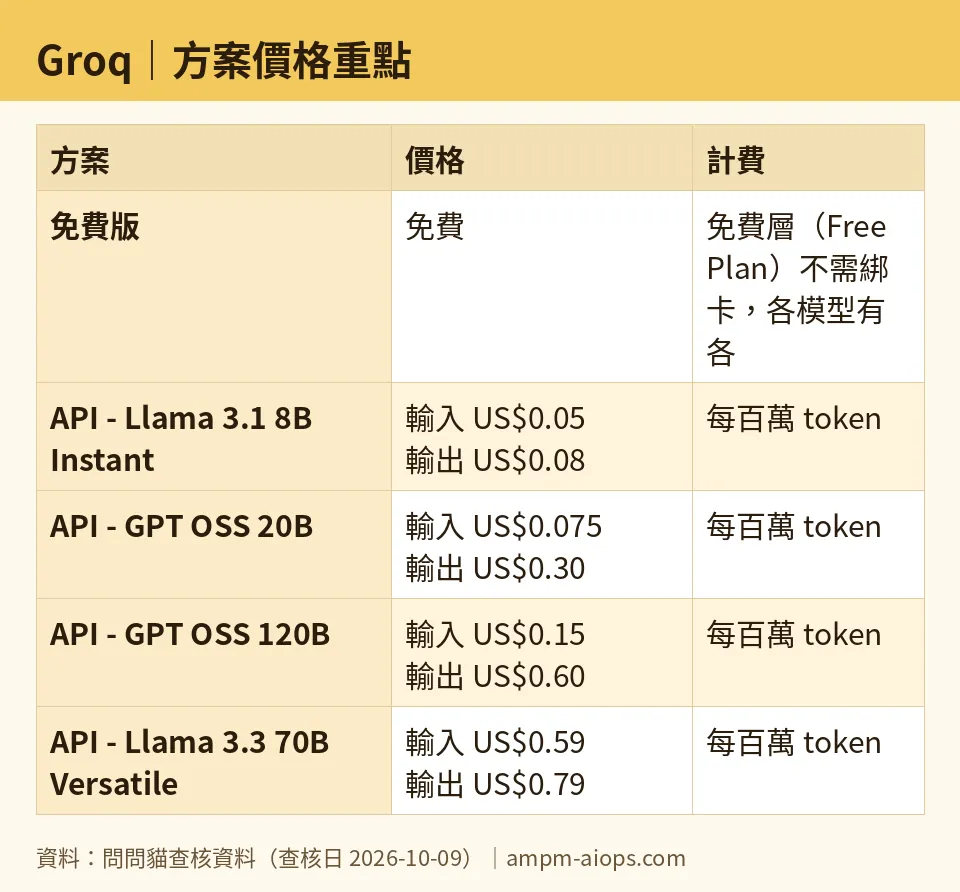
Figure: compiled by AMPM from its verified data (last verified 2026-10-09).
Does the quota reset on a schedule?
Groq’s own documentation doesn’t state a reset time or interval anywhere we could find. The daily and per-minute figures above are confirmed, but when the daily counter rolls over isn’t published. If your workload depends on predictable reset timing, you’ll need to test it yourself rather than trust a published schedule — because there isn’t one.
What does it cost once I outgrow the free tier?
Groq’s API billing is usage-based — you pay per token processed, not a flat monthly seat fee (a “seat” being a paid user slot, which Groq doesn’t use for its API). Prices per million tokens, confirmed from the official pricing page:
- Llama 3.1 8B Instant: US$0.05 input / US$0.08 output, running at roughly 840 TPS (tokens per second, a speed measure).
- GPT OSS 20B: US$0.075 input / US$0.30 output, around 1,000 TPS.
- GPT OSS 120B: US$0.15 input / US$0.60 output, around 500 TPS.
- Llama 3.3 70B Versatile: US$0.59 input / US$0.79 output, around 394 TPS.
There’s also a Batch API (for jobs that don’t need an instant reply) that cuts costs by 50%, and cached input tokens are billed at half price. If you use Groq’s built-in tools, those are billed separately: search runs US$5–8 per thousand requests, web browsing is US$1 per thousand requests, and code execution is US$0.18 per hour.
Does Groq offer GPT-5 or Claude?
No. Groq only runs open-source models — Llama, GPT OSS, and similar. If your project needs a closed model like GPT-5 or Claude, Groq simply doesn’t have it, free or paid. You’d need a separate provider or an aggregator service for that.
🔍 AMPM exclusive check
Here’s the gap: Groq’s official pricing page lists API costs per million tokens in detail, but it does not publish free-tier rate limits anywhere on that page. To get the actual numbers — the 30-per-minute, 14,400-per-day figures and all the rest — we had to go directly into Groq’s developer documentation at console.groq.com/docs/rate-limits, last read on 2026-08-09, separate from the pricing page (read 2026-07-31). A reader relying only on the marketing pricing page would have no idea the free tier even has model-by-model caps this different, let alone what they are. We also confirmed the reset interval for these caps is not published anywhere in Groq’s documentation — not an oversight on our part, it’s simply missing from the vendor’s own materials. Everything else — the per-token prices, the TPS speed figures, the Batch API discount, the tool pricing — matched the official site exactly as of our 2026-10-09 check.
☀️ AMO, the budget-minded cat

AMO only asks one thing: is the free version enough, or do I actually need to pay? For Groq, the honest answer depends entirely on which model you pick. If you’re happy running Llama 3.1 8B — which is still fast, still free, and gives you 14,400 requests and 500,000 tokens a day — AMO says don’t pay a cent. That’s a huge daily allowance for most side projects, prototypes, or even a small live tool. But the moment you need Llama 3.3 70B for better reasoning, the free allowance drops to 1,000 requests and 100,000 tokens a day, and that disappears fast if you’re testing anything seriously. At that point, paying is cheap: US$0.59 per million input tokens and US$0.79 per million output tokens isn’t a lot of money even at moderate volume, and the Batch API knocks another 50% off if your job doesn’t need to run instantly. AMO’s take: start free on the small model, and only open your wallet when you specifically need the bigger model’s reasoning — don’t pay just because the 70B free cap ran out if the 8B model can do the job.
Verdict: who should use it, who should skip it
Use Groq if speed matters more than model choice — real-time chat, voice transcription, anything latency-sensitive — and you’re fine running open-source models. The free tier is genuinely usable for commercial projects, not just testing, as long as you pick a model whose daily cap fits your traffic. Developers building on Llama 3.1 8B get a workable free allowance; everyone else will likely need to budget for usage-based billing once the 70B or GPT OSS caps run out.
Skip Groq if you need GPT-5, Claude, or any closed model — it isn’t here and never will be, since Groq only runs open-source models. Also skip it if your project needs a guaranteed, published reset schedule for rate limits — Groq doesn’t publish one, and you’ll be testing blind.
Written: 2026-10-13 Price last verified: 2026-10-09 Tool last health-checked: 2026-10-13
🔗 Related on AMPM
📎 Sources
All prices and quotas in this article come from AMPM’s verified dataset for Groq (last verified 2026-10-09); primary sources:
🐾 Meet the cats: AMO and PIMI

AMPM is a Taiwan-based AI-tool pricing watchdog. Our motto: ask before you subscribe. Two cats argue every tool from two sides:
- ☀️ AMO — the budget-minded cat. Always asks: is the free tier enough, and is paying actually worth it?
- 🌙 PIMI — the performance-minded cat. Cares about whether it works well, fast, and gets your job done.

When they are done arguing, you know whether to pay. Every number is checked by us, with the verification date at the end.
🐾 Our sister sites also checked
Let's take a look at these
- Groq Comprehensive Introduction: Pricing, Features, and Actual Limitations
- Groq Is the free quota enough?
- Groq Alternatives
- Comprehensive Free Quota List for All Tools
More verified articles on this tool
- [Pitfalls] Groq Free Tier Limits: The Model Cap That Catches People Out
- [Review] Groq Free Tier Limits: Each Model Runs Its Own Quota, Not One Pool
- [Special] Groq's Free Tier: Which Models Hit the Daily Cap First, and How to Plan Around It