[Review] Groq Free Tier Limits: Each Model Runs Its Own Quota, Not One Pool
- Free tier: There is
- Cheapest paid plan: US$0/mo and up
- Free quota: The Free Plan needs no card and each model has its own per-minute and …
- Last checked: 2026-10-14
Article last updated: 2026-10-12



Groq sells itself on speed, not on being cheap, and that distinction matters more than its pricing page lets on. We went looking for a straight answer to a simple question — what do you actually get for free, and is paying worth it — and found the real numbers aren’t on the pricing page at all. They’re in a separate rate-limits document, and once you read it, the free tier turns out to be a collection of small, separate allowances, one per model, not a single quota you can spend however you like.
Groq runs open-source models (Llama, GPT OSS, Whisper) on its own custom chip, called an LPU (language processing unit), built specifically to run inference — the step where a trained model actually generates answers — faster than general-purpose chips. No credit card is required to sign up and get an API key, which is the credential that lets your own code call Groq’s models directly instead of using a chat window.
Why “free tier” doesn’t mean one number
Most free tiers work like a phone plan: one bucket of minutes, spend it on whatever call you want. Groq’s free plan doesn’t work that way. Every model you can run has its own separate ceiling, measured four different ways: requests per minute (RPM), requests per day (RPD), tokens per minute (TPM), and tokens per day (TPD). A token is roughly a word or a word-fragment — the unit models read and write in.
Llama 3.1 8B Instant, the smallest and fastest model Groq offers, gets the most generous allowance: 30 requests per minute, 14,400 per day, 6,000 tokens per minute, and 500,000 tokens per day. Llama 3.3 70B Versatile — a bigger, more capable model — gets 30 requests per minute but only 1,000 per day, 12,000 tokens per minute, and just 100,000 tokens per day. GPT OSS 120B and GPT OSS 20B share the same limits as each other: 30 requests per minute, 1,000 per day, 8,000 tokens per minute, 200,000 tokens per day. Groq’s own “Compound” tool-use model is tighter still — 30 requests per minute, only 250 per day, 70,000 tokens per minute. Whisper Large V3, the speech-to-text model, is measured in audio seconds instead of tokens: 20 requests per minute, 2,000 per day, 7,200 audio-seconds per hour, 28,800 per day.
Run out on any one model and you get an HTTP 429 error — the standard “too many requests” response — until the window resets. One upside: if your request hits a cached response (the system recognizes you’ve sent the same input recently), that doesn’t count against your token limit.
Figure: groq.com official page, captured 2026-10-12.
What you pay once you outgrow free
If you need more than the free quotas allow, Groq bills per million tokens, split by input (what you send) and output (what the model generates). Llama 3.1 8B Instant costs US$0.05 per million input tokens and US$0.08 per million output tokens, running at roughly 840 tokens per second (TPS) — a rough measure of how fast the model generates text. GPT OSS 20B runs US$0.075 in / US$0.30 out at about 1,000 TPS. GPT OSS 120B is US$0.15 in / US$0.60 out at around 500 TPS. Llama 3.3 70B Versatile, the priciest of the four, is US$0.59 in / US$0.79 out at about 394 TPS.
Two ways to cut that bill: Batch API processing (sending requests asynchronously instead of waiting on an instant reply) cuts the price in half, and any input tokens that hit the cache are billed at half price too. Groq’s built-in tools are priced separately — web search runs US$5 to US$8 per thousand searches, web browsing is US$1 per thousand, and code execution is US$0.18 per hour.
What’s missing from all of this: no GPT-5, no Claude, no closed-source models of any kind. Groq only runs open-source models. If your workflow depends on a specific closed model, Groq isn’t an option — you’d need an aggregator service instead.
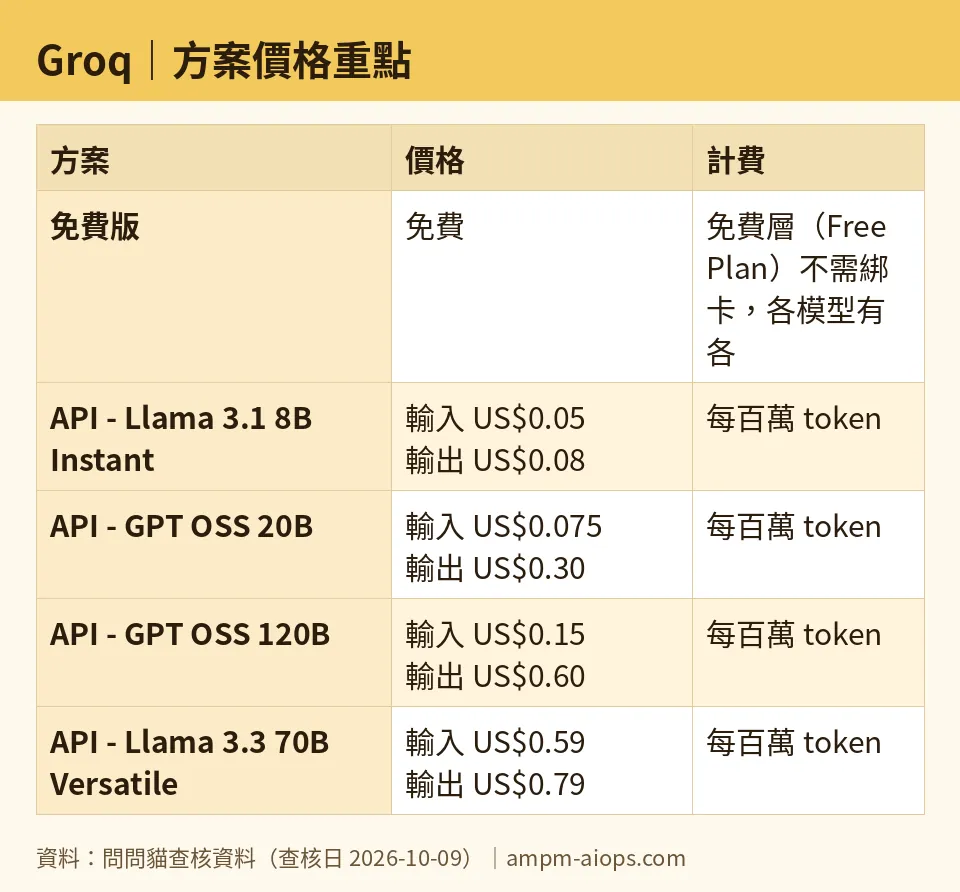
Figure: compiled by AMPM from its verified data (last verified 2026-10-09).
🔍 AMPM exclusive check
Here’s the gap we found: Groq’s main pricing page (groq.com/pricing) does not publish the free tier’s rate limits at all. If you stop there, you’d have no idea what “free” actually gets you beyond “an API key.” The real numbers — the RPM/RPD/TPM/TPD figures for every model, quoted above — live in a separate technical document, the rate-limits page at console.groq.com/docs/rate-limits, which we read directly on 2026-08-09.
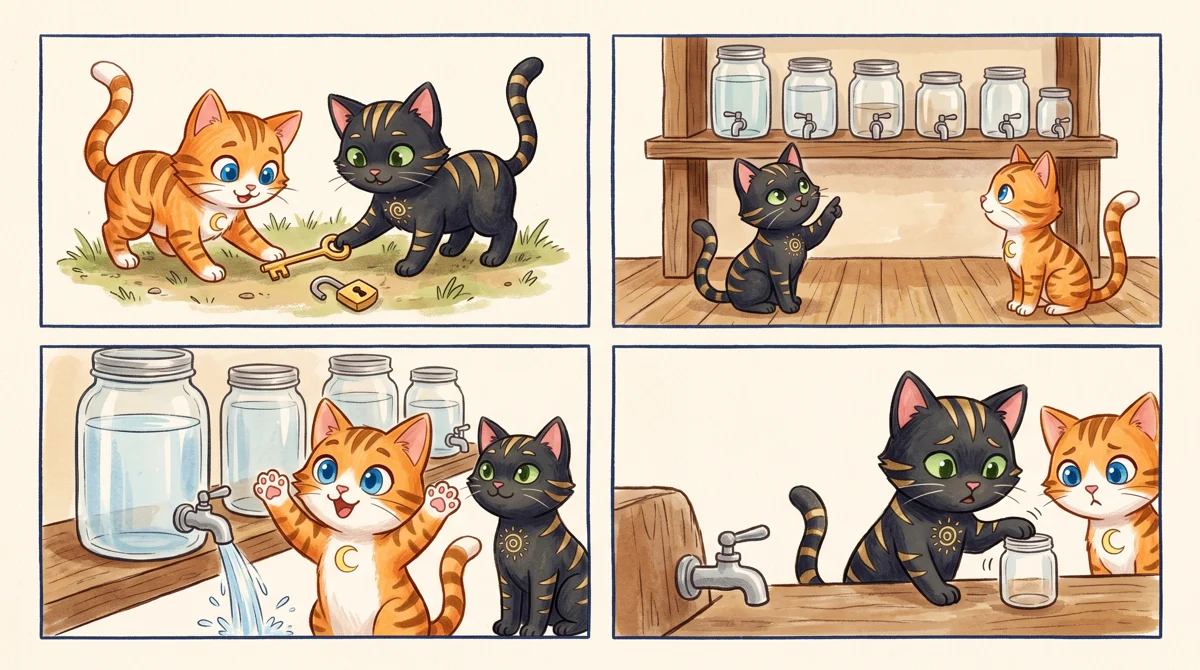
Illustration: Free quota is not a shared bucket; each model draws from its own separate reservoir.
That split matters because it’s easy to assume a “free plan” is one combined allowance, like a data cap on a phone plan. It isn’t. Each model is metered on its own, with its own daily and per-minute caps, and they vary a lot — Llama 3.1 8B Instant’s daily token cap (500,000) is five times bigger than Llama 3.3 70B Versatile’s (100,000). A developer testing one model and assuming the same headroom applies to another will hit a 429 error much sooner than expected. That’s the exclusive: not a secret number, but the fact that you need to read two separate official documents, not one, to understand what “free” means on Groq — and the quota structure itself (per-model, not pooled) isn’t explained anywhere obvious on the marketing site.
☀️ AMO, the budget-minded cat

AMO checked whether “free” on Groq is actually usable, and the honest answer is: for one model, pretty generous; for everything else, you’ll bump into walls fast. If your project leans on Llama 3.1 8B Instant, 500,000 tokens a day and 14,400 requests a day is enough room to build and test a real small project without paying anything, and you don’t even need a credit card to start. That’s a genuinely low-friction way to try Groq’s speed claim for yourself.
But the moment you want a stronger model, the free door narrows hard. Llama 3.3 70B Versatile caps out at 100,000 tokens a day — a fifth of what the small model gets — and only 1,000 requests a day. GPT OSS 120B and 20B share that same 1,000-request, 200,000-token daily ceiling. For a hobby project or a demo, that’s workable. For anything with real daily traffic, you’ll hit the 429 error regularly and need to pay.
The good news on the paid side is that Groq’s rates are genuinely cheap by the numbers in front of us: US$0.05 per million input tokens for the small Llama model is close to the bottom of what any provider charges for a usable model. Batch processing knocking 50% off, plus half-price cached input tokens, means a cost-conscious developer who’s willing to batch requests instead of needing instant replies can push the real bill down further still. AMO’s take: free is worth using to prototype, especially on the small model, but budget users who need the bigger models should expect to pay from early on, not for a surprise bill after some generous unlimited period — because there isn’t one.
🌙 PIMI, the performance-minded cat

PIMI cares about one thing: does it actually run fast, and is the speed real or marketing. Here, Groq delivers. The listed generation speeds are hard numbers, not vague claims — Llama 3.1 8B Instant at roughly 840 tokens per second, GPT OSS 20B at about 1,000 TPS, GPT OSS 120B at around 500 TPS, Llama 3.3 70B Versatile at about 394 TPS. Those are the speeds you get on the free tier too — Groq doesn’t throttle free users to a slower version of the same model. The LPU chip is doing the same work either way; what’s restricted is how often you can call it, not how fast the response comes back.
That’s a meaningful distinction for someone evaluating infrastructure rather than hunting for a discount: speed isn’t a paid feature here, it’s the whole product. The rate limits are the real constraint to plan around, though, especially for Llama 3.3 70B Versatile’s 1,000-requests-per-day free cap — a performance-focused build testing a larger reasoning model will burn through that in a single busy debugging session, free tier or not.
On raw inference speed, nothing else in this dataset competes — Groq’s selling point holds up under our own read of its numbers. Where PIMI would push back is the model lineup: speed on an open-source model doesn’t help if your use case specifically needs GPT-5 or Claude-level reasoning, since Groq doesn’t run either. For open-source-model workloads where speed is the deciding factor, this is about as fast as it gets; for anything that specifically needs a closed frontier model, it’s the wrong tool regardless of speed.
Verdict: who should use it, who should skip it
Groq is worth using if you’re building on open-source models (Llama, GPT OSS) and speed matters to your product — real-time chat, voice pipelines, anything where a slow reply is a worse experience than a slightly weaker model. The free tier is enough to prototype seriously on the small Llama model, and the paid rates are cheap enough that scaling up doesn’t require a big budget, especially if you can batch requests for the 50% discount.
Skip it if you need GPT-5, Claude, or any closed model Groq doesn’t host — there’s no workaround, you’d need a different provider or an aggregator. Also think twice if your app needs steady, predictable throughput on the bigger models: the free tier’s daily caps on Llama 3.3 70B Versatile and the GPT OSS models are tight enough that you’ll be paying, not testing, within your first real day of traffic.
Written: 2026-10-12 Price last verified: 2026-10-09 Tool last health-checked: 2026-10-12
🔗 Related on AMPM
📎 Sources
All prices and quotas in this article come from AMPM’s verified dataset for Groq (last verified 2026-10-09); primary sources:
🐾 Meet the cats: AMO and PIMI

AMPM is an independent AI-tool pricing watchdog tracking official prices worldwide. Our motto: ask before you subscribe. Two cats argue every tool from two sides:
- ☀️ AMO — the budget-minded cat. Always asks: is the free tier enough, and is paying actually worth it?
- 🌙 PIMI — the performance-minded cat. Cares about whether it works well, fast, and gets your job done.

When they are done arguing, you know whether to pay. Every number is checked by us, with the verification date at the end.
🐾 Our sister sites also checked
Let's take a look at these
- Groq Comprehensive Introduction: Pricing, Features, and Actual Limitations
- Groq Is the free quota enough?
- Groq Alternatives
- Comprehensive Free Quota List for All Tools
More verified articles on this tool
- [Pitfalls] Groq Free Tier Limits: The Model Cap That Catches People Out
- [FAQ] Groq Free Tier Limits: Why the Model You Pick Changes Your Daily Allowance So Much
- [Special] Groq's Free Tier: Which Models Hit the Daily Cap First, and How to Plan Around It