[Pitfalls] Groq Free Tier Limits: The Model Cap That Catches People Out
- Free tier: There is
- Cheapest paid plan: US$0/mo and up
- Free quota: The Free Plan needs no card and each model has its own per-minute and …
- Last checked: 2026-10-14
Article last updated: 2026-10-14



Groq sells speed. Its custom chip (called an LPU, a processor built just for running AI models fast) pushes open-source models like Llama and GPT OSS at speeds most cloud providers can’t match. But if you’re searching “Groq free tier limits” because you want to know what you actually get for nothing, the official pricing page won’t tell you. You have to read the technical docs. We did. Here’s what’s really there, and where people get tripped up.
The free tier exists, but the numbers are buried
Sign up for Groq and you get an API key (a password-like string that lets your app talk to the service) immediately, no credit card. That part is simple. What’s not simple: finding out how much you can actually run before you get cut off.
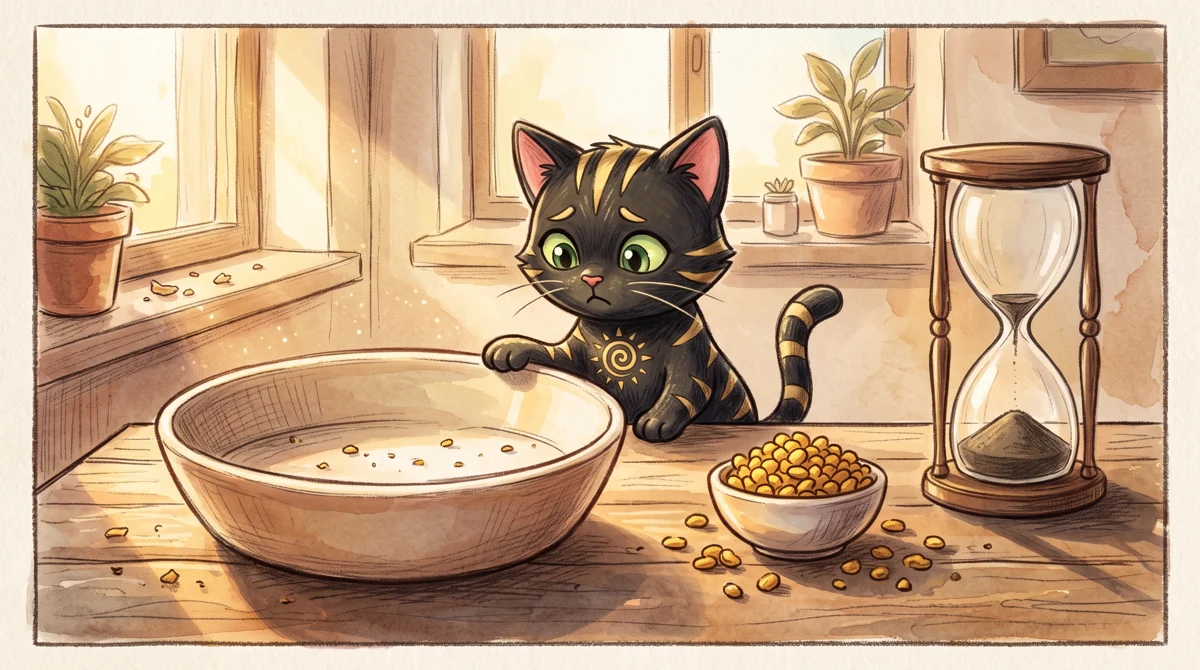
Illustration: Free quotas shrink drastically for larger models, leaving developers running empty far sooner than expected
The pricing page at groq.com doesn’t list per-model daily or per-minute caps. Those numbers live in a separate technical reference page, not the page most people check first. We read that reference directly (dated 2026-08-09) and pulled the real figures model by model:
- Llama 3.1 8B Instant: 30 requests per minute, 14,400 per day; 6,000 tokens per minute, 500,000 tokens per day. (A token is roughly a word-fragment — the unit models are billed and limited by.)
- Llama 3.3 70B Versatile: 30 requests per minute, but only 1,000 per day; 12,000 tokens per minute, 100,000 tokens per day.
- GPT OSS 120B and GPT OSS 20B: 30 requests per minute, 1,000 per day; 8,000 tokens per minute, 200,000 tokens per day.
- Groq Compound: 30 requests per minute, 250 per day; 70,000 tokens per minute.
- Whisper Large V3 (speech-to-text): 20 requests per minute, 2,000 per day; 7,200 audio-seconds per hour, 28,800 audio-seconds per day.
Run out, and you get an HTTP 429 error — the standard “too many requests, slow down” response. One thing that works in your favor: tokens served from cache (repeated prompts the system already processed) don’t count against your daily cap.
Figure: groq.com official page, captured 2026-10-14.
The 1,000-call-a-day trap
The 8B model gives you 14,400 calls a day. The 70B model, which most developers actually want for real reasoning tasks, gives you 1,000. That’s not a typo — it’s a 14x drop for a model that’s only mildly more capable in Groq’s own lineup. If you’re testing an app that calls the 70B model in a loop, or running automated evals, you can burn through 1,000 calls before lunch. Same cap applies to both GPT OSS sizes and to Groq Compound, except Compound’s daily limit is just 250.
How to avoid it: route high-volume traffic to the 8B model where the free daily quota is 14x larger, and save the 70B calls for requests that actually need the extra reasoning.
No flat monthly plan — and no GPT-5 or Claude
Groq doesn’t sell a subscription. Everything paid is usage-based: you pay per token processed, with no flat monthly figure to budget against. Rates, per million tokens:
- Llama 3.1 8B Instant: US$0.05 input / US$0.08 output, around 840 tokens per second.
- GPT OSS 20B: US$0.075 input / US$0.30 output, around 1,000 tokens per second.
- GPT OSS 120B: US$0.15 input / US$0.60 output, around 500 tokens per second.
- Llama 3.3 70B Versatile: US$0.59 input / US$0.79 output, around 394 tokens per second.
Batch API (submitting requests for asynchronous processing instead of real-time) cuts the bill by 50%. Cached input tokens are half price too. But built-in tools are billed on top, separately: search runs US$5–8 per 1,000 searches, web browsing is US$1 per 1,000 pages, and code execution is US$0.18 per hour. None of that shows up in the headline per-token rate — it’s easy to budget for the model and forget the tools around it.
And Groq only runs open-source models. There’s no GPT-5, no Claude, nothing closed-source. If your workflow depends on those, Groq isn’t an option on its own — you’d need an aggregator service instead.
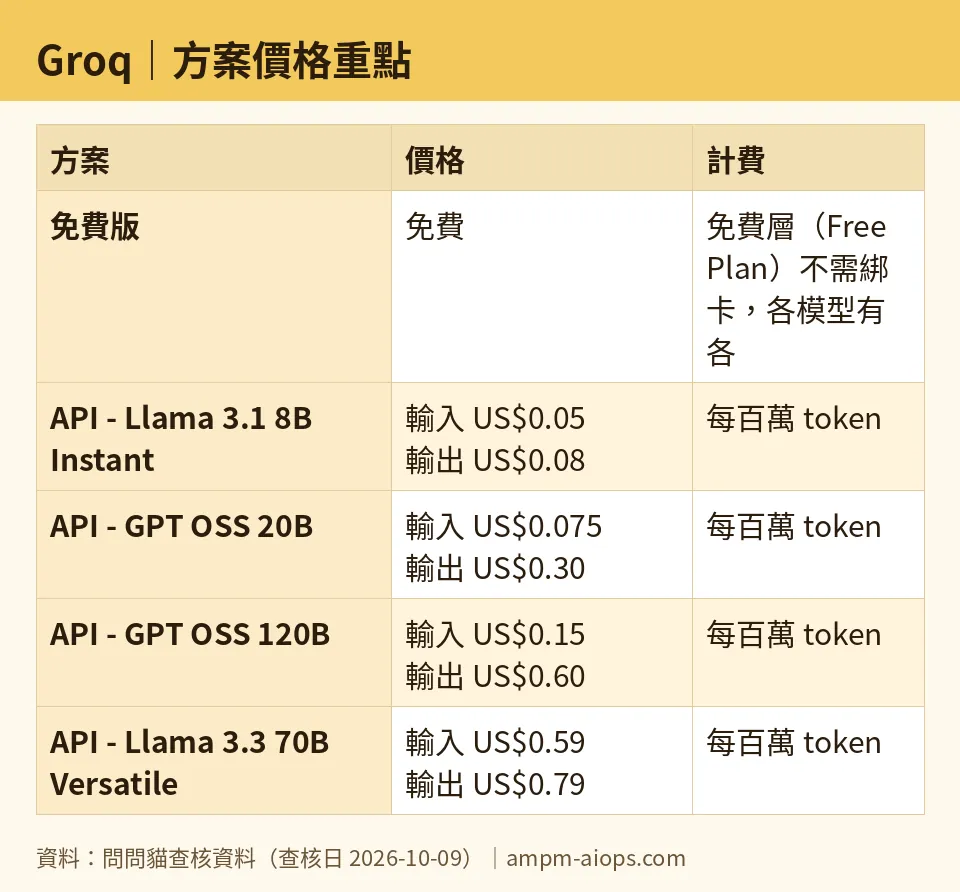
Figure: compiled by AMPM from its verified data (last verified 2026-10-09).
🔍 AMPM exclusive check
The vendor’s own pricing page at groq.com never states the free tier’s daily or per-minute caps. That information sits in a separate rate-limits reference page inside Groq’s developer docs, not in the pricing or plans section most visitors read first. We read that docs page directly, dated 2026-08-09, and confirmed every number above model by model — something the main pricing page simply doesn’t spell out. If you only checked the pricing page before signing up, you’d have no idea the 70B model caps at 1,000 requests a day until you hit the wall.
☀️ AMO, the budget-minded cat

For anyone asking “is the free tier enough, or is it worth paying,” here’s the plain math. The free tier is genuinely usable for light testing and small personal projects — 14,400 daily calls on the 8B model is a lot of room if your app is small. But the moment you need the 70B model for real reasoning work, 1,000 calls a day disappears fast, especially during development when you’re calling the API over and over to debug prompts.
Paying doesn’t mean a subscription jump — it’s pay-per-token, so costs stay close to actual usage. The 8B model costs US$0.05 per million input tokens and US$0.08 per million output tokens, which is cheap enough that casual paid use barely dents a budget. The 70B model jumps to US$0.59 input and US$0.79 output per million tokens — about 10x the 8B rate — so only pay for it when you actually need the stronger reasoning, not as a default. If your workload leans on the 70B or GPT OSS models daily, paying is worth it the day you hit that 1,000-call wall. If you’re staying on 8B for simple tasks, the free tier’s 14,400-a-day limit is probably enough to never need a card.
Verdict: who should use it, who should skip it
Use Groq if speed matters more than model choice — you’re building something latency-sensitive (chatbots, live translation, real-time transcription) and you’re fine running on Llama or GPT OSS instead of GPT-5 or Claude. The free tier is workable for the 8B model specifically; budget around the 1,000-call daily caps on 70B, GPT OSS, and Compound models if you plan to test heavily.
Skip it if you need closed-source models (GPT-5, Claude) as your primary engine — Groq simply doesn’t run them, and you’d need a separate aggregator service anyway. Also skip it if you want predictable flat billing: there’s no subscription tier here, only usage-based pricing plus separate charges for search, browsing, and code execution tools that aren’t included in the base per-token rate.
Written: 2026-10-14 Price last verified: 2026-10-09 Tool last health-checked: 2026-10-13
🔗 Related on AMPM
📎 Sources
All prices and quotas in this article come from AMPM’s verified dataset for Groq (last verified 2026-10-09); primary sources:
🐾 Meet the cats: AMO and PIMI

AMPM is a Taiwan-based AI-tool pricing watchdog. Our motto: ask before you subscribe. Two cats argue every tool from two sides:
- ☀️ AMO — the budget-minded cat. Always asks: is the free tier enough, and is paying actually worth it?
- 🌙 PIMI — the performance-minded cat. Cares about whether it works well, fast, and gets your job done.

When they are done arguing, you know whether to pay. Every number is checked by us, with the verification date at the end.
🐾 Our sister sites also checked
Let's take a look at these
- Groq Comprehensive Introduction: Pricing, Features, and Actual Limitations
- Groq Is the free quota enough?
- Groq Alternatives
- Comprehensive Free Quota List for All Tools
More verified articles on this tool
- [FAQ] Groq Free Tier Limits: Why the Model You Pick Changes Your Daily Allowance So Much
- [Review] Groq Free Tier Limits: Each Model Runs Its Own Quota, Not One Pool
- [Special] Groq's Free Tier: Which Models Hit the Daily Cap First, and How to Plan Around It