[How-to] Hemory Free Usage Limits 2026: What the Quota Really Counts
- Free tier: Yes
- Cheapest paid plan: US$10/mo and up
- Free quota: Free Trial: a one-time 10 hours of voice listening (does not reset …
- Last checked: 2026-10-22
Article last updated: 2026-10-22


Hemory wants to sit in the background all day and record. The pitch is a memory bank that keeps listening, then lets an AI agent dig through what it heard. For a beginner, the only question that matters at the start is simpler: when does the free meter run out, and what makes it tick? That is where most people get the math wrong. So let’s get you productive without burning the trial by accident.
What you actually get for free
Hemory’s free tier is a Free Trial: a one-time 10-hour voice listening allowance. Read that twice. It is not 10 hours every month. It does not reset. When those 10 hours are gone, they are gone until you pay.

Illustration: The sand trickles only when voice ripples appear in the air, remaining paused during silence with no refill.
Two details make this more generous than it sounds:
- It uses VAD — voice activity detection, a feature that only starts the clock when someone is actually talking. Silence, background hum, the long gaps in a meeting while people read a slide: none of that eats your quota. Only speech does.
- There is no credit card required to begin. You are not pre-authorizing a charge you might forget to cancel.
So the real-world value of 10 hours is bigger than 10 hours of wall-clock time. If you leave Hemory on through a two-hour meeting where you personally spoke for twenty minutes and others spoke for another forty, the meter moves by the speaking time, not the full two hours. The exact accounting is the vendor’s, but the principle is clear: dead air is free.
That is the trap, too. Because the trial does not reset, there is no “use it or lose it this month” pressure — which means it is easy to leave the app running out of curiosity and quietly drain the whole allowance on hallway chatter you never needed transcribed.
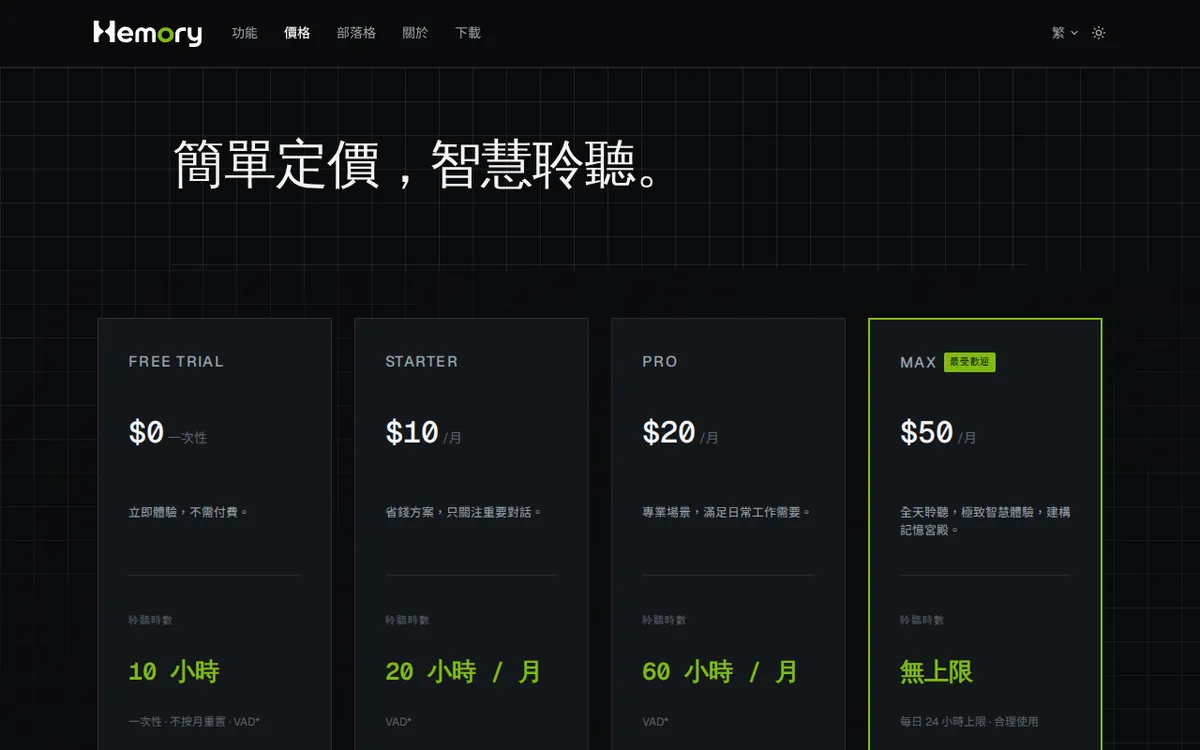
Figure: hemory.com official pricing page, captured 2026-10-22.
Getting your first useful transcript
Here is the fastest path from install to something you can actually search.
1. Install and grant microphone access. Hemory is an always-on recorder, so it needs permission to listen continuously. On a work machine, check your employer’s policy before you do this — more on the legal side below.
2. Do a 60-second test, then stop. Before you commit your trial to a real meeting, say a few sentences, end the session, and look at the output. You want to confirm that the transcription is readable and that the right language was detected. Burning two minutes of a 10-hour trial to verify it works is cheap insurance.
3. Let it clean up the raw text. Hemory includes AI auto-cleanup — it strips filler, fixes run-on speech, and organizes the raw transcript into something readable. You don’t paste the transcript into another tool; the processing is built in. This is where a long rambling call turns into notes you’d actually reread.
4. Turn on speaker identification for group audio. If more than one person talks, speaker labels are what make the transcript usable later (“who said we’d ship Friday?”). For a solo voice memo you can ignore it.
5. Ask the transcript a question. Hemory ships a built-in Q&A agent — an assistant you ask in plain language (“what were the three action items?”) instead of scrolling the transcript yourself. This is the feature that turns a pile of recordings into a memory bank. Try it on your test clip so you know what good questions look like.
One caveat for free-tier users: the data lists the full feature set — 100-language transcription, AI cleanup, speaker ID, the Q&A agent, and MCP — explicitly under the paid Starter plan. The free Free Trial entry only spells out the 10-hour listening allowance. The vendor’s own pages did not lay out, feature by feature, exactly which of those are live during the trial versus gated behind a subscription. Assume the trial lets you evaluate the core loop; confirm any single feature you’re depending on before you build a workflow around it.
Connecting Hemory to your AI agent (MCP)
The reason Hemory is tagged as more than a note-taker is MCP — Model Context Protocol, a standard way for an outside AI tool (think a coding assistant or a chatbot) to reach into another app’s data and query it. With MCP, your AI agent can ask Hemory’s memory bank questions directly, instead of you copy-pasting transcripts over.
For a beginner this is the “later” feature, not the “day one” feature. Get comfortable recording and searching inside Hemory first. Once you have a body of transcripts worth querying, MCP is how you wire them into whatever assistant you already use. In the data, MCP support is listed under the paid Starter plan’s feature set, so treat agent integration as something you validate after you’ve decided the core product earns a subscription.
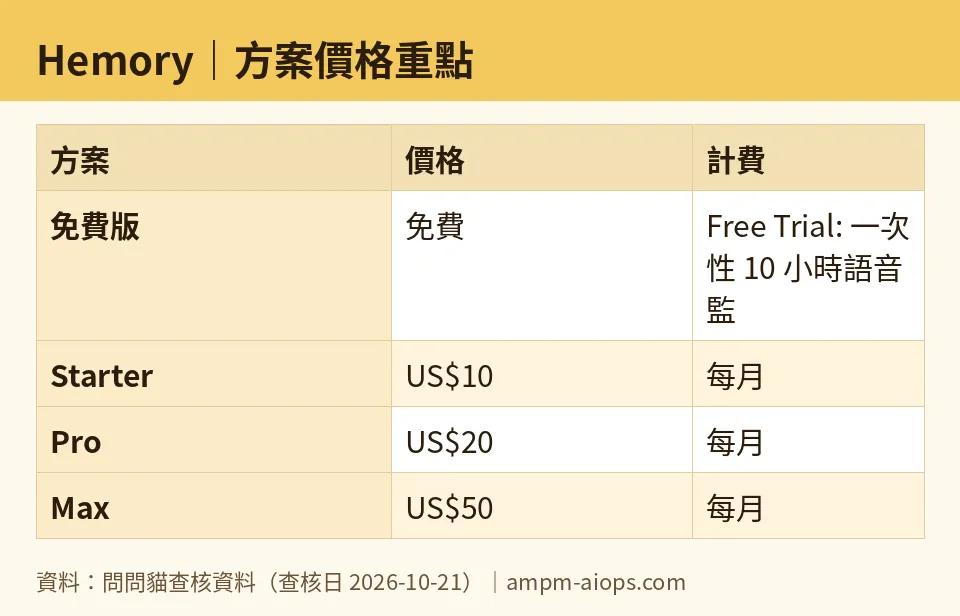
Figure: compiled by AMPM from its verified data (last verified 2026-10-21).
What the paid plans change
If the trial convinces you, here is what the ladder looks like. The thing that scales is effective recording transcription quota — hours of actual speech transcribed per month, measured the same VAD way.
- Starter — US$10/month. 20 hours of effective recording transcription per month. Full features unlocked: 100-language transcription, AI auto-cleanup, speaker identification, the built-in Q&A agent, and MCP support.
- Pro — US$20/month. 60 hours per month. Same feature set as Starter; the data frames it for heavy daily-meeting users.
- Max — US$50/month. No stated cap on recording transcription, subject to a fair-use policy of 24 hours per day. The official site marks this as its most popular plan.
A few honest notes. The free allowance is counted as listening hours; the paid tiers are counted as transcription hours. The data presents them with different wording, so don’t assume one free hour equals one paid hour of the same thing. And there is no annual price in the data — only these monthly figures — so I’m not going to multiply anything out for you. If you want a yearly number, the official pricing page is where to look.
🔍 AMPM exclusive check
Two things the vendor page does not make obvious, which matter before you spend an hour of trial:
The free trial does not reset, and the paid plans do. The official framing calls it a “Free Trial” with a 10-hour allowance. What’s easy to miss is that this is a one-time bucket — unlike the Starter/Pro/Max quotas, which are monthly. So the free tier is for evaluating, not for living in. We flag it because “10 hours” reads like a recurring number and isn’t.
The trial’s feature coverage is under-documented. The full feature list — 100 languages, speaker ID, the Q&A agent, MCP — is attached to the paid plans in the data, not itemized for the trial. We could not confirm, line by line, which of those run during the free trial. If a specific feature is your reason to try Hemory, test that exact feature inside your 10 hours before you form an opinion.
A transparency note on our end: Hemory came into our list as an auto-added challenger candidate and has been through a single verification pass, not our usual three-way manual cross-check. Every number above matches the official site as read on 2026-10-21. For commercial terms and the free allowance, treat the live vendor page as the final word.
Verdict: who should use it, who should skip it
Use it if you sit in a lot of meetings or talk through ideas out loud, and you want a searchable record you can later ask questions of. Start on the free trial, run the 60-second test, then point it at one real meeting and judge the cleanup and Q&A quality. If 20 hours a month of transcription covers your calendar, Starter at US$10/month is the obvious first paid step; Pro at US$20/month is the move only once you’ve actually hit the 20-hour wall.
Skip it — for now — if you need a guaranteed recurring free quota (there isn’t one; the trial is one-time), if your work environment forbids always-on recording, or if you’re in a jurisdiction or meeting where recording others without clear consent is a problem. An always-on microphone is a legal and trust question before it’s a pricing one. Settle that first.
Max at US$50/month, despite being flagged as the most popular plan, is not a beginner’s choice — “no cap, within 24 hours a day of fair use” is a signal for people already running Hemory all day, every day.
Written: 2026-10-22 Price last verified: 2026-10-21 Tool last health-checked: 2026-10-21
🔗 Related on AMPM
📎 Sources
All prices and quotas in this article come from AMPM’s verified dataset for Hemory (last verified 2026-10-21); primary sources:
🐾 Meet the cats: AMO and PIMI

AMPM is a Taiwan-based AI-tool pricing watchdog. Our motto: ask before you subscribe. Two cats argue every tool from two sides:
- ☀️ AMO — the budget-minded cat. Always asks: is the free tier enough, and is paying actually worth it?
- 🌙 PIMI — the performance-minded cat. Cares about whether it works well, fast, and gets your job done.

When they are done arguing, you know whether to pay. Every number is checked by us, with the verification date at the end.
🐾 Our sister sites also checked
Read next
- Hemory Full breakdown: pricing, features and real-world limits
- Hemory Is the free quota enough?
- Hemory Alternatives
- Free plan limits for every AI tool we track