Ask Cat › AI Tool Summary › holaOS
[Review] holaOS Pricing: The 2% Stripe Connect Cut Outweighs the US$99 Monthly Fee
- Free tier: There is
- Cheapest paid plan: US$99/mo and up
- Free quota: The open‑source self‑hosted version uses a Modified Apache 2.0 license …
- Last checked: 2026-10-05
Article last updated: 2026-10-08



holaOS bills itself as an open-source AI agent workbench — a local-first tool for running AI agents, built so it can plug into Claude Code, Codex, and more than 100 other integrations. The headline pricing looks simple: free to self-host, or US$99 a month to get started with the paid version. But after checking holaOS pricing against the vendor’s own page, the number that actually matters isn’t the monthly fee. It’s a percentage cut buried in the plan details: holaOS takes a slice of whatever money you collect from your own customers through Stripe Connect, a payment feature that lets platforms route customer payments to themselves. That cut shrinks as you pay more, and it’s the detail most readers will skip over.
What holaOS Actually Sells You
holaOS has two faces. One is the open-source, self-hosted version, released under a Modified Apache 2.0 license. You run it yourself and bring your own key (BYOK) — meaning you supply your own API key, the credential that lets holaOS talk to an AI model like Claude or GPT, and you pay whatever that model provider charges separately. The official tagline for this version is “Free to run, yours to change.” There’s no subscription fee here, but also no guardrails or hosted convenience — you’re running the infrastructure.
The other face is the hosted desktop product, which the site describes as “free to start.” Here’s the first gap: holaOS does not publish a specific number for that free tier. No stated count of free runs, no credit allowance, nothing. Compare that to tools that tell you “50 free requests a month” — holaOS just doesn’t say. If you’re trying to figure out exactly how far the free version goes before you hit a wall, the vendor page won’t tell you.

Figure: holaboss.ai official pricing page, captured 2026-10-08.
Three Tiers, Three Different Deals
Once you’re ready to pay, holaOS splits into three plans, and they don’t scale the way you’d expect from the price alone.
Starter costs US$99 per seat per month, for one seat, and includes roughly 500 credits — credits being the usage units an agent burns through as it runs tasks. On top of that US$99, holaOS takes 2% of what you collect, specifically money a Starter user brings in from their own customers via Stripe Connect.
Growth costs US$499 a month, supports up to five seats, and includes about 6,000 credits. The take rate drops to 1%, and this tier adds a custom domain plus Slack and email channels — features Starter doesn’t get. Growth also comes with a first-7-days-free trial, per the vendor’s own wording (“Growth is free for 7 days”). That’s a trial period, not a discounted price, and the site doesn’t list an end date for the offer.
Scale starts at “US$3,000+ a month,” according to the site — it’s an open-ended starting price, not a fixed number. Seats are customized, credits run around 25,000, and the take rate drops to zero. There’s no checkout button for Scale, only “Talk to us,” which means the real price is negotiated case by case.
So the jump from Starter to Growth isn’t just more seats and credits — it’s also a smaller cut on your collected payments. And Scale’s main selling point, beyond volume, is that the commission disappears entirely.
Where the Real Cost Hides
Here’s the part easy to miss if you only skim the pricing page: that percentage is a cut on money flowing through your Stripe Connect account, not a flat platform fee. If you’re using holaOS purely as an internal agent tool and never collect a dime from end customers through it, the 2% or 1% figures are irrelevant to you — you’ll just pay the flat monthly seat price. But if you’re building something on holaOS where customers pay you, and that money runs through holaOS’s Stripe Connect setup, the commission adds up quietly behind the advertised US$99 or US$499 sticker price.
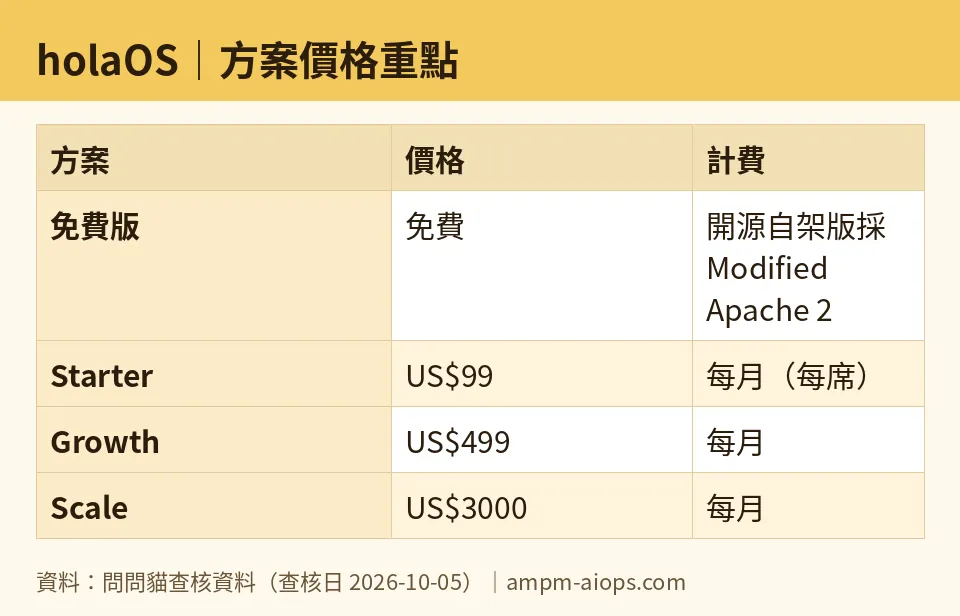
Figure: compiled by AMPM from its verified data (last verified 2026-10-05).
🔍 AMPM exclusive check
The gap we found isn’t a wrong number — it’s what the vendor page doesn’t spell out clearly. The Stripe Connect take rate (2% on Starter, 1% on Growth, 0% on Scale) sits in the fine print of each plan description, not in the headline pricing table. Anyone comparing holaOS by monthly fee alone — US$99 vs. US$499 vs. US$3,000+ — would miss that the real cost difference includes a shrinking commission on revenue you process through the platform, which only matters if your use case involves collecting customer payments. For anyone not collecting payments through holaOS, this entire axis is moot, and only the seat price and credit allotment matter.
Separately, we confirmed the free tier has no disclosed quota. Both the open-source self-hosted version (“Free to run, yours to change”) and the desktop version (“free to start”) avoid stating a specific number of free credits, requests, or days. That’s not a discrepancy with the official page — it’s consistent with it. We’re flagging it because it means you can’t plan usage against the free tier the way you could with a tool that states “X free credits per month.” As of this check (2026-10-05), every number above matches the official pricing page; the only thing missing is a number the vendor itself hasn’t published.
☀️ AMO, the budget-minded cat

If you’re watching every dollar, start with the free, self-hosted version — it costs nothing beyond whatever your own AI API key charges, since it’s BYOK. The catch is you won’t know your real ongoing cost until you’ve run it a while, because holaOS doesn’t publish a free quota number to budget against. The desktop “free to start” option has the same blind spot.
Once you’re looking at paid plans, Starter’s US$99 per seat per month for a single seat and about 500 credits is a steep entry price if you’re not going to use most of those credits. Jumping to Growth at US$499 a month for up to five seats and about 6,000 credits only makes sense if you actually need multiple seats — otherwise you’re paying for headroom you won’t use. The one genuinely low-risk move is Growth’s first-7-days-free trial: it costs nothing to test whether the extra seats, custom domain, and Slack/email channels justify the US$499 price before committing. Scale, starting at “US$3,000+” and requiring a sales conversation, is out of range for anyone budget-conscious — it’s built for a different kind of buyer. My bottom line: try the free self-hosted route first, and only pay once you’ve found a specific feature (seats, credits, or the lower take rate) you actually need.
🌙 PIMI, the performance-minded cat

The technical story here is more interesting than the price tags. holaOS is local-first and open source, which means you control where your data and agent logic actually run — no forced cloud dependency for the self-hosted version. It also connects to Claude Code, Codex, and over 100 other integrations, which matters if you already have an AI tooling stack and don’t want to rebuild it inside a closed platform.
Where it gets serious is the credit scaling: 500 credits on Starter, roughly 6,000 on Growth, and about 25,000 on Scale. That’s a big jump in raw capacity as you move up, and it tells you holaOS expects heavier, more automated workloads at the higher tiers — this isn’t a tool meant to be run at Starter level for anything beyond light testing. The declining take rate (2% → 1% → 0%) also signals who Scale is built for: teams running agents that actually process customer payments at volume, where even 1% starts to bite. At that point, a negotiated US$3,000+ monthly deal with zero commission can work out cheaper than staying on a lower tier and bleeding a percentage on every transaction. For performance-focused teams, the real question isn’t “does it run fast” — the data here doesn’t cover latency or benchmarks — it’s “does the integration breadth and credit ceiling match my workload,” and on paper, the three-tier credit jump suggests holaOS is built to scale with usage rather than cap it artificially.
Verdict: who should use it, who should skip it
holaOS fits two kinds of users well: developers who want a free, open-source, local-first agent tool they can bend to their own workflow with BYOK, and teams planning to run a commercial product on top of it — where Growth or Scale’s lower take rate pays for itself once transaction volume grows. It’s a weaker fit for anyone expecting a clearly bounded free tier, since the vendor doesn’t publish one, or anyone who’d pay US$99 for Starter without using most of its 500 credits or seat. Skip the paid tiers entirely if you’re not collecting customer payments through the platform and don’t need more than one seat — the open-source version covers that case for free. If you are collecting payments at scale, run the numbers on your own transaction volume against the 2%/1%/0% take rates before picking a tier, since that’s the cost line the pricing page doesn’t put front and center.
Written: 2026-10-08 Price last verified: 2026-10-05 Tool last health-checked: 2026-10-07
🔗 Related on AMPM
📎 Sources
All prices and quotas in this article come from AMPM’s verified dataset for holaOS (last verified 2026-10-05); primary sources:
🐾 Meet the cats: AMO and PIMI

AMPM is a Taiwan-based AI-tool pricing watchdog. Our motto: ask before you subscribe. Two cats argue every tool from two sides:
- ☀️ AMO — the budget-minded cat. Always asks: is the free tier enough, and is paying actually worth it?
- 🌙 PIMI — the performance-minded cat. Cares about whether it works well, fast, and gets your job done.

When they are done arguing, you know whether to pay. Every number is checked by us, with the verification date at the end.
🐾 Our sister sites also checked
Let's take a look at these
- holaOS Comprehensive Introduction: Pricing, Features, and Actual Limitations
- holaOS Is the free quota enough?
- holaOS Alternatives
- Comprehensive Free Quota List for All Tools