[How-to] Kagi Free vs Paid: How to Spend the Trial Before You Commit
- Free tier: No
- Cheapest paid plan: US$5/mo and up
- Free quota: No long‑term free version; provides a free trial quota of a total of …
- Last checked: 2026-10-23
Article last updated: 2026-10-25


Most search engines are free and sell your attention to advertisers. Kagi does the opposite: no ads, no tracking, and you pay for it. There is no permanent free version. What Kagi gives you instead is a free trial with a fixed allowance — and once that runs out, you either subscribe or walk away.
That makes the trial the whole decision. If you burn through it on idle searches, you learn nothing. If you use it deliberately, you’ll know within a week whether a paid search engine belongs in your life. This guide shows a first-time user how to get productive, what the trial can and can’t do, and which plan to pick if you decide to stay.
Start here: what the free trial actually gets you
When you sign up, Kagi gives you a trial allowance of 100 searches and 100 standard-model AI interactions. “Standard model” means Kagi’s default AI, not the premium one — more on that split later. An “AI interaction” is one question-and-answer exchange with Kagi’s built-in assistant, which is a chatbot that replies in plain prose instead of a list of links.
The number that trips people up: this allowance is cumulative, not monthly. It is a one-time pool of 100 searches total, across the entire life of the free account. It does not reset at the start of each month. When you’ve used your 100 searches, the free ride is over — there’s no rolling free tier waiting underneath.
So treat those 100 searches as a test budget, not a free plan. Spend them on the searches you actually do in a normal week: the work lookups, the shopping comparisons, the “how do I fix this” questions. That’s the only honest way to find out whether ad-free results are worth money to you.
One housekeeping note before you start: prices vary by country, and we checked these from Taiwan. The US dollar figures below are the ones Kagi lists; use those as your reference.
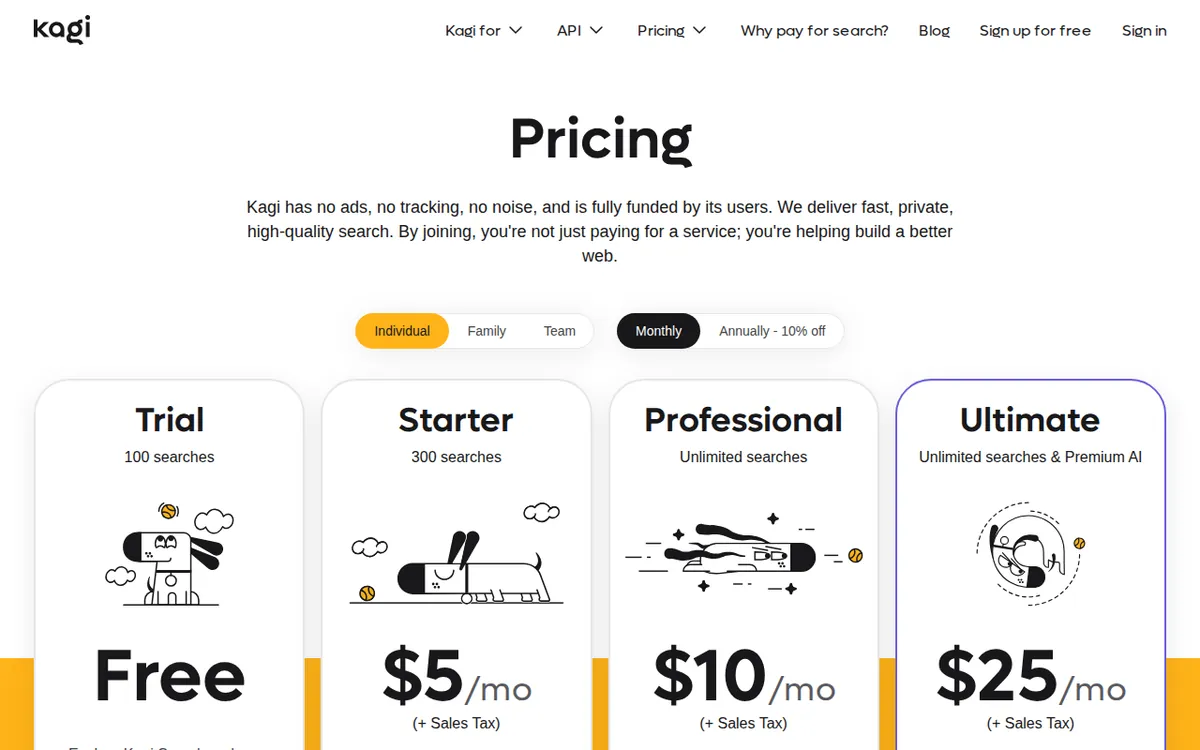
Figure: kagi.com official pricing page, captured 2026-10-25.
A beginner’s first week with Kagi
Here’s a concrete way to make the trial tell you something.
Set Kagi as a search option, not your only one. Add it as a search engine in your browser so you can fire a query at it quickly, but keep your old engine too. You want to compare, and you don’t want to panic-ration your 100 searches on day one.
Run your real searches through it. For a few days, send your genuine questions to Kagi first. Notice two things: whether the top results are what you wanted without scrolling past ads, and whether the lack of tracking changes how the results feel. This is the core product. If plain search doesn’t win you over, nothing else will.
Try the assistant on something specific. Ask the AI assistant a question you’d normally type into a chatbot — summarize a long article, draft a reply, explain a concept. Each exchange draws from your 100 AI interactions, so pick questions that matter. On the trial you’re using the standard model, so judge it on that basis, not on the premium models you haven’t unlocked yet.
Watch your counter. Because the allowance is a fixed pool, keep a rough tally of how fast you’re spending it. If you blow through 40 searches in two days of casual browsing, that tells you something real about how heavily you’d lean on a paid plan — and which plan you’d need.
By the end, you’ll have a number in your head: roughly how many searches a month you do, and whether you ever hit the assistant hard enough to care about the AI side.
Which paid plan fits — and the traps
Kagi lists five paid plans. Here’s how to read them against what your trial just taught you.
Starter — US$5/month. You get 300 searches a month and 300 standard-model AI Assistant interactions, in the clean ad-free, no-tracking environment. The trap here is the cap. “300 searches” sounds like a lot until you remember that a single research session can eat a dozen. If your trial showed you doing heavy daily searching, Starter will feel tight, and hitting a wall on a paid plan is a worse feeling than hitting one on a free trial.
Professional — US$10/month. This is Kagi’s most popular plan, and the reason is simple: unlimited searches. No counting, no rationing. It also includes the standard Kagi Assistant and Kagi Summarize, a feature that condenses a web page down to its key points. For most people who decided they liked the trial, this is the plan — the one where Kagi stops being a thing you meter and becomes your default search.
Ultimate — US$25/month. Everything in Professional, plus the parts power users ask about. This is where you unlock the flagship models — the latest versions of Claude and GPT, the premium AI rather than the standard one you tested on the trial. It also adds Research mode, a deep multi-step research tool that chases a question across sources instead of answering in one shot, and a best-quality translation mode. If your trial made you want to run the assistant as a serious work tool, this is the tier that matters. If you mostly wanted clean search, it’s overkill.
Duo — US$14/month. Two separate Professional accounts, one for each person. Paid annually it works out to US$12.60/month. Worth doing the math: two solo Professional plans at US$10 each is more than Duo, so if you and one other person both want the unlimited-search plan, Duo is the cheaper route.
Family — US$20/month. Up to six members, each with Professional features. Annually it comes to US$18/month. For a household of even three or four regular searchers, this undercuts buying individual plans by a wide margin.
The common beginner mistake is reaching straight for Ultimate because it has the most features. Don’t. The trial runs on the standard model, so you’ve never actually needed the flagship ones yet. Start at the tier that matches what you used — Professional for unlimited search, Ultimate only if you genuinely leaned on the AI assistant and wanted better than the standard model gave you.
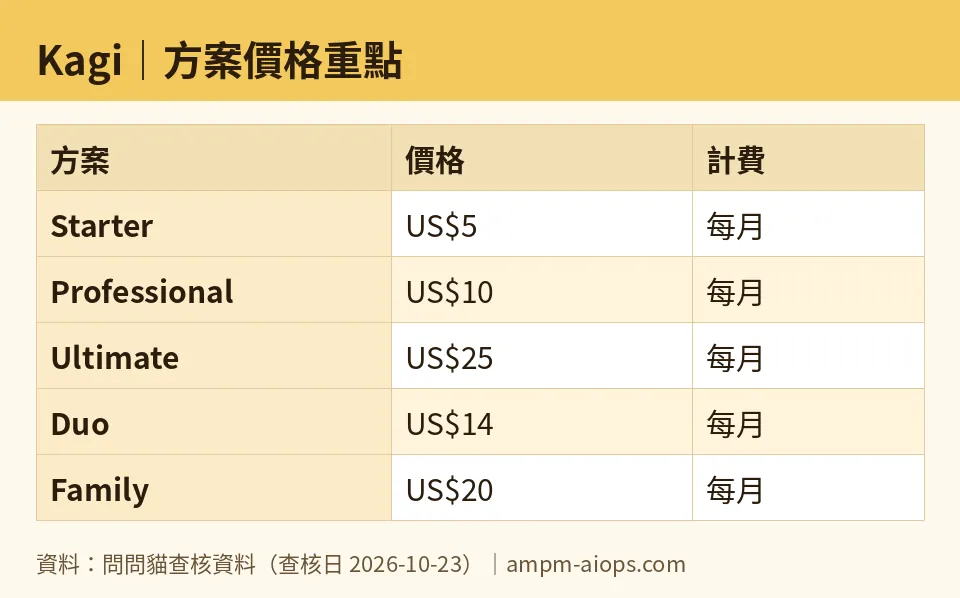
Figure: compiled by AMPM from its verified data (last verified 2026-10-23).
🔍 AMPM exclusive check
Two things the pricing page doesn’t put in bold, and one honesty note.

Illustration: The trial behaves like a sealed glass reservoir that empties permanently once used, without any recurring monthly refill.
First, the trial allowance is cumulative and one-time — 100 searches and 100 standard-model AI interactions for the lifetime of the free account, not a monthly refill. The vendor describes it as a free trial; what it doesn’t spell out plainly is that there’s no standing free tier underneath. When the pool is gone, it’s gone. Plan your 100 searches as a one-shot test, not a recurring freebie.
Second, there’s a real split between “standard” and “flagship” AI models across the plans. Your trial and the Starter and Professional plans run the standard model. The latest Claude and GPT models are gated behind Ultimate. So the assistant you evaluate on the free trial is not the assistant you get if you later pay for Ultimate — judge the trial on standard-model quality and don’t assume the premium is the same thing, only more.
The honesty note: this is a first-pass verification on our side. Kagi came in as an auto-added challenger tool, and we’ve checked the numbers once, not run them through our usual three-way manual cross-check yet. Everything above matches what Kagi’s own site showed on 2026-10-23. For free-trial limits and any business or commercial terms, confirm against the live pricing page before you pay, because those are exactly the details a vendor can change quietly.
Verdict: who should use it, who should skip it
Use the free trial if you’ve ever been annoyed by ad-stuffed, SEO-gamed search results and wondered what a clean engine feels like. That’s the whole pitch, and 100 real searches is enough to answer it.
Pay for Professional at US$10/month if the trial sold you on the search itself and you want to stop counting — unlimited search plus the Summarize tool is the plan most people land on. Step up to Ultimate at US$25/month only if you found yourself using the AI assistant as a daily work tool and want the flagship models and Research mode. Pick Duo or Family if more than one person at home will use it — the shared pricing beats stacking individual plans.
Skip Kagi if your searching is light and occasional. Starter’s US$5/month buys you 300 searches, but if you’re a casual searcher, free ad-supported engines already do the job and the privacy upgrade may not be worth a monthly bill. And skip it entirely if paying for search is a line you’re not willing to cross — Kagi will never be free, and there’s no shame in deciding that’s not for you.
The trial costs you nothing but attention. Spend it on your real searches, watch the counter, and let the number decide.
Written: 2026-10-25 Price last verified: 2026-10-23 Tool last health-checked: 2026-10-25
🔗 Related on AMPM
📎 Sources
All prices and quotas in this article come from AMPM’s verified dataset for Kagi (last verified 2026-10-23); primary sources:
🐾 Meet the cats: AMO and PIMI

AMPM is a Taiwan-based AI-tool pricing watchdog. Our motto: ask before you subscribe. Two cats argue every tool from two sides:
- ☀️ AMO — the budget-minded cat. Always asks: is the free tier enough, and is paying actually worth it?
- 🌙 PIMI — the performance-minded cat. Cares about whether it works well, fast, and gets your job done.

When they are done arguing, you know whether to pay. Every number is checked by us, with the verification date at the end.
🐾 Our sister sites also checked
Read next
- Kagi Full breakdown: pricing, features and real-world limits
- Kagi Is the free quota enough?
- Kagi Alternatives
- Free plan limits for every AI tool we track