[News] Manus Pricing: Team Plan Is Here — But Did Anything Actually Change?
- Free tier: There is
- Cheapest paid plan: US$20/mo and up
- Free quota: 300 credits per day (reset every 24 hours), supports Chat mode and …
- Last checked: 2026-10-03
Article last updated: 2026-10-15



Manus just put out a blog post announcing its new Team Plan and Enterprise Plan, pitched as the moment any company can go “AI-native” without hiring a pile of engineers. Read past the launch language, though, and the headline number for the Team Plan — US$20 per paid seat per month — is the same figure that’s been sitting on Manus’s pricing page for weeks. What actually shipped this week isn’t a price change. It’s a set of team-management tools built around a price that was already live.
That distinction matters if you’re deciding whether to upgrade. Here’s what moved, what didn’t, and what it means for your account.
What Manus Actually Added This Week
The new pieces are collaboration and governance features, not new price tiers. A “Project” feature now lets a team share instructions, files, and connector settings, so a scheduled task — say, a weekly report that runs automatically — keeps the same context every time instead of being rebuilt from scratch. Teams can also share custom “Skills” (saved task templates), and admins can enforce specific workflows so everyone on the team follows the same process.
On permissions, Manus added a real boundary: paid seats can be set to “team-only visible” to keep internal work private, while a separate Guest seat — which costs nothing — lets outside collaborators view shared work and leave comments without needing a paid account at all. Credits (the point system Manus charges against every task) across all paid seats on a team now pool into one balance, tracked on a central usage dashboard, and admins can top up credits whenever they want instead of waiting for a monthly reset.
For larger organizations, Manus added role management, audit logs, single sign-on (SSO, meaning employees log in with their company identity instead of a separate Manus password), and SCIM (automated user provisioning). It’s also promising that model vendors won’t train on customer data, backed by SOC 2 Type II, ISO 27001, and ISO 27701 certifications. Anything beyond the Team Plan — legal hold, SIEM log integration (security log monitoring), or controls over which agents can talk to which systems — sits in the Enterprise Plan, which isn’t self-serve; you have to contact sales for that one.
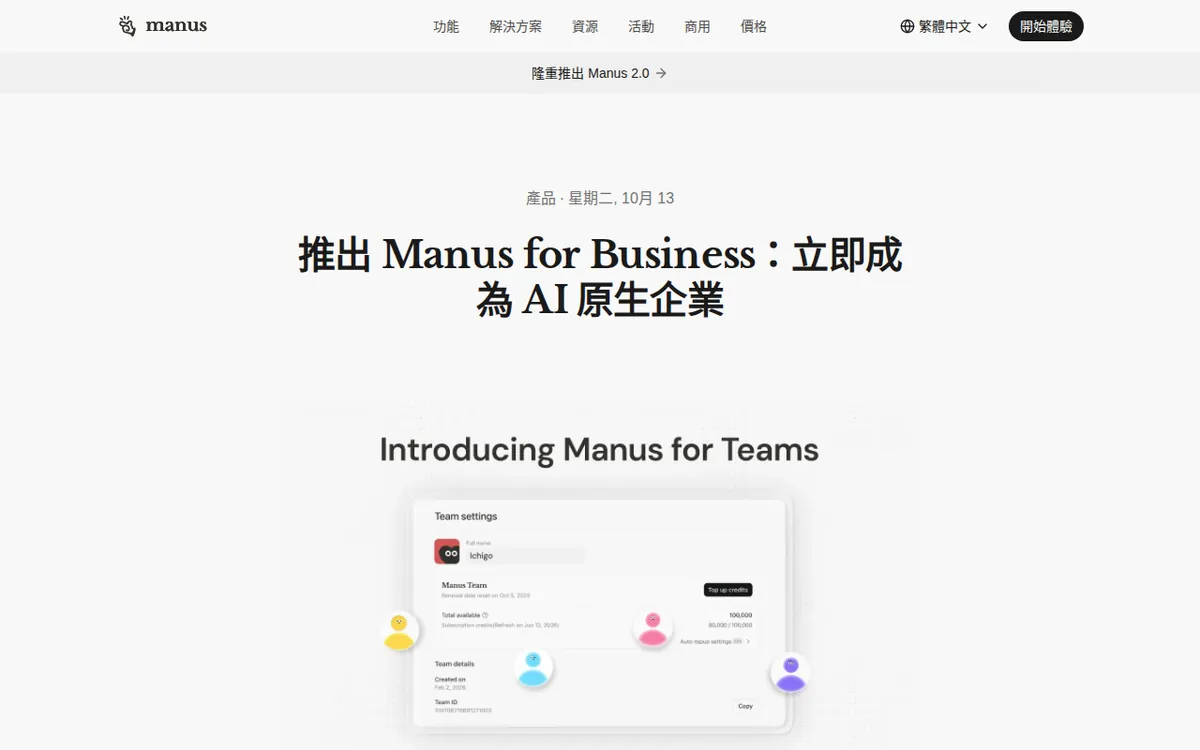
Figure: manus.im official pricing page, captured 2026-10-15.
The Numbers That Didn’t Move
If you’re already a free or solo-paid Manus user, none of this touches your account. The free tier is unchanged: 300 credits per day, resetting every 24 hours, usable in Chat mode or Agent mode (running on Manus 1.6 Lite), with exactly 1 task allowed to run at a time and zero scheduled tasks. New signups still get a one-time bonus of 1,000 starter credits on top of that.
The three individual paid plans are also unchanged. Basic is US$20 a month for 4,000 credits plus a 300-credit daily top-up. Starter is US$40 a month for 8,000 credits with usage you can customize. Pro is US$200 a month for 40,000 credits, and it’s the only individual plan that throws in a free Cloud Computer. All three unlock 20 concurrent tasks and 20 scheduled tasks — a big jump from the free tier’s 1 and 0 — which is worth noticing since it’s not spelled out in the big comparison numbers most people skim.
What a Seat Actually Buys You
The Team Plan itself: US$20 per paid seat per month, or US$200 per seat per year, each seat starting with 4,000 credits that can scale up as the team needs. Guest seats are free and don’t count toward the paid total. Manus’s own help center separately notes that annual billing saves 17% compared to paying monthly — which lines up with the US$20-a-month versus US$200-a-year figures in this announcement, though we’re reporting both numbers as published rather than doing that math ourselves.
So a five-person team paying for Team seats is really buying: pooled credits instead of five separate credit buckets, a shared Project workspace so scheduled tasks don’t lose context between runs, shared Skills templates, admin-enforced workflows, and the option to bring in unlimited unpaid Guests to review and comment on work. That’s the actual upgrade. The credit allowance per seat (4,000) is identical to what a solo Basic subscriber already gets for US$20 a month.
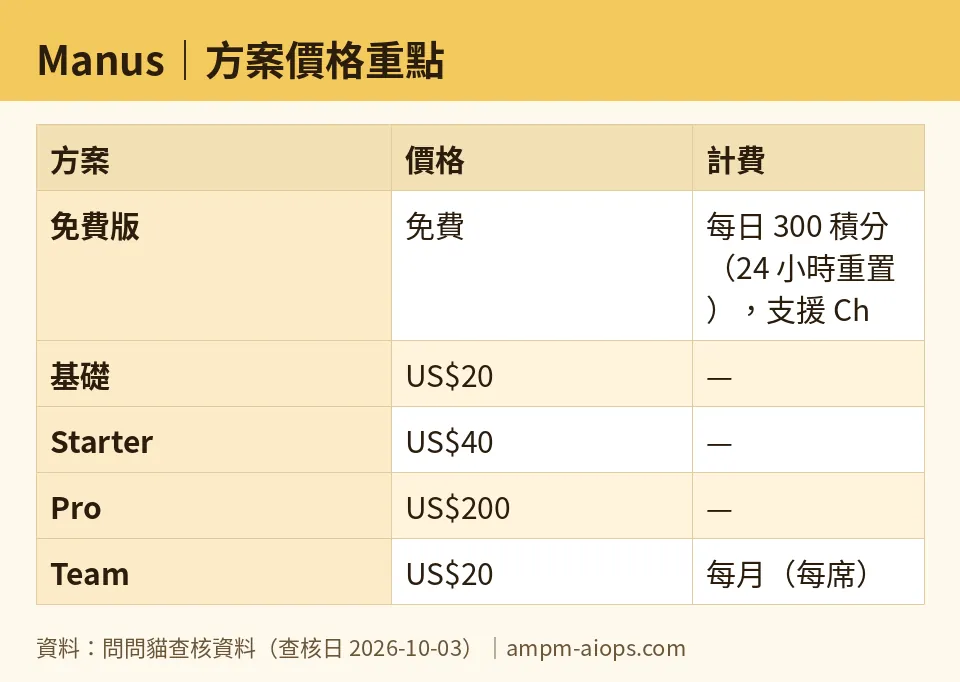
Figure: compiled by AMPM from its verified data (last verified 2026-10-03).
🔍 AMPM exclusive check
We cross-checked this announcement against our own pricing records for Manus, which we’ve re-verified four times since early August (2026-08-09, 2026-09-08, 2026-09-24, and 2026-10-03) — all four checks found the same numbers, with no price movement. That matters here specifically: Manus’s own blog post frames the Team Plan as something that just “launched,” but the US$20-per-seat-per-month price, and the 17% annual discount, were already documented on Manus’s official help center page before this announcement went out. The blog post is formalizing and bundling features around a price point that was quietly already live — it’s a product-and-governance update dressed as a launch, not a new price tier.
The other thing the vendor’s own comparison page doesn’t make obvious: the gap between the free tier and every paid tier on concurrency isn’t a minor detail. Free users get exactly 1 task running at a time and 0 scheduled tasks. The moment you pay for anything — even the cheapest US$20 Basic plan — that jumps to 20 concurrent and 20 scheduled tasks. If you’re a free user running into a wall with task queuing, that’s the number actually blocking you, more so than running out of credits.
☀️ AMO, the budget-minded cat

AMO ran the math a free user actually feels. 300 credits reset every day, and Manus’s own guidance is that a mid-size task — something research-report-level — burns anywhere from a few hundred to around a thousand credits. That means a free account’s entire daily allowance covers roughly one small task before you’re waiting for tomorrow’s reset. The 1,000-credit one-time bonus for new signups buys you a little runway in week one, but it’s a one-time thing, not a recurring cushion.
For a solo user doing occasional light tasks — one report, one slide deck, once in a while — free is genuinely enough, especially since the only hard cap beyond credits is running 1 task at a time, which doesn’t matter if you’re not multitasking. But the moment you need more than one task running, or anything scheduled to repeat automatically, free stops being an option entirely: it’s 0 scheduled tasks, full stop. That’s when Basic’s US$20/month — 4,000 credits plus a 300-credit daily top-up, 20 concurrent and 20 scheduled tasks — starts paying for itself, not because the credits are dramatically bigger, but because the task limits that free blocks you on simply disappear. AMO’s take: don’t upgrade for credits alone; upgrade when you hit the concurrency or scheduling wall, because that’s the real gate, not the daily point count.
Verdict: who should use it, who should skip it
If you’re on a free Manus account doing occasional one-off tasks, this announcement changes nothing for you — stay put. If you’re already paying for Basic, Starter, or Pro solo, your price and credits are untouched; this is simply not aimed at you unless you’re about to add teammates. If you’re assembling a small team and want shared context across repeated tasks, pooled credits, and a cheap way to let outside reviewers see work without buying them a seat, the Team Plan at US$20 per seat per month is worth a look — the price was already there, but the tooling around it just got genuinely more useful. If you need legal hold, SIEM integration, or control over agent-to-agent network access, skip Team and go straight to sales for Enterprise — those features aren’t in the self-serve plan at any price.
Written: 2026-10-15 Price last verified: 2026-10-03 Tool last health-checked: 2026-10-15
🔗 Related on AMPM
📎 Sources
All prices and quotas in this article come from AMPM’s verified dataset for Manus (last verified 2026-10-03); primary sources:
🐾 Meet the cats: AMO and PIMI

AMPM is a Taiwan-based AI-tool pricing watchdog. Our motto: ask before you subscribe. Two cats argue every tool from two sides:
- ☀️ AMO — the budget-minded cat. Always asks: is the free tier enough, and is paying actually worth it?
- 🌙 PIMI — the performance-minded cat. Cares about whether it works well, fast, and gets your job done.

When they are done arguing, you know whether to pay. Every number is checked by us, with the verification date at the end.
🐾 Our sister sites also checked
Let's take a look at these
- Manus Comprehensive Introduction: Pricing, Features, and Actual Limitations
- Manus Is the free quota enough?
- Manus Alternatives
- Comprehensive Free Quota List for All Tools
More verified articles on this tool
- [Review] Manus Pricing and Free Tier Limits: How Far the Daily Credits Go, and Which Plan Fits
- [Verified] Manus free tier lasts longer than you'd think—if you work small, and you work alone