Ask Cat › AI Tool Summary › Manus
[Review] Manus Pricing and Free Tier Limits: 300 Credits a Day, Plans From US$20
- Free tier: There is
- Cheapest paid plan: US$20/mo and up
- Free quota: 300 credits per day (reset every 24 hours), supports Chat mode and …
- Last checked: 2026-10-03
Article last updated: 2026-10-07



Manus bills itself as a general-purpose AI agent — you hand it a task, like “build me a research report” or “turn this into a website,” and it runs the job on its own instead of answering turn by turn like a chatbot. Everything on Manus runs on credits: a usage currency you spend per task, not a flat monthly fee for unlimited use. That distinction matters more than the sticker price, because the question every reader actually types into a search bar is “Manus pricing free tier limits” — and the free tier limits are the part Manus doesn’t put front and center.
Here’s the plain version: free users get 300 credits a day, reset every 24 hours, plus a one-time 1,000-credit bonus when they sign up. Paid plans start at US$20 a month. Everything past that depends on how many credits your tasks actually burn, and that’s where this review digs in.
What 300 credits a day actually gets you
The free tier isn’t a stripped-down demo — it includes Chat mode and Agent mode (running on Manus 1.6 Lite), in-depth research, website generation, slide creation, and even early access to beta features. On paper, that’s a generous free tier for a product with “agent” in its pitch.
The catch is concurrency and scheduling, not features. Free accounts are capped at 1 task running at a time. Paid plans — Basic, Starter, and Pro — all list 20 concurrent tasks. Scheduled tasks, meaning jobs you set to run automatically on a timer instead of triggering by hand, are listed as 20 on every paid tier and simply absent from the free tier’s feature list. If you want Manus to run things on a schedule, free won’t do it.
The daily 300-credit allowance resets every 24 hours, so unused credits don’t roll over into a stockpile. According to Manus’s own credit example, a single mid-sized task — something like a research report — can cost anywhere from a few hundred to over a thousand credits. That means a free account’s daily allowance is realistically good for about one modest task a day, not a parallel workflow.

Figure: manus.im official pricing page, captured 2026-10-07.
Four paid tiers, one credit system
Manus sells four paid plans, and the jump between them is steep:
- Basic — US$20/month for 4,000 credits a month, plus the same 300 daily refresh credits free users get. Includes 20 concurrent and 20 scheduled tasks, plus beta access.
- Starter — US$40/month for 8,000 credits a month, pitched as letting you “self-set” your usage pattern. Same 20/20 task limits.
- Pro — US$200/month for 40,000 credits a month. This is the only tier that throws in a free Cloud Computer (a bundled cloud workspace included at no extra cost), plus support for heavier, sustained Wide Research use and batch slide production.
- Team — starts at US$20 per seat per month (a “seat” is one paid user license within a team account), billed monthly, with annual billing cutting the price by 17% according to Manus’s own help center. Manus doesn’t publish a flat team-wide credit number for this plan on the pricing data we have — it’s a per-seat structure, not a shared pool with one price tag.
The Basic plan sits oddly close to the free tier: you’re paying US$20/month for 4,000 bonus monthly credits on top of the same 300/day free users already get, plus the concurrency and scheduling unlock. That’s the real product you’re buying at the entry price — not more daily credits, but the ability to run tasks in parallel and on autopilot.
What a credit actually buys
Credits are Manus’s internal unit of compute spent per task — think of them like a prepaid card balance that drains as the agent works, rather than a subscription seat. Manus’s own guidance says a single “research report level” task can run from a few hundred to over a thousand credits. That’s a wide range, and Manus doesn’t publish a fixed credit cost per task type — it depends on complexity, how much browsing or data analysis the agent does, and how long the task runs.
Do the math on Pro’s 40,000 monthly credits against that range: if a heavy task eats 1,000+ credits, even the top consumer plan caps out somewhere between a few dozen and low hundreds of serious tasks a month. This is not a “set it and forget it” unlimited-use tool at any price point Manus sells.
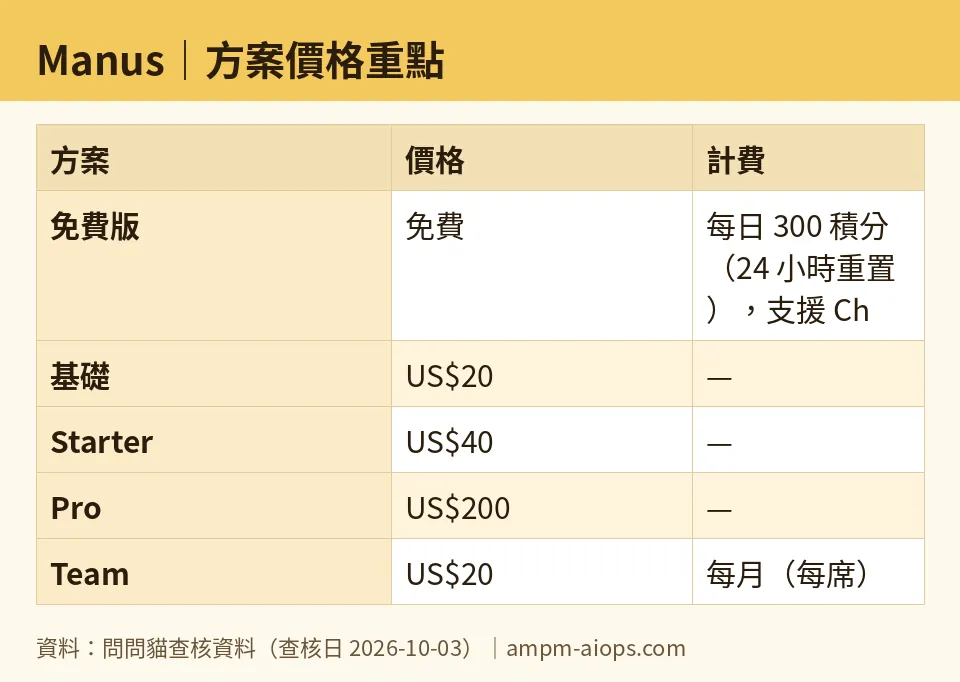
Figure: compiled by AMPM from its verified data (last verified 2026-10-03).
🔍 AMPM exclusive check
Manus’s pricing page lists concurrent-task and scheduled-task counts for every paid plan — 20 and 20, consistently. What the pricing page doesn’t spell out clearly is the free tier’s side of that same table: our check of the free account confirms it’s capped at 1 concurrent task and lists no scheduled-task allowance at all, versus the 20/20 every paid tier gets. The vendor page presents this as a feature list per paid plan rather than a direct free-vs-paid comparison, so the actual size of the gap — 1 task versus 20, and zero scheduling versus full scheduling — is easy to miss unless you read the free tier’s feature list side by side with the paid ones, which is what we did. Every credit and dollar figure in this piece otherwise matches the official pricing page as of 2026-10-03.
☀️ AMO, the budget-minded cat

I ran the free numbers and here’s my take: 300 credits a day, reset every 24 hours, is enough to get a feel for Manus without paying anything. New users also get a one-time 1,000-credit bonus on top, which is a decent trial cushion. If your use case is one small task a day — draft a short piece of research, generate one slide deck, test a simple website build — free might genuinely cover you indefinitely, since the 300-credit refresh never runs out as a program, only daily.
Where free breaks down is the moment you want more than one thing running, or you want Manus to run on a schedule instead of you clicking “go” every day. Free gives you 1 concurrent task and 0 scheduled tasks — full stop. That’s not a soft limit you can work around; it’s a hard wall built into the account tier.
Is Basic at US$20/month worth crossing that wall for? Only if concurrency or scheduling is the actual blocker. You’re not buying more credits in any meaningful sense — 4,000 a month plus the same 300/day refresh isn’t a huge jump in raw task volume if your tasks run in the hundreds-of-credits range per Manus’s own example. You’re buying the unlock for 20 concurrent and 20 scheduled tasks. If you only ever need one task at a time, done manually, save your US$20 and stay free.
🌙 PIMI, the performance-minded cat

Forget the free tier — I want to know if Manus can actually do the work, and the credit system tells a clear story about capacity, not just cost. A research-report-level task running “a few hundred to over a thousand credits” per Manus’s own documentation means heavier jobs are expensive in the plan’s own currency, not just slow. That’s the real signal: this tool is built for substantial multi-step agent work, not quick one-line prompts, and it prices accordingly.
Pro at US$200/month for 40,000 credits is where performance-focused users actually belong. It’s the only tier with a free Cloud Computer bundled in, it’s built for “large-scale” deep research and batch slide production rather than one-off jobs, and it’s explicitly positioned for “continued heavy use” of Wide Research, Manus’s task-scaling feature. That phrase — continued heavy use — tells me Manus itself doesn’t expect Starter or Basic users to run this hard.
The 20 concurrent / 20 scheduled task ceiling is identical across Basic, Starter, and Pro, which is worth knowing before you pay more than US$20 just for throughput: raising your plan from Basic to Pro doesn’t raise your concurrency ceiling at all. It buys you more monthly credits (40,000 versus 4,000) and the Cloud Computer. If your bottleneck is running more things at once rather than running bigger things, Basic already gives you the same 20-task ceiling Pro does — you’d be paying 10x for credit volume, not parallelism.
Verdict: who should use it, who should skip it
Three things are genuinely annoying about Manus pricing. First, the free tier’s task limits — 1 concurrent, 0 scheduled — aren’t stated as plainly as the credit allowance is, so you don’t learn about them until you try to run a second task or set up a recurring one. Second, the credit cost per task is a range (“a few hundred to over a thousand”), not a fixed number, which makes it hard to predict your actual monthly bill before you commit to a plan. Third, the Basic plan’s jump from free is modest in raw credits (4,000/month plus the same daily 300 you already had) — the real upgrade is unlocking concurrency and scheduling, not getting dramatically more to spend.
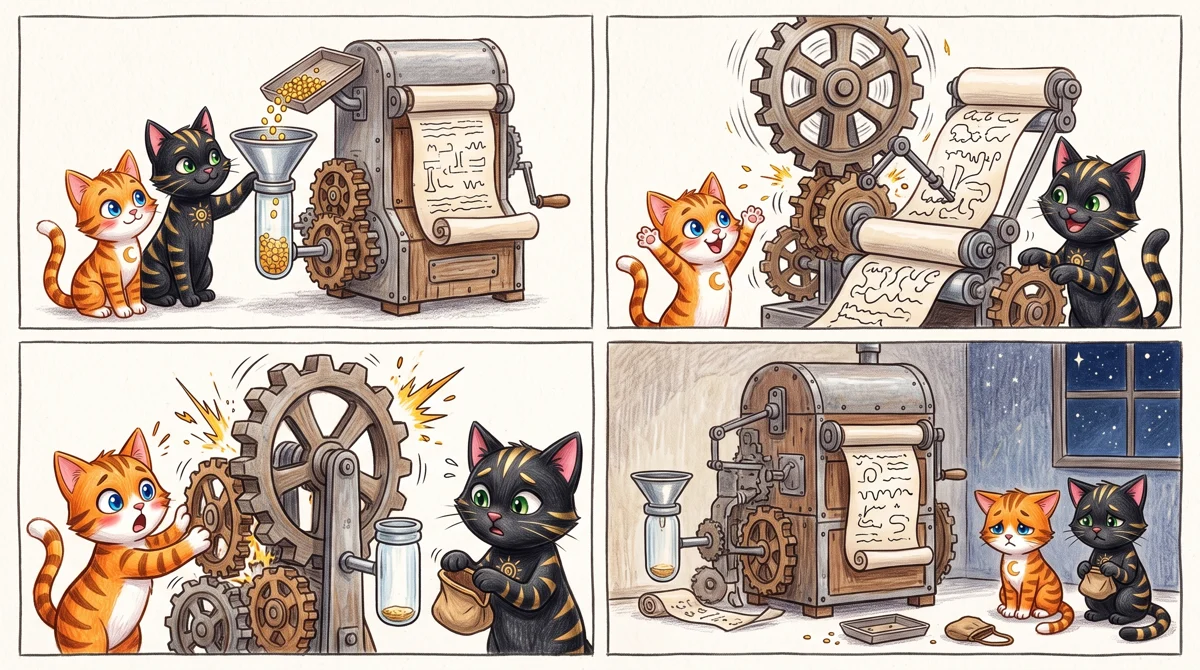
Illustration: A complex research task grinds to a dead stop when the small daily fuel supply empties halfway through.
What Manus does well, based on the numbers here: the free tier is unusually feature-complete for an agent product — in-depth research, website builds, slide generation, and beta access are all included free, just rate-limited by credits and concurrency rather than walled off entirely. And the Team plan’s 17% annual-billing discount, confirmed via Manus’s own help center, is a real saving for anyone already committed to multi-seat use.
Use the free tier if you run one task a day and don’t need scheduling — it won’t cost you anything and the daily reset means you’re never truly locked out. Step up to Basic only when concurrency or scheduled automation is the actual thing blocking you, not because you think you need more credits. Go straight to Pro if your work is large-scale, repeated, or credit-hungry — Basic and Starter share Pro’s same 20-task ceiling, so Pro’s real value is the 40,000-credit pool and the bundled Cloud Computer, not extra throughput. Skip Manus entirely if your workflow depends on predictable, fixed per-task costs — a credit system with a “few hundred to over a thousand” range per task is not that.
Written: 2026-10-07 Price last verified: 2026-10-03 Tool last health-checked: 2026-10-07
🔗 Related on AMPM
📎 Sources
All prices and quotas in this article come from AMPM’s verified dataset for Manus (last verified 2026-10-03); primary sources:
🐾 Meet the cats: AMO and PIMI

AMPM is a Taiwan-based AI-tool pricing watchdog. Our motto: ask before you subscribe. Two cats argue every tool from two sides:
- ☀️ AMO — the budget-minded cat. Always asks: is the free tier enough, and is paying actually worth it?
- 🌙 PIMI — the performance-minded cat. Cares about whether it works well, fast, and gets your job done.

When they are done arguing, you know whether to pay. Every number is checked by us, with the verification date at the end.
🐾 Our sister sites also checked
Let's take a look at these
- Manus Comprehensive Introduction: Pricing, Features, and Actual Limitations
- Manus Is the free quota enough?
- Manus Alternatives
- Comprehensive Free Quota List for All Tools