Ask Cat › AI Tool Summary › Mistral AI
[Review] Mistral AI Pricing Check: Large 3 Runs US$0.5/US$1.5 per Million Tokens, Small 4 Dropped to US$0.15/US$0.6
- Free tier: There is
- Cheapest paid plan: US$14.99/mo and up
- Free quota: About 25 messages per day: Mistral Vibe's free tier has a limited …
- Last checked: 2026-09-27
Article last updated: 2026-10-04



Mistral AI is the French lab that keeps undercutting OpenAI and Anthropic on price while still shipping open-weight models. We checked its current pricing — both the consumer chat app and the raw API that developers pay per token for — and the numbers moved since our last check. This piece is about whether that pricing still makes Mistral worth using, not just cheap.
An API, if you haven’t dealt with one, is just a way for a developer’s own software to send text to Mistral’s models and get a response back, billed by usage instead of a flat monthly fee. “Tokens” are the chunks of text that usage is measured in — roughly a few characters each — and API prices here are quoted per 1 million tokens. That’s the unit everything below uses.
What the free tier actually gives you
Mistral’s consumer product is called Mistral Vibe. The free version caps you at roughly 25 messages a day, based on our check, but inside that quota you still get web search, code editing and execution, image generation, and access to Mistral’s 40+ third-party connectors. That’s a wider free feature set than it sounds — the limit is on volume (how many messages per day), not on which features are locked away. The catch: commercial use isn’t allowed on the free tier, and the daily cap resets you back to zero use once you hit it.
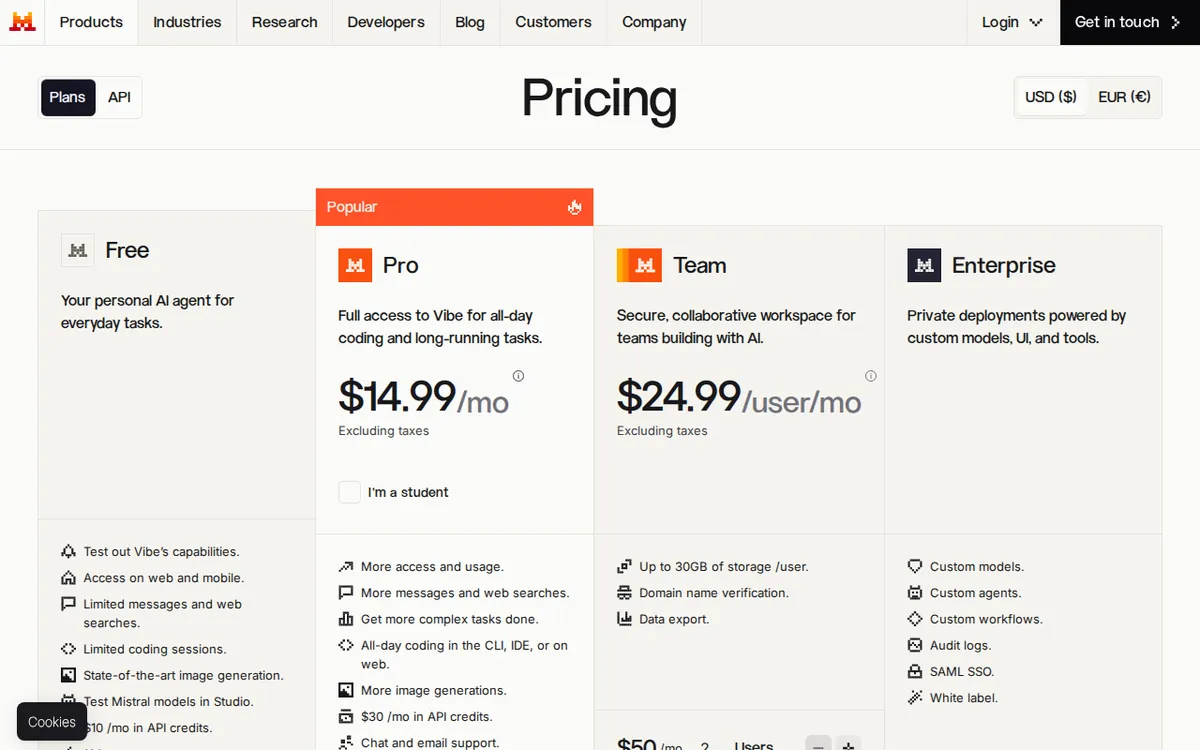
Figure: mistral.ai official pricing page, captured 2026-10-04.
The API price gap: Large 3 vs Small 4
This is where Mistral’s pricing actually changed. Mistral Large 3, the flagship reasoning model, now costs US$0.5 per 1 million input tokens and US$1.5 per 1 million output tokens. That’s a real drop from the prior generation, Mistral Large 2, which was priced at US$2 input / US$6 output — Large 3 is a quarter of that on input and output alike.
Mistral Small, the budget model meant for simple tasks like classification or routing short conversations, now runs US$0.15 per 1 million input tokens and US$0.60 per 1 million output tokens. That’s actually a small increase from the previous recorded price of US$0.14 input / US$0.42 output — the jump lines up with the model itself being upgraded to “Mistral Small 4.” Neither API tier has a rate limit; you just pay for what you use, with no monthly cap to bump into.
Chat plans: Pro, Team, and the student discount
Above the free Vibe tier sits Pro at US$14.99 a month, which unlocks all Mistral models, all-day code editing, advanced web search, a bigger monthly image-generation quota, the full connector list, chat and email support, and project folders (up to 1,000 of them). Team is US$24.99 per seat a month — “seat” just means per user account — with a US$50/month minimum, so it only makes sense once you have a handful of people on it. It adds up to 30GB of storage per user, domain verification, data export, and team management tools on top of everything in Pro. There’s also a verified-student Education plan at US$5.99 a month, a real discount off the normal US$14.99 Pro price, with the same feature set as Pro.
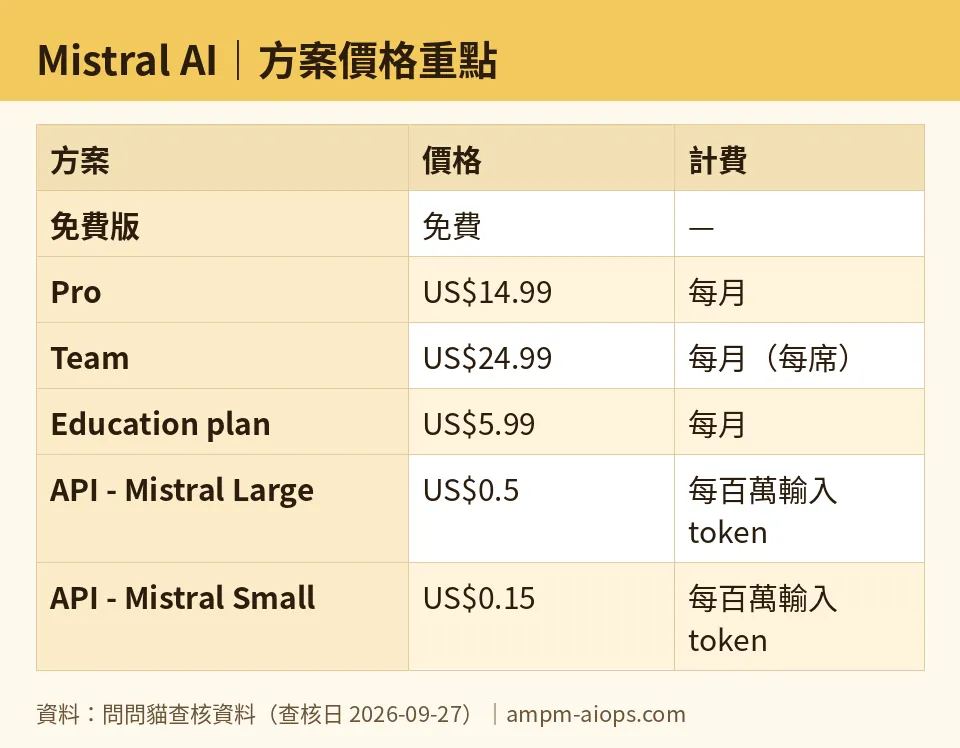
Figure: compiled by AMPM from its verified data (last verified 2026-09-27).
🔍 AMPM exclusive check
The vendor’s pricing page just shows today’s numbers — it doesn’t tell you what changed or why. We read mistral.ai/pricing directly in-browser on 2026-09-05 and cross-checked the figures against two independent third-party sources, developer.puter.com and a Hugging Face dataset, before accepting them. That comparison is what caught two things the official page alone wouldn’t flag:

Illustration: The flagship model quietly updated its generation, swapping the long costly bill for a vastly lighter one.
First, the Large model’s price drop isn’t a discount — it’s a generation change. The old US$2/US$6 figure in our records was for Mistral Large 2; the current US$0.5/US$1.5 pricing belongs to Mistral Large 3, a different, newer model. Anyone pricing out a project against an old quote would overestimate costs by 4x without realizing the model name underneath had changed.
Second, we re-checked the Small tier again on 2026-08-11 specifically because the price had moved, and confirmed the model itself had quietly become “Mistral Small 4” — the US$0.15/US$0.60 pricing is tied to that new version, not a markup on the old one. Both corrections are now reflected in the numbers above, last verified 2026-09-27.
☀️ AMO, the budget-minded cat

I only care about one thing: can I avoid paying, and if not, what’s the cheapest way in? The free Mistral Vibe tier gets you surprisingly far — web search, code execution, even image generation, all included, not gated behind a paywall. The only real constraint is the roughly 25-message daily cap, and you can’t use any of it commercially. For a student, hobbyist, or anyone testing whether Mistral’s models fit their workflow before committing money, that’s a real free option, not a crippled trial.
If you do need to pay, the API is where the budget math gets interesting. Mistral Small at US$0.15 input / US$0.60 output per million tokens is about as cheap as a usable model gets — fine for routing requests, tagging text, or short back-and-forth chat where you don’t need deep reasoning. Jumping to Large 3 at US$0.5/US$1.5 is still cheap in absolute terms, especially next to its own predecessor’s US$2/US$6 pricing, but it’s roughly 3x the input cost and 2.5x the output cost of Small. My rule: start on Small, and only pay the Large 3 premium when Small’s answers are visibly worse. The Pro subscription at US$14.99/month only earns its keep if you’re hitting that ~25-message daily wall regularly — otherwise you’re paying monthly for something the free tier already covers for occasional use.
🌙 PIMI, the performance-minded cat

Price is only interesting once I know the thing actually performs. What matters to me here is that Mistral didn’t just discount an aging model — it shipped Large 3 and Small 4, newer versions, and priced them lower (Large) or barely higher (Small) than what came before. A price cut on a genuinely newer model is a different signal than a price cut on stock clearance; it suggests Mistral is competing on capability, not just discounting what’s left on the shelf.
The no-rate-limit structure on both API tiers matters for anything latency-sensitive or bursty — you’re not going to get throttled mid-task the way some capped plans do; you just pay for throughput as you use it. For production work, Large 3’s US$0.5/US$1.5 per million tokens positions it as a serious option for complex reasoning and code generation without the cost of top-tier closed models, and Small 4 at US$0.15/US$0.60 is squarely built for high-volume, low-complexity jobs like classification where you’re calling the model constantly and can’t afford to pay reasoning-model prices for it.
Where I’d push back: the consumer-facing Vibe app’s daily message cap (~25) is going to feel tight fast if you’re actually testing the model’s output quality across many prompts in a session — that’s a UI constraint, not a model-quality one, and it’s the kind of limit that pushes serious evaluation straight to the API instead. The Team plan’s US$50/month floor also means small teams pay a premium per seat before they’ve even scaled to make per-seat pricing attractive.
Verdict: who should use it, who should skip it
Use Mistral’s API if you want current-generation models — Large 3 for reasoning-heavy work, Small 4 for high-volume simple tasks — at prices well under legacy competitors, with no rate-limit ceiling to plan around. Use the free Vibe tier if you’re exploring casually or need occasional chat, search, and code help without paying; the ~25-message daily cap is real but not crippling for light use. Skip Pro (US$14.99/month) unless you’re consistently hitting that free-tier cap, and skip Team (US$24.99/seat, US$50 minimum) unless you have enough users to make the per-seat math work. Skip the whole platform if you need commercial rights on the free tier — that’s not on offer at any price point below Pro.
Written: 2026-10-04 Price last verified: 2026-09-27 Tool last health-checked: 2026-10-04
🔗 Related on AMPM
📎 Sources
All prices and quotas in this article come from AMPM’s verified dataset for Mistral AI (last verified 2026-09-27); primary sources:
🐾 Meet the cats: AMO and PIMI

AMPM is a Taiwan-based AI-tool pricing watchdog. Our motto: ask before you subscribe. Two cats argue every tool from two sides:
- ☀️ AMO — the budget-minded cat. Always asks: is the free tier enough, and is paying actually worth it?
- 🌙 PIMI — the performance-minded cat. Cares about whether it works well, fast, and gets your job done.

When they are done arguing, you know whether to pay. Every number is checked by us, with the verification date at the end.
🐾 Our sister sites also checked
Let's take a look at these
- Mistral AI Comprehensive Introduction: Pricing, Features, and Actual Limitations
- Mistral AI Is the free quota enough?
- Mistral AI Alternatives
- Comprehensive Free Quota List for All Tools