Ask Cat › AI Tool Summary › Nano Banana
[Review] Nano Banana Pricing: The US$4.99 Plan Is a Permanent Cut, Not a Sale
- Free tier: There is
- Cheapest paid plan: US$4.99/mo and up
- Free quota: The free version of Gemini includes a small amount of Nano Banana …
- Last checked: 2026-10-07
Article last updated: 2026-10-07



Nano Banana is the Gemini image generator that went viral for keeping faces consistent across edits and handling photo retouching better than most rivals. We dug into its actual pricing pages, not just the marketing copy, and found one thing worth flagging before you make a buying decision: the US$4.99 price for Google AI Plus is not a limited-time discount. Google permanently cut it from US$7.99 to US$4.99 starting June 9, 2026, and the “50% off for your first two months” badge that used to sit next to new signups has been removed. If you were holding off because you assumed the low price would expire, it won’t — at least not on the schedule you might expect. This review covers what each tier actually gives you, where the official pricing page stays vague, and whether paying is worth it depending on how much you shoot.
What “Nano Banana Pro” actually means now
As of July 30, 2026, Google’s own site confirmed the formal name is “Nano Banana Pro,” with access split by subscription tier: Plus gets limited access, Pro gets more, and Ultra gets the highest or maximum access. That’s the extent of what Google states in writing. The specific generation caps — how many images you actually get per month on each plan — are not published anywhere on the official pricing page. Every number you’ll see about exact image counts, including ours below, comes from third-party estimation, not a Google-confirmed figure.
What Google does confirm are relative multipliers against the free tier’s quota. Free Gemini accounts get “a small allotment” of Nano Banana generations, undefined in exact units. From there:
- Google AI Plus (US$4.99/month): 2x the free tier’s image quota, plus 2TB of cloud storage and the ability to share the plan with up to 5 people.
- Google AI Pro (US$19.99/month): 4x the free quota, using the stronger “Nano Banana Pro” model version, 5TB storage, a limited YouTube Premium tier, Google Home Premium, and a large (not unlimited) allotment of Deep Research — Google’s multi-step web research feature.
- Google AI Ultra 5x (US$99.99/month): roughly 20x the free quota, 20TB storage, full YouTube Premium, unlimited Deep Research runs.
- Google AI Ultra 20x (US$199.99/month): 4x the Ultra 5x quota (so roughly 80x the free tier), the same 20TB storage as the 5x plan, functionally unlimited image generation for heavy/agency use, plus priority support.
Annual billing knocks about 16% off the Pro and both Ultra tiers, according to Google’s own comparison notes. There’s no annual discount mentioned for the entry-level Plus plan.
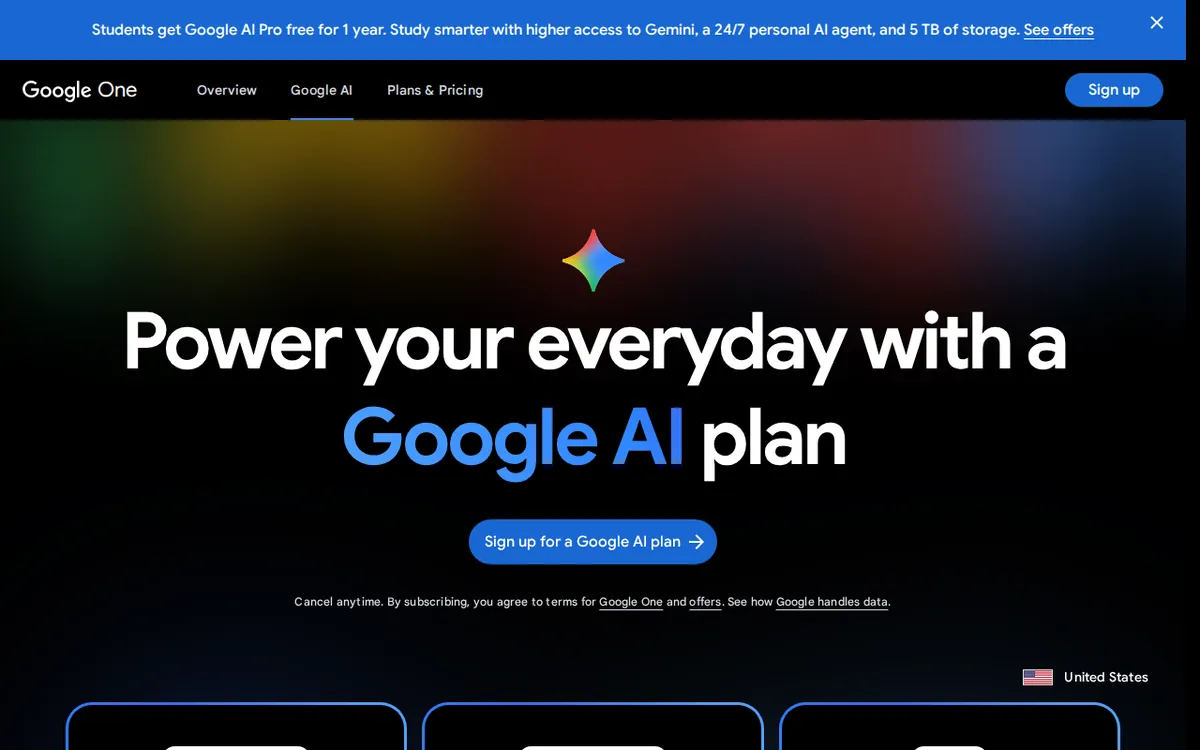
Figure: one.google.com official pricing page, captured 2026-10-07.
The free tier isn’t nothing, but it has strings attached
Before paying anything, it’s worth knowing what the free tier covers. Gemini’s free access includes limited use of certain models, free input and output tokens (the chunks of text and prompts the model processes), and free access to Google AI Studio, the developer console for testing prompts. Google pitches this as suited to “developers and small projects getting started with the Gemini API.” The catch: anything you input on the free tier can be used by Google to improve its products. If you’re feeding in client photos, draft designs, or anything sensitive, that’s worth knowing before you hit generate.
Why the price history matters more than the price itself
A US$3 monthly difference (US$7.99 versus US$4.99) sounds small, but the context changes how you should read it. A temporary half-off promo creates urgency — sign up now before it ends. A permanent price cut means there’s no rush, and also means Google is positioning Plus as a genuinely cheap entry point rather than a loss-leader hook. Our check found the promotional language entirely gone from new-signup flows, which lines up with “permanent” rather than “limited-time.”

Illustration: The entry tier features a permanent baseline price drop rather than a temporary countdown sale promotion.
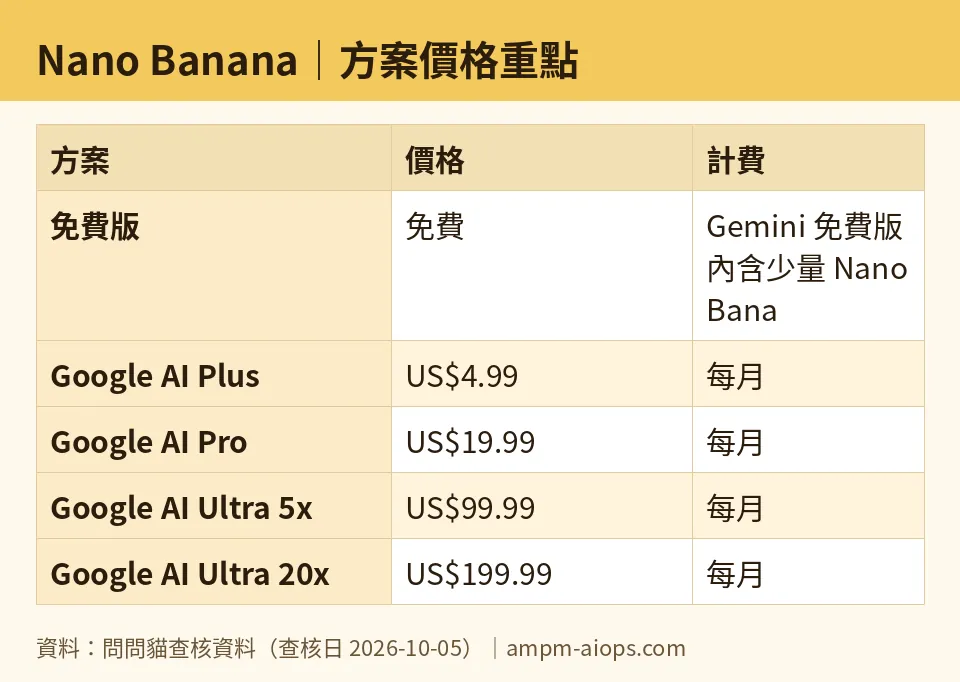
Figure: compiled by AMPM from its verified data (last verified 2026-10-05).
🔍 AMPM exclusive check
Two things the official pricing page doesn’t spell out, which we verified directly. First, the US$4.99 Plus price has been checked daily against the live Google page from July 26, 2026 through October 5, 2026, with no reversion to US$7.99 and no reappearance of the “first 2 months” discount messaging — confirming this is a standing price change, not a promo that Google could let lapse without notice. Second, Google’s own plan comparison pages state quota multipliers (2x, 4x, ~20x, and 4x again for the top Ultra tier) but never publish the underlying number of images those multiples apply to. Every “X images per month” figure floating around the web for Nano Banana is a third-party guess layered on top of an unpublished baseline — treat any specific image count you read elsewhere, including rough ones we might cite from other outlets, as unverified until Google publishes a real number.
☀️ AMO, the budget-minded cat

If you’re asking “is free enough,” the honest answer is: it depends on volume, and Google won’t tell you the exact ceiling. The free tier gives you some Nano Banana generations, free token usage, and free AI Studio access — enough to test whether the tool fits your workflow before spending a cent. The catch is that free usage feeds back into Google’s product training, which matters if you’re generating anything you wouldn’t want reused elsewhere.
Once you outgrow free, Plus at US$4.99/month is the cheapest paid rung, and it’s a genuinely small ask: 2x the free image quota plus 2TB of storage, which most people will never fill with a single subscription. The jump to Pro at US$19.99/month is four times the Plus price for twice the image quota (4x free vs 2x free) — that’s not a great ratio if images are the only thing you care about, though you also pick up YouTube Premium Lite, Google Home Premium, and a meaningfully larger Deep Research allowance, which could tip the math if you’d use those anyway. Ultra’s US$99.99 and US$199.99 tiers are hard to justify unless you’re generating images constantly — the 20x plan is four times the price of the 5x plan for four times the quota, so at least that step scales proportionally, but it’s still real money for a single tool’s image generator. For casual or occasional use, free-to-Plus covers almost everyone; don’t pay for Pro or Ultra unless you’ve actually hit the Plus ceiling.
🌙 PIMI, the performance-minded cat

The real question isn’t the sticker price, it’s which model version you’re actually getting. Google’s tiering ties image quality to subscription level: Plus still runs on the standard Nano Banana model, while Pro, Ultra 5x, and Ultra 20x all unlock “Nano Banana Pro” — described by Google as the stronger version, with Ultra’s variant pushed further still for “highest quality image generation and long-context processing.” If consistent faces and clean edits are why you want this tool in the first place, Plus doesn’t get you the upgraded model at all — you need Pro or above for that, not just more free-tier quota.
For throughput, the quota multipliers matter even without exact numbers: Pro’s 4x and Ultra 5x’s ~20x give you real headroom if you’re producing images daily, and Ultra 20x’s unlimited-feeling tier (roughly 80x the free baseline) is built for agencies or workflows running generation around the clock, not individual creators. Deep Research access scaling from “large allotment” on Pro to fully unlimited on both Ultra tiers is also relevant if your image work is paired with research-heavy prompting. The gap between Plus and everything above it isn’t subtle: Plus is priced like a toy, Pro and up are priced like tools meant for actual production work. If you need Nano Banana Pro’s model quality specifically, budget for at least the US$19.99 tier — Plus won’t get you there regardless of price.
Verdict: who should use it, who should skip it
Use the free tier to test fit, move to Plus at US$4.99/month if you need more than free quota and don’t need the upgraded Pro model, and only pay for Google AI Pro or higher if the stronger Nano Banana Pro model or the bundled extras (storage, YouTube, Deep Research) are things you’d actually use. Skip Ultra entirely unless you’re generating images at a volume that would make the free or Plus ceiling a daily problem — at US$99.99 or US$199.99 a month, it’s priced for studios and agencies, not individual creators. Anyone avoiding Plus because they thought the US$4.99 price was a temporary promo can stop waiting: our check confirms it’s Google’s standing price, not a countdown.
Written: 2026-10-07 Price last verified: 2026-10-05 Tool last health-checked: 2026-10-07
🔗 Related on AMPM
📎 Sources
All prices and quotas in this article come from AMPM’s verified dataset for Nano Banana (last verified 2026-10-05); primary sources:
🐾 Meet the cats: AMO and PIMI

AMPM is a Taiwan-based AI-tool pricing watchdog. Our motto: ask before you subscribe. Two cats argue every tool from two sides:
- ☀️ AMO — the budget-minded cat. Always asks: is the free tier enough, and is paying actually worth it?
- 🌙 PIMI — the performance-minded cat. Cares about whether it works well, fast, and gets your job done.

When they are done arguing, you know whether to pay. Every number is checked by us, with the verification date at the end.
🐾 Our sister sites also checked
Let's take a look at these
- Nano Banana Comprehensive Introduction: Pricing, Features, and Actual Limitations
- Nano Banana Is the free quota enough?
- Nano Banana Alternatives
- Comprehensive Free Quota List for All Tools
More verified articles on this tool
- [Pricing] Nano Banana Pricing: The US$4.99 Plan Is Real, But Ultra Now Splits Into Two Tiers
- [How-to] Nano Banana for beginners: start on the free tier, and know that US$4.99 Plus buys more quota, not a better model