[Review] OpenSEO Pricing: Is the Hosted Plan Worth It When Self-Hosting Is Free?
- Free tier: Yes
- Cheapest paid plan: US$10/mo and up
- Free quota: Self-hosted version is completely free (requires self-paid DataForSEO …
- Last checked: 2026-10-24
Article last updated: 2026-10-17


OpenSEO is an open-source SEO (search engine optimization — the practice of getting a site to rank higher in search results) toolkit that does keyword research, backlink analysis, rank tracking, and site audits, and plugs into AI agents like Claude, Cursor, and ChatGPT. It runs on a pay-as-you-go model, which sounds simple until you look at what each query actually costs. We read the official pricing page, checked the GitHub repo, and tracked the numbers daily through 2026-10-16. Here’s what the data says, and where “free” stops meaning free.
Two ways to run it, two very different cost structures
OpenSEO gives you a choice: self-host it yourself, or pay US$10 a month for the hosted version. Self-hosting means you download the code and run it on your own server — OpenSEO itself charges nothing for this. But you still pay DataForSEO, the data provider behind the keyword and backlink numbers, directly for every API (application programming interface — a service your software calls to fetch data automatically) call you make. OpenSEO doesn’t publish a starting price for that API cost on its own site, so we can’t quote one here.
The hosted version removes the setup work. You get a web interface, the same four core features, and a monthly US$10 credit (a prepaid balance that drains as you use the tool) baked into the US$10/month Base Plan. New users also get a one-time US$0.50 trial credit to test the hosted version before committing.
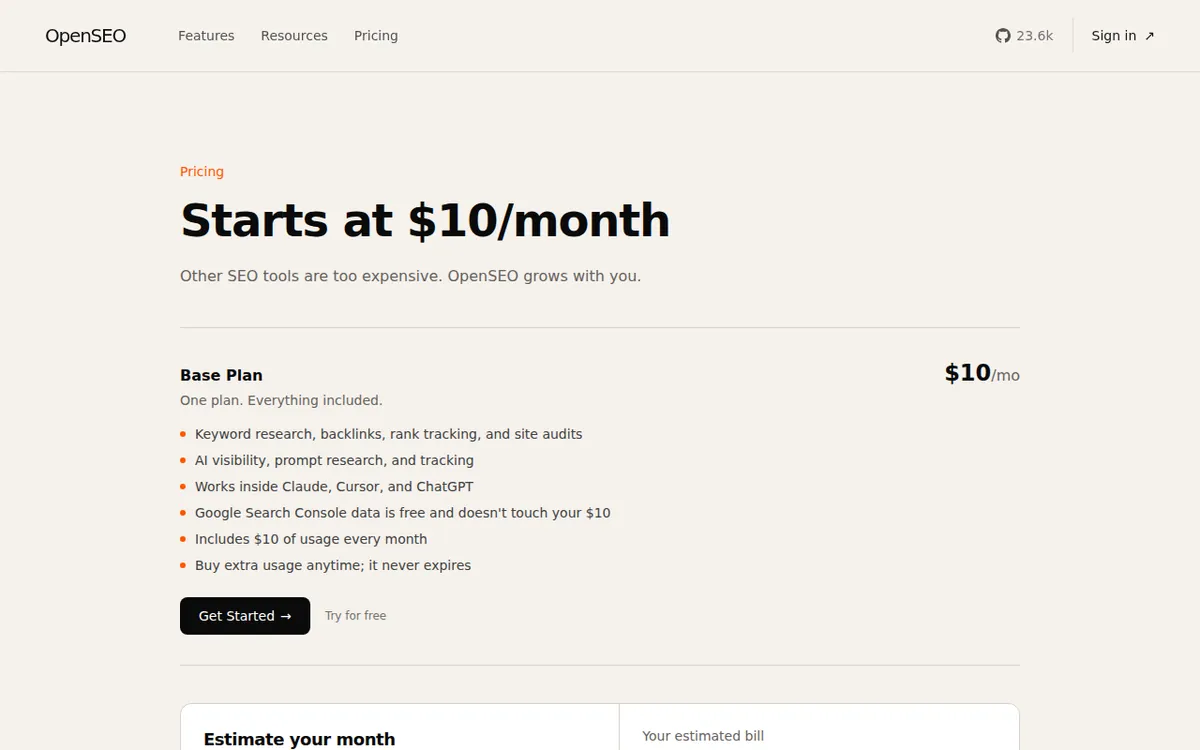
Figure: openseo.so official pricing page, captured 2026-10-17.
What each query actually costs you
This is where the pay-per-use model gets interesting, and where budget planning gets tricky. Once you’re past your included credit, OpenSEO charges per action: a keyword search is US$0.05, a backlink check is US$0.08, and a brand check is US$1.09. That last number is the one to watch. A single brand check costs more than twice the entire US$0.50 trial credit you start with — meaning a new user can’t even run one brand check before either topping up or hitting a wall.

Illustration: A single brand audit token is far too heavy for the modest trial dish, catching budget-conscious AMO completely off guard.
On the US$10/month Base Plan, that included credit covers roughly 200 keyword searches, or 125 backlink checks, or about 9 brand checks, before you’re paying extra on top of your monthly fee. If your work leans heavily on brand monitoring — tracking how often your company or product name shows up across the web — that US$10 disappears fast.
The credit rules nobody reads twice
There’s a split in how OpenSEO treats unused money that matters more than it looks. The US$10 monthly credit that comes with the Base Plan resets to zero at the start of every billing cycle — if you don’t use it, you lose it. But if you buy extra top-up credit beyond that monthly allowance, it doesn’t expire; it carries over indefinitely. So the incentive is to use your included US$10 before the cycle ends, and only top up when you actually need more.
🔍 AMPM exclusive check
Two things the vendor’s pricing page doesn’t spell out clearly, which we confirmed by reading the page directly and checking the project’s GitHub repo as of 2026-08-02, then re-verifying daily through 2026-10-16.
First: the monthly US$10 credit on the Base Plan and any top-up credit you buy are not treated the same way. The US$10 resets to zero every billing cycle. Top-ups don’t expire. OpenSEO’s pricing page doesn’t separate these two pools visually, so it’s easy to assume all your credit rolls over — it doesn’t, unless you bought it as a top-up.
Second: we had an earlier internal note suggesting self-hosted OpenSEO carried an approximate US$6/month baseline cost. We went back to find the official source for that figure and couldn’t trace one. The official pricing page states self-hosting is free aside from your own DataForSEO API bill, with no OpenSEO-side monthly charge. We’re dropping that US$6 figure from this review since it doesn’t check out against the source — which is exactly the kind of gap this exclusive check exists to catch.
Everything else — the US$10/month Base Plan, the US$0.50 trial credit, the US$0.05/US$0.08/US$1.09 per-action rates — matched the official page on every verification pass from 2026-08-09 through 2026-10-16.
☀️ AMO, the budget-minded cat

If you’re counting every dollar, self-hosting is the obvious starting point: OpenSEO charges nothing for the software itself, and you only pay DataForSEO for the data you actually pull. No official starting price exists for that API cost, so budget for it as a variable expense, not a fixed one.
The hosted plan is where the math gets uncomfortable. US$10 a month sounds cheap next to most SEO tools, and the included credit covers a reasonable number of keyword searches or backlink checks. But brand checks at US$1.09 each are brutal on a tight budget — nine of them and your entire monthly credit is gone, with nothing left for keyword or backlink work that cycle. And because that US$10 resets to zero every billing period, overspending one month and underusing the next doesn’t average out. You either use it or lose it.
My honest take: the US$0.50 trial credit is basically a demo, not a real test — it can’t even cover one brand check. If you’re serious about staying cheap, self-host and treat the DataForSEO bill as your only real cost. Only pay the US$10/month hosted fee if the convenience of skipping server setup is worth more to you than the money, and only if your usage leans toward cheap actions like keyword searches rather than brand checks.
🌙 PIMI, the performance-minded cat

Does OpenSEO actually do the job well? On paper, yes — it covers the four things SEO people check daily: keyword research, backlink analysis, rank tracking, and site audits, and it talks directly to AI agents like Claude, Cursor, and ChatGPT, so you can run audits or pull rankings through an agent workflow instead of clicking through a dashboard manually.
Self-hosting is where performance shines if you’re technical: no caps, no credit system, no per-query anxiety. You pay DataForSEO for what you pull and run as many queries as your budget allows. For a team doing high-frequency competitive tracking, this is the only version that scales sanely — the hosted plan’s per-action pricing, especially that US$1.09 brand check, turns frequent monitoring into a real line item fast.
The hosted plan trades raw scalability for convenience: a ready UI, no server to maintain, and the same four features without any DevOps work. That’s a legitimate performance win if your team doesn’t have infrastructure time to spend. But there’s a ceiling here too — this tier excludes custom API access and priority support, both of which require an enterprise upgrade that isn’t detailed in the data we have. If your workflow needs either of those, the US$10 plan alone won’t get you there.
Bottom line on performance: the feature set is genuinely useful and the AI-agent integration is a real differentiator, but speed and scale on the hosted tier are bounded by how fast your US$10 credit burns through US$1.09 brand checks.
Verdict: who should use it, who should skip it
Use OpenSEO if you’re comfortable self-hosting and want a genuinely free SEO toolkit where your only cost is the DataForSEO API usage you choose to run — this is the best value path by far, with no monthly OpenSEO fee at all. It’s also a reasonable pick for hosted-plan users whose work is mostly keyword searches (US$0.05 each) or occasional backlink checks (US$0.08 each), since US$10/month covers a solid volume of those before you’re paying extra.
Skip the hosted plan, or at least the frequent-brand-check habit, if brand monitoring is central to your work. At US$1.09 per check, that single feature can burn through an entire month’s US$10 credit in nine checks, and because the included credit resets to zero every cycle, there’s no way to bank savings from a slower month. Teams needing custom API access or priority support should also know this plan doesn’t include either — that’s an enterprise-tier conversation OpenSEO’s current pricing page doesn’t spell out in dollar terms.
Written: 2026-10-17 Price last verified: 2026-10-16 Tool last health-checked: 2026-10-17
🔗 Related on AMPM
📎 Sources
All prices and quotas in this article come from AMPM’s verified dataset for OpenSEO (last verified 2026-10-16); primary sources:
🐾 Meet the cats: AMO and PIMI

AMPM is a Taiwan-based AI-tool pricing watchdog. Our motto: ask before you subscribe. Two cats argue every tool from two sides:
- ☀️ AMO — the budget-minded cat. Always asks: is the free tier enough, and is paying actually worth it?
- 🌙 PIMI — the performance-minded cat. Cares about whether it works well, fast, and gets your job done.

When they are done arguing, you know whether to pay. Every number is checked by us, with the verification date at the end.
🐾 Our sister sites also checked
Read next
- OpenSEO Full breakdown: pricing, features and real-world limits
- OpenSEO Is the free quota enough?
- OpenSEO Alternatives
- Free plan limits for every AI tool we track