[News] AI Infostealer That 'Autodoxes' Victims: What It Means for PostSyncer Users and Social Logins
- Free tier: No
- Cheapest paid plan: US$29/mo and up
- Free quota: There is no free plan. The official pricing page only has three paid …
- Last checked: 2026-11-02
Article last updated: 2026-11-01



What happened
On 2026-11-01, Wired reported on a new piece of infostealer malware that uses AI to “autodox” its victims. The headline calls it “spooky”. Cisco’s Talos security group is the second independent source, and its research is part of the coverage.
Two terms, in plain words:
- Infostealer: malware that quietly collects data from an infected computer. Typical targets are saved passwords, browser session cookies (small files that keep you logged in) and similar material.
- Doxing: digging up and exposing someone’s personal information. “Autodox” means the malware does this automatically, with AI doing the sorting and profiling.
The Wired URL names the malware family. We have not read the full reports for this piece, so we are not repeating technical claims beyond the headline and summary. We do not describe its infection method, its targets or its numbers.
One point matters for the rest of this article. As far as the material we hold shows, neither report names PostSyncer or any social media scheduling tool as a target or a victim. The link to PostSyncer is our angle, not theirs.

Figure: postsyncer.com official pricing page, captured 2026-11-01.
How AMPM sees it
Why a pricing watchdog covers this. PostSyncer is a tool for scheduling and publishing posts across many social platforms at once. To do that, it holds permission to post as you on each connected account. That makes it a useful stand-in for a wider question. What happens to your brand’s accounts when the computer of someone on your team is infected?

Illustration: Fragmented stolen data scraps assemble automatically into an organized personal dossier through automated compilation.
Who is affected. Everything below is our inference, not a finding from the reports.
- Anyone whose computer gets infected. An infostealer attacks the device, not the tools you use on it. If PostSyncer is open and logged in on a compromised machine, the session on that machine is exposed like any other.
- Small teams and agencies. The plans we track allow unlimited team members. That is convenient. It also means more laptops, more browsers and more chances for one infected device to matter. This is how the product is built, not a flaw in it.
- Social media managers who use personal and work accounts on one device. This is the group where a data stealer plus automated profiling hurts most. Stolen data tied to a real person is easier to turn into targeted fraud or pressure.
What “AI” changes. Before this kind of malware, a criminal who stole a pile of data still had to sort it by hand. Our reading of the “autodox” label is that AI now does the sorting and the profiling, so each victim’s data becomes more usable. We are inferring this from the headline. We cannot say how well it works.
If that holds, the risk shifts from “your password leaked into a huge dump” to “someone built a file about you”. A social media manager’s file would include which brands they run, which accounts they can post to, and who they work with. That is more interesting to an attacker than a single password.
Does PostSyncer have a problem here? Nothing in the reports says so, and we have no evidence of a PostSyncer breach. Our last routine check of its public pages, on 2026-10-31, found nothing related. That check covers pricing and plan details, not security, so it tells you nothing about how PostSyncer handles your data. We have not audited its security setup.
The question behind the Chinese edition’s title. Our Chinese edition asked whether you can use PostSyncer to send out security warnings about this kind of news. As a mechanical matter, yes. It schedules posts to many platforms, and a warning is just a post. The tool does not stop being usable because a malware story is in the news.
Whether you should is a different question, and it is about the message, not the tool. Some rules we would follow:
- Link to the primary source. Point readers to the Wired or Talos article. Do not paraphrase technical details you have not read yourself.
- Do not claim specifics we do not know. Saying “this malware steals X” when the report says otherwise would put a false statement under your brand’s name.
- Keep it practical. Tell followers to keep their devices updated, use a password manager, turn on two-factor authentication, and be careful with downloads. This is general advice and does not depend on the specifics of this malware.
- Do not use fear as a hook. A scare post gets reach but costs trust.
What to check on your own side. If you manage accounts through PostSyncer or a similar tool, do a short audit. These are general hygiene steps, not advice tied to anything in the reports.
- Who has access? Remove former team members and old contractors.
- Which devices are logged in? Log out of sessions you do not recognise.
- What is connected? Disconnect social accounts you no longer post to. Fewer connections mean less to lose.
- Any API keys? An API is a way for other software to talk to a service. The plans we track include API access and an AI-assistant connector. If you created access keys for either, find them and revoke what you do not use. Treat a key like a password, because anyone holding it can act as you.
- Is two-factor authentication on? Turn it on for your PostSyncer login and for every connected social account, wherever the platform offers it.
Where this fits in the industry. Infostealers are not new. What the headline signals is a trend we expect to continue (inference): criminals adding AI to the step after the theft, not just the theft. Tools that store the keys to many accounts, such as schedulers, password managers and AI assistants with connectors, become more attractive as targets. The reason is not weak security. It is the concentration of access. That is true of the whole category, not just PostSyncer.
What to watch next.
- Follow-up reporting. Details on how the malware spreads and who it targets will decide whether a marketing or social media worker is more exposed than an ordinary user.
- Platform responses. Watch for changes to how social networks handle stolen session cookies and logins from new devices.
- Vendor statements. If a scheduling tool, PostSyncer included, publishes guidance on this kind of threat, that is worth reading. We saw none as of 2026-11-01.
Should you change your decision about PostSyncer? Not because of this story. A report about malware on personal computers is not a reason to drop or adopt a scheduling tool. It is a reason to tighten your own habits, whichever tool you use. If you were already unsure about trusting any third-party tool with your social accounts, that is a separate question, and this news does not settle it either way.
Sources
- Wired, “Spooky New Infostealer Malware Uses AI to ‘Autodox’ Victims”: https://www.wired.com/story/kernel-panic-volta-autodoxer-ai-infostealer-malware/
- Cisco Talos Intelligence (second independent source for the same story): https://talosintelligence.com
- PostSyncer official site, for tool details: https://postsyncer.com
Written: 2026-11-01 Price last verified: 2026-10-31 Tool last health-checked: 2026-11-01
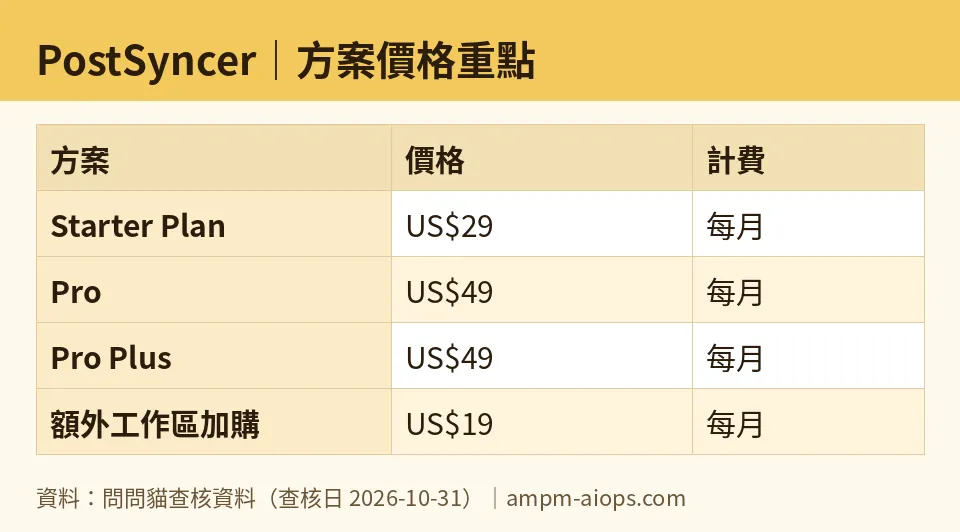
Figure: compiled by AMPM from its verified data (last verified 2026-10-31).
🔗 Related on AMPM
📎 Sources
All prices and quotas in this article come from AMPM’s verified dataset for PostSyncer (last verified 2026-10-31); primary sources:
🐾 Meet the cats: AMO and PIMI

AMPM is a Taiwan-based AI-tool pricing watchdog. Our motto: ask before you subscribe. Two cats argue every tool from two sides:
- ☀️ AMO — the budget-minded cat. Always asks: is the free tier enough, and is paying actually worth it?
- 🌙 PIMI — the performance-minded cat. Cares about whether it works well, fast, and gets your job done.

When they are done arguing, you know whether to pay. Every number is checked by us, with the verification date at the end.
🐾 Our sister sites also checked
Read next
- PostSyncer Full breakdown: pricing, features and real-world limits
- PostSyncer Is the free quota enough?
- PostSyncer Alternatives
- Free plan limits for every AI tool we track
