[Review] Recall.ai Pricing: What the Per-Hour Meter Really Costs You
- Free tier: Yes
- Cheapest paid plan: US$0.5/mo and up
- Free quota: Register for the Pay As You Go plan and get the first 5 hours of …
- Last checked: 2026-11-02
Article last updated: 2026-11-02


Recall.ai sells one thing: a bot that joins your video calls and records them, plus a unified API to pull that recording out. An API, in plain terms, is a set of instructions one piece of software uses to talk to another. If you build meeting tools, you are the buyer here. If you just want a transcript of your own Zoom calls, you are not.
The pricing is metered. There is no monthly subscription, no seat count, no platform fee. You pay per hour of recording, billed to the second. That sounds clean. It is also where the interesting parts hide, because recording is only the first line item. Transcription is a second. Storage past a week is a third.
Here is what the verified data actually says, and where the meter gets uncomfortable.
The three-line bill nobody quotes as three lines
The headline rate is US$0.50 per hour of recording. That applies to both the Meeting Bot API and the Desktop Recording SDK. No monthly minimum sits underneath it.
Then transcription. Built-in transcription is an add-on at US$0.15 per hour. You can also bring your own third-party key instead, which moves that cost off Recall.ai and onto whoever you already pay.
Then storage. Every recording gets 7 days of free storage. Past that, keeping an hour of recording for 30 days costs US$0.05.
Add those up in your head and you get a number. We are not going to do that for you, because the data does not present a bundled total, and inventing one would misrepresent how the meter works. What matters is that three separate meters run at once, and only one of them is the number people remember.
The free tier: registering for Pay As You Go gives you the first 5 hours of recording free. The Calendar API is free as well. Five hours is a real test window. It is not a production window.
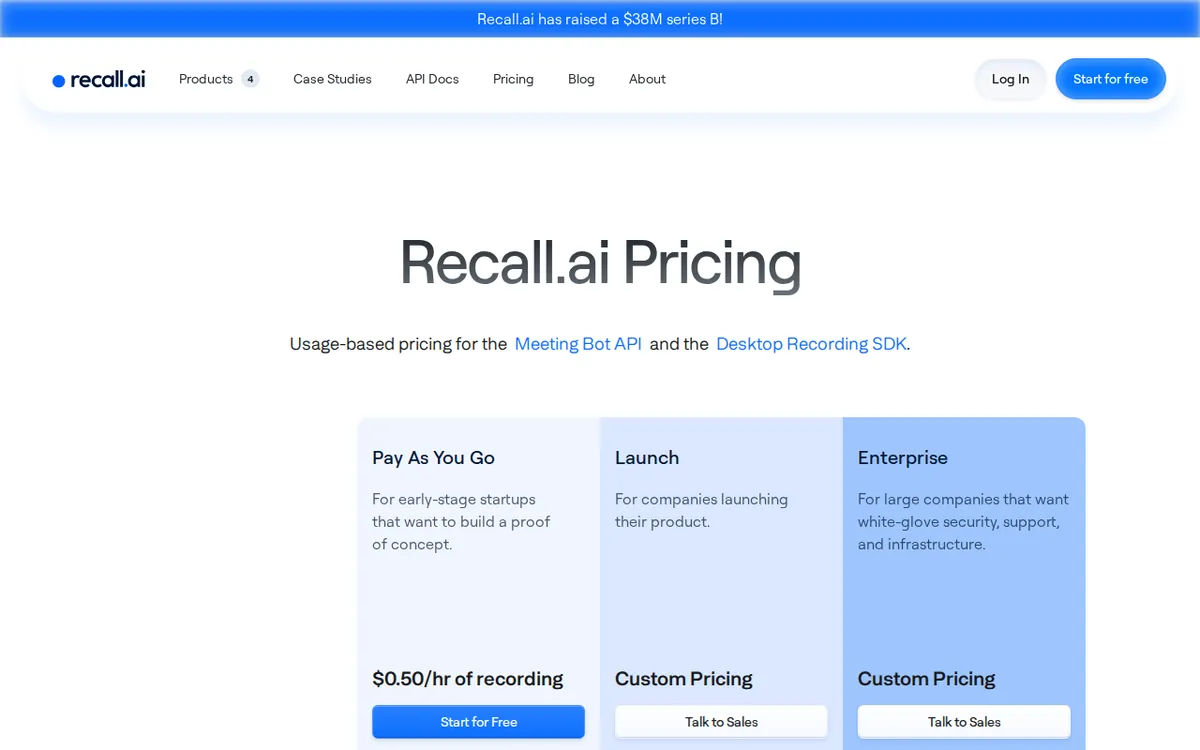
Figure: recall.ai official pricing page, captured 2026-11-02.
Where the free tier stops being free
Five hours sounds generous until you map it to actual usage. A weekly one-hour standup burns a fifth of it. A daily 30-minute sync burns it in ten working days. If you are prototyping an integration, five hours is plenty. If you are running anything with real users, you will cross it inside the first sprint.
The Calendar API being free is the genuinely useful part of the free tier. Calendar access is often the piece vendors charge for, because it is what lets your bot know when to show up. Getting it at no cost lowers the barrier to building the scheduling layer.
One caution from the data itself: this tool was checked in a single pass and has not been through three-way human cross-verification. The free quota and commercial terms should be confirmed against the vendor’s page at the moment you sign up. That is not a knock on Recall.ai. It is an honest statement about how much checking stands behind these numbers.
🔍 AMPM exclusive check
Nothing differed from the official page this time; every number below matches it, checked 2026-11-01.
What the vendor page does not spell out in one place is that the US$0.50 figure is not the cost of a recorded hour. It is the cost of the recording meter alone. Transcription at US$0.15 per hour and post-7-day storage at US$0.05 per hour for 30 days are separate meters that run on the same hour of audio. A reader who scans the pricing page and remembers one number will undercount.
The second thing worth flagging: the 7-day storage window is free, and the US$0.05 rate buys 30 days of retention. Those are two different clocks. The data does not describe what happens to a recording after the 30-day retention period ends, and we will not guess.
The third: the data notes that the free 5 hours applies to the Pay As You Go plan specifically. It does not describe a separate permanent free tier outside that plan.
Prices vary by country; we checked from Taiwan.
☀️ AMO, the budget-minded cat

Five free hours is the whole question for me. Is it enough, and is paying worth it after?
For a solo developer testing whether a meeting bot fits their product, five hours is a genuine gift. You can wire up the Calendar API at no cost, run a handful of real calls, and see whether the recording quality and the API shape work for you. That is a complete evaluation, and it costs nothing.
Past five hours, the meter is honest but it is not cheap in aggregate. US$0.50 per recorded hour is the entry point. Add built-in transcription at US$0.15 per hour and you are paying for two meters on the same audio. If you already pay a transcription provider, bringing your own key removes that second meter entirely, and that is the single biggest lever a budget-conscious builder has here.
Storage is the sneaky one. Seven days free is fine if you process recordings immediately and push them somewhere else. If your product keeps recordings around, US$0.05 per hour for 30 days is a third meter, and it runs on hours you already paid to record.
My read: the free tier is enough to decide. Whether paying is worth it depends entirely on whether you need built-in transcription and long retention. Skip both and the bill stays at one line. Need both and you are running three meters at once, with no monthly cap to stop them.
🌙 PIMI, the performance-minded cat

Does it do the job well? The pricing structure tells you what the product is built for, and it is built for developers who want control.
Two recording paths, the Meeting Bot API and the Desktop Recording SDK, both at US$0.50 per hour. That matters. Bot-based recording and desktop-based recording fail in different ways, and having both under one API means you are not stitching two vendors together when one approach does not fit a customer’s setup.
Bring-your-own transcription key is the feature I care about most. Built-in transcription at US$0.15 per hour is convenient, but convenience is not the same as accuracy. If you have already tuned a transcription provider for your domain, jargon, accents, whatever your users sound like, you keep it. You are not forced onto the vendor’s engine to get the recording.
The Calendar API being free is a performance point too, not just a budget one. Scheduling is where meeting bots break. A free calendar layer means you can build and test the hard part without paying per hour to discover it does not work.
The 7-day free storage window is short. If your pipeline is fast, that is fine. If it is not, you are paying US$0.05 per hour to hold recordings for 30 days, and the data does not say what happens after that.
What I cannot tell you from this data: latency, accuracy, uptime. None of those numbers exist here. Anyone claiming otherwise is making them up.
Verdict: who should use it, who should skip it
Use it if you are building a product that needs to record meetings or calls and you want one API across bot and desktop recording. The free 5 hours plus the free Calendar API is a real evaluation, not a demo. The bring-your-own-transcription-key option keeps you off a meter you may not want.
Skip it if you want a finished transcription tool for your own calls. This is infrastructure for developers, priced per hour of audio, with three meters that can run at once.
Skip it, or at least budget carefully, if your product stores recordings long-term. Seven days free, then US$0.05 per hour for 30 days, and the data stops there.
The honest summary: US$0.50 per hour buys the recording. Transcription and retention are separate decisions, and they are the ones that change your bill.
Written: 2026-11-02 Price last verified: 2026-11-01 Tool last health-checked: 2026-11-02
🔗 Related on AMPM
📎 Sources
All prices and quotas in this article come from AMPM’s verified dataset for Recall.ai (last verified 2026-11-01); primary sources:
🐾 Meet the cats: AMO and PIMI

AMPM is a Taiwan-based AI-tool pricing watchdog. Our motto: ask before you subscribe. Two cats argue every tool from two sides:
- ☀️ AMO — the budget-minded cat. Always asks: is the free tier enough, and is paying actually worth it?
- 🌙 PIMI — the performance-minded cat. Cares about whether it works well, fast, and gets your job done.

When they are done arguing, you know whether to pay. Every number is checked by us, with the verification date at the end.
🐾 Our sister sites also checked
Read next
- Recall.ai Full breakdown: pricing, features and real-world limits
- Recall.ai Is the free quota enough?
- Recall.ai Alternatives
- Free plan limits for every AI tool we track