[Pricing] Replicate Has No Free Tier, and It Can Bill You for Idle GPU Time Too
- Free tier: No
- Cheapest paid plan: US$0/mo and up
- Free quota: The official pricing page does not offer a free tier or trial quota …
- Last checked: 2026-09-27
Article last updated: 2026-10-08


Replicate doesn’t have a free tier. Not a free trial with a time limit, not a handful of free credits to try it out — nothing. We went straight to the official pricing page to check, and the page offers no free quota at all. If you want to run a model, you register and add a payment method first. That’s the starting point for this breakdown of what Replicate actually costs, plan by plan.
Replicate is a platform that hosts thousands of open-source AI models — for images, video, and code — and lets you call any of them on demand. You don’t install anything or manage a server. You send a request through the platform’s interface or its API (an API is just a way for one piece of software to ask another piece of software to do something, in this case “generate this image”), and Replicate runs the model and returns the result. The appeal is breadth: one account, thousands of models, no setup.
How Replicate actually charges you
There’s no subscription. Everything is metered, and how it’s metered depends on what you’re running.
For most public models, you pay per output. The rate is set per model. A few examples straight from the pricing page: FLUX Dev costs US$0.025 per image, FLUX Pro costs US$0.04 per image, Ideogram v3 Quality costs US$0.09 per image, and WAN 2.1 video generation at 720p costs US$0.25 per second of output. If you’re calling a language model instead of an image generator, pricing switches to tokens — tokens are the small chunks of text a model reads and writes, roughly pieces of words. Claude 3.7 Sonnet on Replicate is billed at US$3.00 per million input tokens.
For public models that don’t have flat per-output pricing, you pay for the processing time, measured by the second, on whichever GPU (a GPU, or graphics processing unit, is the specialized chip that runs AI models fast) tier the model needs. Replicate’s per-second rates convert to hourly figures on the pricing page: a CPU Small instance runs US$0.000025 per second, which works out to US$0.09 an hour. A plain CPU instance is US$0.0001 per second, or US$0.36 an hour. A T4 GPU is US$0.000225 per second, or US$0.81 an hour. An L40S is US$0.000975 per second, or US$3.51 an hour. An A100 80GB is US$0.0014 per second, or US$5.04 an hour. An H100, the fastest tier listed, is US$0.001525 per second, or US$5.49 an hour. Importantly, this per-second billing only counts time the model is actually processing your request.
Put those numbers together and ordinary use is cheap. Generating 100 images with FLUX Dev costs around US$2.50. Running a model on an A100 for a full hour costs US$5.04. If you use Replicate occasionally — a batch of images here, a short video clip there — you might spend less in a month than a single month of a flat-rate subscription tool.
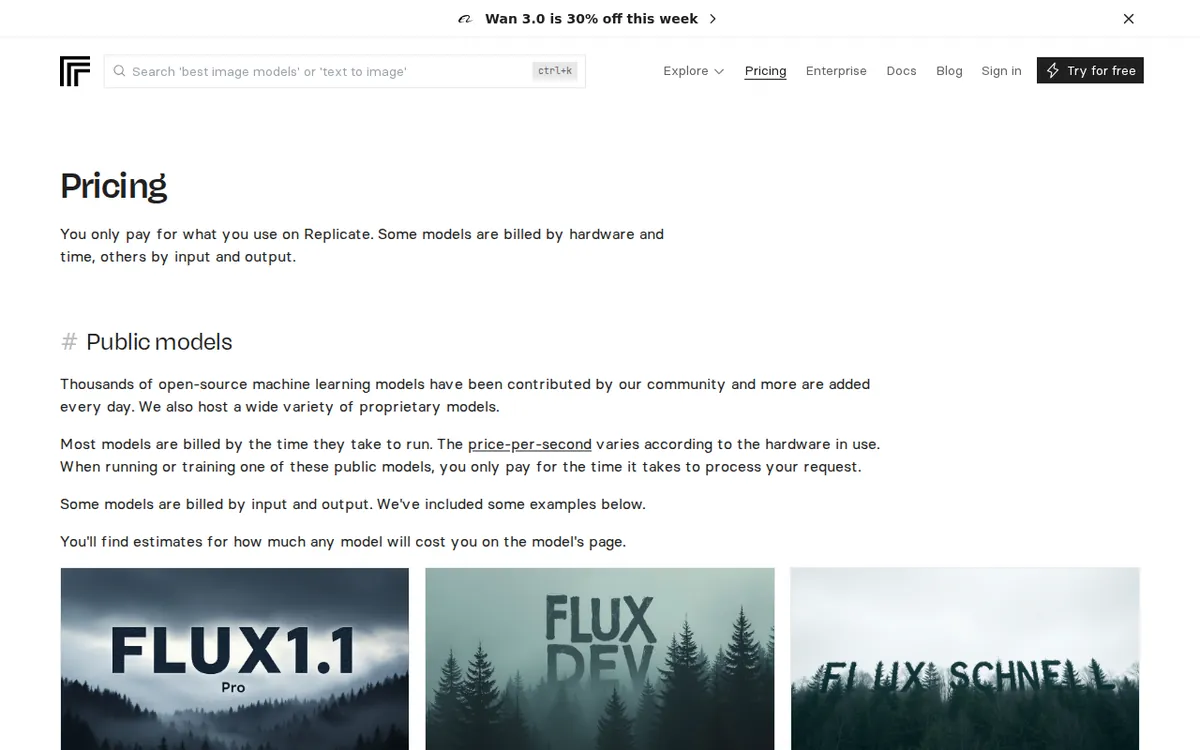
Figure: replicate.com official pricing page, captured 2026-10-08.
The idle-time trap in private models
The catch is in a different product on the same page: private models, run on dedicated hardware. This is for anyone who needs a model running on hardware reserved just for them — not sharing capacity with everyone else hitting the public endpoints.
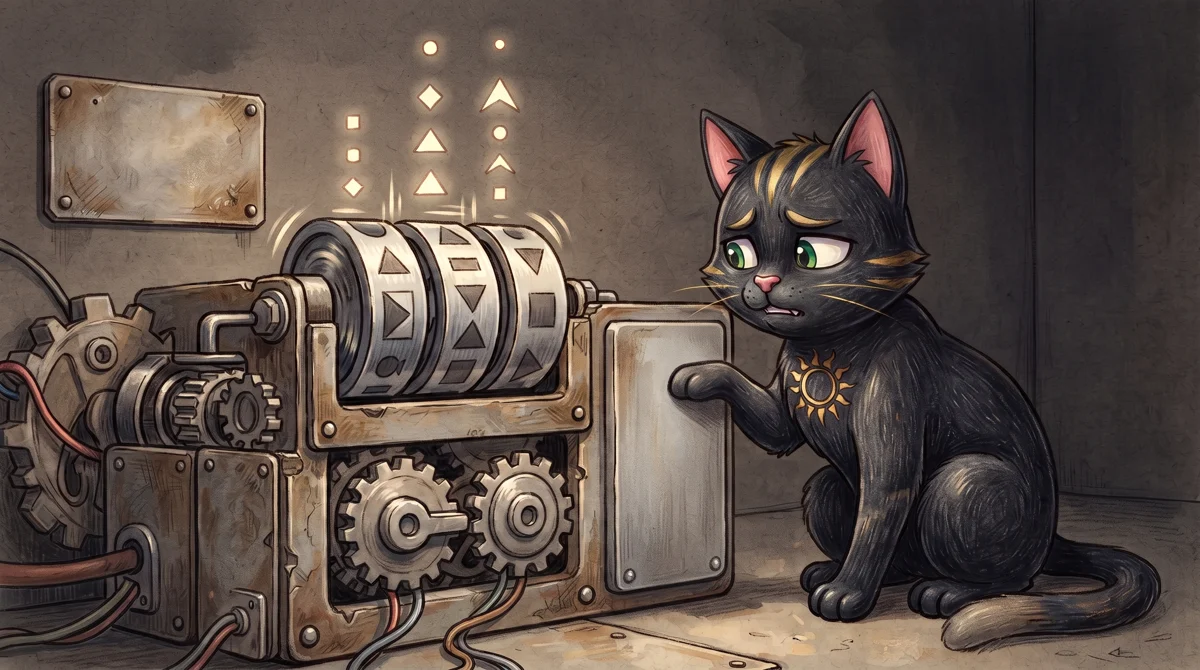
Illustration: Private models charge for total uptime, meaning startup and idle time continuously cost money even when doing nothing.
Dedicated instances are billed for the entire time the hardware is powered on, not just the time it spends computing your request. That includes startup time and any idle time while the instance sits there waiting for the next job. If you spin up a dedicated deployment and let it idle between requests, the meter keeps running the whole time, on top of whatever GPU hourly rate applies.
There’s one exception: fast-boot fine-tuned models, which are only billed for the time they actually spend processing, not for boot or idle time. But that exception doesn’t apply to standard dedicated deployments. If you’re used to pay-as-you-go pricing on the public model side — where idle time is free — the private-model billing model is a real behavior change, and it’s easy to get an unexpectedly large bill if an instance is left running.
🔍 AMPM exclusive check
We checked the official pricing page directly (last confirmed 2026-07-31, re-verified 2026-09-27) and every number in this piece — the per-image rates, the per-second GPU rates, the hourly conversions, the idle-billing rule for private models — matches what’s published there. On that front, nothing differed from the official page.
One thing the pricing page doesn’t resolve either way: whether new accounts get any one-time signup credit separate from the published usage rates. The pricing page itself states no free tier and no trial allowance — that’s the official position, and we confirmed it reads that way. But we haven’t been able to independently confirm or rule out a possible registration bonus outside the pricing page’s scope, so we’re flagging that as still pending re-check rather than stating it either way.
The other thing worth calling out, because it’s easy to miss on a first read of the pricing page: the idle-time billing rule applies specifically to private, dedicated-hardware deployments — not to the public per-image and per-second rates most casual users will actually touch. If you only ever use public models, you’re not exposed to idle charges at all. That distinction is on the page, but it’s not the first thing you see.
☀️ AMO, the budget-minded cat

AMO wants to know: is free enough, or is it worth paying? For Replicate, the honest answer is there’s no free version to compare against — AMO has to put a card down from the first request. The real question for AMO isn’t “pay or not,” it’s “does the metered pricing stay cheap at light, occasional use.” Based on the published rates, it mostly does. A hundred images on FLUX Dev costs about US$2.50 — less than a single month of most flat-rate image subscriptions, if that’s all AMO needs that month. Spinning up a CPU Small instance for a quick job costs US$0.09 an hour if left running, or a fraction of a cent for a short task since public-model billing only counts actual processing time, not idle waiting. That’s the kind of math that favors someone who generates in bursts rather than constantly. Where AMO needs to be careful: anything described as a private or dedicated deployment. Those are billed for total boot time, idle included, and an A100 left running costs US$5.04 every hour whether or not it’s doing anything. For AMO’s typical pattern — occasional, bursty use on public models — Replicate’s metered pricing is close to as cheap as a free tier would be, just without the zero-dollar floor. For anything dedicated or constantly running, the math flips fast, and AMO should treat that tier as a different product entirely.
Verdict: who should use it, who should skip it
Use Replicate if you need access to a wide range of open-source models without picking one favorite tool and subscribing to it. It suits people who generate in short bursts — a batch of images for a project, a quick video clip, an occasional model experiment — because public-model billing only charges for processing time, and the per-unit costs (US$0.025–US$0.09 per image depending on model, US$0.25 per second for the video model listed) stay low at that usage level. It also suits developers who want GPU access by the second without managing their own infrastructure, with rates starting at US$0.09 an hour for the smallest CPU tier.
Skip it, or budget carefully, if you need an always-on, dedicated deployment. Private models are billed for every second the hardware is powered on, including idle time, and that can turn into a meaningful ongoing cost compared to a flat subscription. It’s also not the right fit if you want a guaranteed-free way to try things first — there is no free tier here, and no trial allowance published on the pricing page, so you’re committing a payment method before your first run no matter how small.
Written: 2026-10-08 Price last verified: 2026-09-27 Tool last health-checked: 2026-10-08
🔗 Related on AMPM
📎 Sources
All prices and quotas in this article come from AMPM’s verified dataset for Replicate (last verified 2026-09-27); primary sources:
🐾 Meet the cats: AMO and PIMI

AMPM is an independent AI-tool pricing watchdog tracking official prices worldwide. Our motto: ask before you subscribe. Two cats argue every tool from two sides:
- ☀️ AMO — the budget-minded cat. Always asks: is the free tier enough, and is paying actually worth it?
- 🌙 PIMI — the performance-minded cat. Cares about whether it works well, fast, and gets your job done.

When they are done arguing, you know whether to pay. Every number is checked by us, with the verification date at the end.
🐾 Our sister sites also checked
Read next
- Replicate Full breakdown: pricing, features and real-world limits
- Replicate Is the free quota enough?
- Replicate Alternatives
- Free plan limits for every AI tool we track