[Review] Suno Free vs Paid: The Daily Reset Nobody Reads Twice
- Free tier: Yes
- Cheapest paid plan: US$10/mo and up
- Free quota: 50 credits reset every day on the US$0/month free plan, which the …
- Last checked: 2026-10-24
Article last updated: 2026-10-15


Suno lets you type a few lines of lyrics and a genre, and it writes and sings a full song back at you. The vendor’s pricing page looks simple: one free plan, two paid tiers. We read the pricing page and the help center line by line to see what the free plan actually lets you keep, and what the paid plans actually unlock. Two AMPM cats went through the same verified numbers from two angles — one asking “is free enough,” the other asking “does this actually work for real output.” Here’s what we found.
The Daily Reset Nobody Reads Twice
Suno’s free plan, officially called the Free Plan on the pricing page (the help center still calls it “Basic” in older documentation), costs nothing. You get 50 credits — the unit Suno uses to measure how much song-generation you can do — and here’s the part easy to miss: those 50 credits reset every day, not every month. The site’s footer spells it out directly: credits included in your plan do not roll over daily or monthly. Whatever you don’t use today is gone tomorrow, replaced by a fresh 50. That’s generous in one sense — you’re not stuck waiting a month for more — but it also means there’s no saving up. You can’t bank three quiet days into one big session.
The free plan locks you into one model, called v4.5-all, which Suno’s own site calls “the best free model.” Paid plans unlock v4, v4.5, v4.5+, v5, and v5.5 — the newer, more capable versions aren’t available at any credit cost on free. Free generations also run in a shared queue with up to 4 songs processing at once, while paid plans get a priority queue handling up to 10. Audio uploads — if you’re feeding in a reference track to remix or extend — are capped at 8 minutes on free, versus 30 minutes on paid.
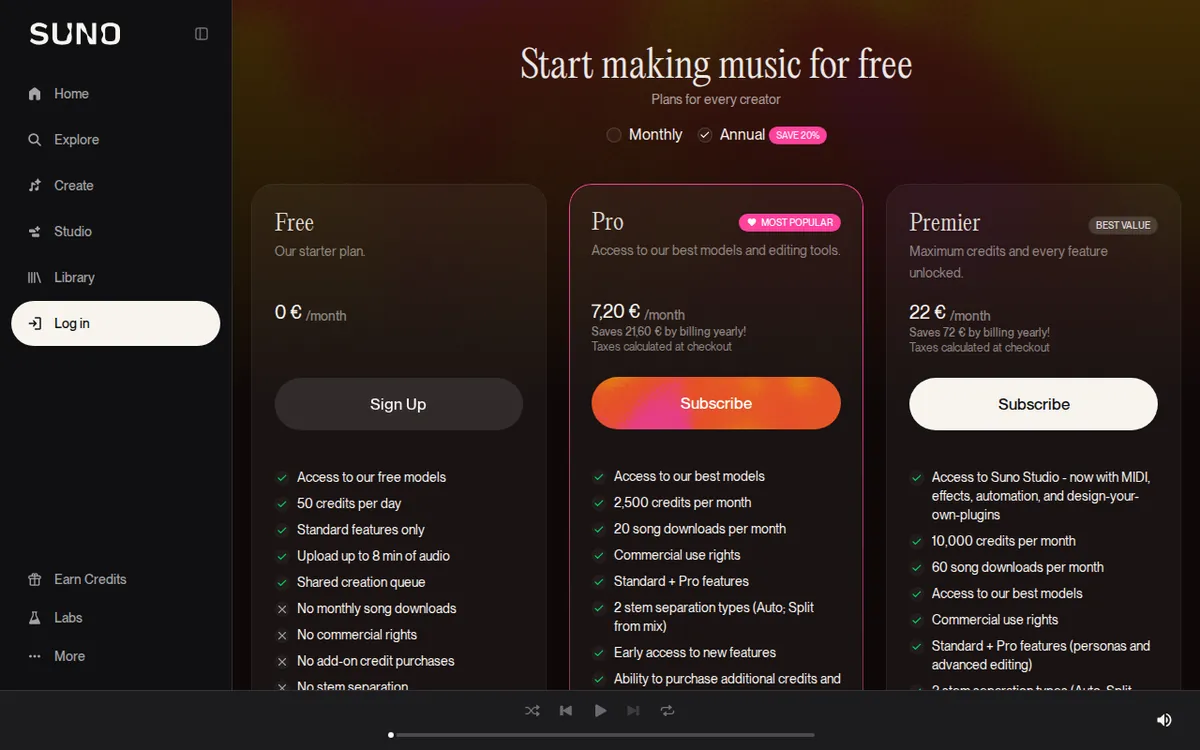
Figure: suno.com official pricing page, captured 2026-10-15.
What US$10 Actually Buys (And What Doesn’t Transfer)
The Pro plan is priced at US$10/month if you pay monthly. Suno’s pricing page defaults to showing US$8/month, but that number only applies if you commit to annual billing — US$96 for the year. Premier works the same way: US$30/month billed monthly, or the displayed US$24/month if you pay annually upfront, totaling US$288 for the year. Neither plan page states a “first month discount” or a promo code; the only markdown is the standard 20% you save by committing annually instead of paying month to month.
Pro gives you 2,500 credits that refresh monthly (not daily), access to all the newer models including v5.5, the priority queue, 30-minute uploads, two types of stem separation (splitting a finished song into separate instrumental and vocal tracks), and — important — the ability to buy extra add-on credits if you run out mid-month. Premier jumps to 10,000 credits, adds a third stem-separation mode called “Advanced Split,” and unlocks something called Suno Studio that isn’t available on Pro at all.
The one thing that doesn’t show up anywhere on the free plan page in bold letters: commercial use. Suno’s pricing page states free plan songs come with “No commercial use.” Both paid plans explicitly include commercial use rights for new songs you make while subscribed.
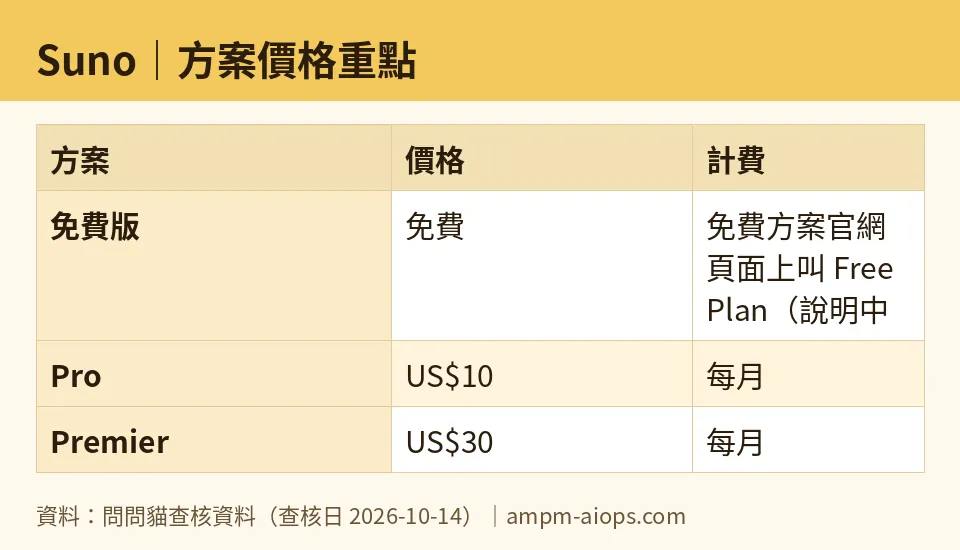
Figure: compiled by AMPM from its verified data (last verified 2026-10-14).
🔍 AMPM exclusive check
The pricing page tells you free is “No commercial use.” What it doesn’t say — and what we had to go dig up in Suno’s separate help center — is who actually owns the song. The help center states plainly that songs made on the free plan are copyrighted to Suno itself; the free-tier user is only allowed to use the result for non-commercial purposes. That’s a meaningfully bigger restriction than “you can’t sell it.” It means the free-tier creator doesn’t hold the copyright at all. Suno does. The main pricing page never uses the word “copyright” — you only find that framing by reading the help center separately. Everything else we checked — the US$10/US$30 monthly billing figures embedded in the page’s own data, the 50-credit daily reset, the 2,500 and 10,000 monthly credit caps on Pro and Premier — matched what’s displayed on the live pricing page as of our 2026-10-14 check. The gap we found wasn’t a wrong number; it was where Suno chooses to disclose the copyright assignment, and it isn’t on the page where you decide whether to subscribe.
☀️ AMO, the budget-minded cat

I went in assuming free was a trial and paid was the “real” plan. That’s not quite it. Free gives you 50 credits every single day — that’s 7 fresh shots a week with no monthly ceiling to hit and panic about. If you’re just messing around, writing a birthday song for a friend, testing what a genre mashup sounds like, free is actually not stingy on volume. The catch isn’t the number, it’s the shape: no rollover means you can’t stockpile credits for a big project weekend, you’re locked to one model (v4.5-all) while every paid tier gets access to v5.5 and friends, and your uploads cap at 8 minutes instead of 30.
The real line in the sand is commercial use. If all you want is a toy to play with and you never plan to put a song anywhere public-facing or monetized, free plus its daily reset might genuinely be enough — you don’t need to spend a cent. But the moment you want to use a song for literally anything beyond personal, non-commercial listening, free doesn’t just restrict you, it doesn’t give you the copyright at all; Suno keeps it. That’s not a feature gap you can work around by upgrading later and backdating rights — it applies to what you made while on free. If commercial use matters, the actual entry price is US$10/month billed monthly, not the US$8 the page shows you first (that number requires paying for the whole year, US$96, up front). Premier at US$30/month (US$288/year if annual) is a lot of credits — 10,000 a month — but unless you’re producing in volume or need Suno Studio specifically, that’s more than a casual user needs. For most budget-conscious users, free covers hobby noodling; Pro at US$10/month is the actual gate you pay to own and legally use what you make.
🌙 PIMI, the performance-minded cat

Strip away the price tags and look at what you can actually produce. Free locks you to one model — v4.5-all — while every paid tier opens the door to v4, v4.5, v4.5+, v5, and v5.5. If quality and newer model behavior matter to your output, free isn’t holding you back on credits, it’s holding you back on which brain is writing the song. That’s the bigger ceiling, not the 50-credit count.
Throughput is the second wall. Free runs in a shared queue capped at 4 concurrent generations; Pro and Premier both get priority queue access handling up to 10 songs at once. If you’re iterating — generating several versions of a hook and picking the best — the shared queue on free will bottleneck you well before you run out of credits. Upload length matters too if you’re remixing or extending existing audio: 8 minutes on free versus 30 minutes on paid is a real difference for anyone working with full-length reference tracks instead of short clips.
Stem separation — splitting a finished track into isolated parts like vocals and instrumental — doesn’t exist on free at all. Pro gets two separation modes, Premier gets three including “Advanced Split.” If your workflow involves pulling the vocal out to remix, or handing instrumentals to someone else, you need at least Pro. Premier’s extra edge is Suno Studio, which free and Pro users simply don’t get access to, plus the jump from 2,500 to 10,000 monthly credits — relevant only if you’re generating at real volume, not occasional tracks. For anyone treating this as a production tool rather than a toy, Pro at US$10/month is the functional floor. Premier only earns its US$30/month if you’re either burning through credits fast or specifically need Suno Studio.
Verdict: who should use it, who should skip it
Free works for casual, non-commercial experimenting — the 50-credit daily reset is actually decent volume for someone just playing around, as long as you accept one model, a shared queue, and the fact that Suno — not you — holds the copyright on anything you make. Skip free if you have any plan to use a song commercially or need the copyright yourself; that right simply isn’t available at US$0, no matter how many credits you have left.
Pro, at US$10/month billed monthly (or US$96/year if you commit annually), is the real starting point for anyone who wants commercial rights, newer models up through v5.5, a priority queue, and basic stem separation. Premier, at US$30/month billed monthly (US$288/year annually), only makes sense if you need Suno Studio specifically or you’re burning through more than 2,500 credits a month — otherwise its extra credit ceiling is more than most users will touch.
Written: 2026-10-15 Price last verified: 2026-10-14 Tool last health-checked: 2026-10-15
🔗 Related on AMPM
📎 Sources
All prices and quotas in this article come from AMPM’s verified dataset for Suno (last verified 2026-10-14); primary sources:
🐾 Meet the cats: AMO and PIMI

AMPM is a Taiwan-based AI-tool pricing watchdog. Our motto: ask before you subscribe. Two cats argue every tool from two sides:
- ☀️ AMO — the budget-minded cat. Always asks: is the free tier enough, and is paying actually worth it?
- 🌙 PIMI — the performance-minded cat. Cares about whether it works well, fast, and gets your job done.

When they are done arguing, you know whether to pay. Every number is checked by us, with the verification date at the end.
🐾 Our sister sites also checked
Read next
- Suno Full breakdown: pricing, features and real-world limits
- Suno Is the free quota enough?
- Suno Alternatives
- Free plan limits for every AI tool we track
More verified articles on this tool
- [Use cases] Suno Free vs Paid: Who Should Actually Upgrade in 2026?
- [Pitfalls] Suno's Free Tier Resets Daily, and the Pricing Page Doesn't Show What You'll Actually Pay
- [Special] Suno's Free Tier Resets Every Day, and None of the Songs Are Yours to Sell