Ask Cat › AI Tool Summary › Suno
[Special] Suno's Free Tier Resets 50 Credits a Day — and None of Them Are Yours to Sell
- Free tier: There is
- Cheapest paid plan: US$10/mo and up
- Free quota: 50 credits reset every day on the US$0/month free plan, which the …
- Last checked: 2026-10-08
Article last updated: 2026-10-05



Suno gives away a surprising amount of music-making power for free. Type in a style and some lyrics, and its free tier hands you a finished song, vocals and all, no studio, no instruments, no music theory. The catch isn’t a low cap — 50 credits a day is actually generous. The catch is what happens to those credits, and what you’re allowed to do with the song once it exists.
This piece checked suno.com/pricing and Suno’s help center directly on 2026-10-05 to see how the free plan actually behaves day to day, not just what the marketing page promises.
The daily reset nobody reads twice
Suno’s free tier — called “Free Plan” on the pricing page and still referred to as “Basic” in some help-center articles — costs US$0 a month. But the credits aren’t a monthly allowance. They’re a daily one: 50 credits, reset every day. That sounds better than a monthly quota on paper, since you never have to ration across four weeks. But the pricing page’s footer carries a specific warning: credits included in the plan do not roll over daily or monthly. Whatever part of your 50 you don’t spend today is gone tomorrow, not banked for later. There’s no stockpiling a quiet week into a big weekend session.
Generation on the free tier is also locked to one model, v4.5-all — which Suno’s own page calls the “Best free model,” implying it’s the ceiling, not a sampler. Paid plans unlock the newer model lineup: v4, v4.5, v4.5+, v5, and v5.5. If you’ve seen people online talking about Suno’s v5.5 sound, that’s not something the free tier gives you access to at all.
Free users can also generate four songs at once, but they sit in a shared queue with every other free user on the platform — not a space Suno prioritizes. Paid plans get a priority queue and can run ten songs at once. And if you want to upload your own audio to build on, the free tier caps you at 8 minutes; paid accounts get 30.
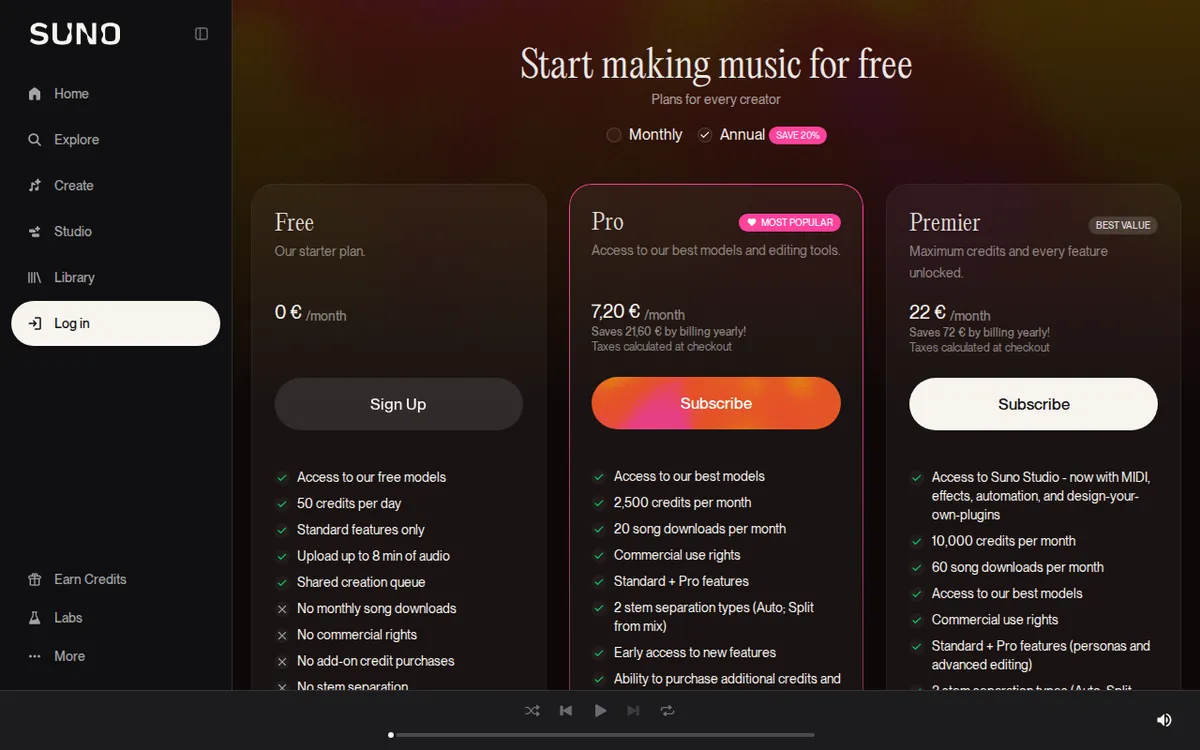
Figure: suno.com official pricing page, captured 2026-10-05.
What you can’t do, even if you never run out
Running out of credits isn’t actually the biggest limitation on the free plan — ownership is. Suno’s pricing page states plainly: no commercial use. The help center spells out what that means in practice: songs made on the free plan are copyrighted by Suno, not by the user, and you’re only permitted to use them non-commercially. So even a free song you love, that fits a video project perfectly, legally can’t go into anything you’re monetizing. You’d need a paid plan for that.
The free plan’s feature list is also explicit about what’s missing: “Standard features only.” No stem separation (splitting a track into vocals, instruments, and other layers for remixing or mastering). And critically, no add-on credits — when your 50 run out, there’s no button to buy more. You wait for tomorrow’s reset or you upgrade.
What upgrading actually buys
Suno sells two paid tiers, Pro and Premier, both billed in credits per month rather than per day.
Pro is US$10 a month if you pay monthly. The pricing page’s default display shows US$8, but that’s the monthly-equivalent rate under annual billing, where the full year costs US$96. Pro gives you 2,500 credits a month, commercial use rights on anything you make, the priority queue (up to 10 songs at once), 30-minute uploads, and two types of stem separation (automatic, and splitting from a mix).
Premier is US$30 a month billed monthly, with the page’s default US$24 figure again reflecting annual billing — a full year at US$288. Premier bumps you to 10,000 credits a month, adds a third stem-separation mode (an advanced split), and is the only tier that includes Suno Studio, a more detailed editing environment. Both paid tiers let you buy extra add-on credits if you burn through your monthly pool — the one feature free users are explicitly denied.
There’s no sign-up discount, no limited-time promo code, and no first-month markdown on Suno’s pricing page. The only price break is the standing 20% saved by committing to annual billing instead of monthly — and tax gets added separately at checkout, on top of whatever price you see.
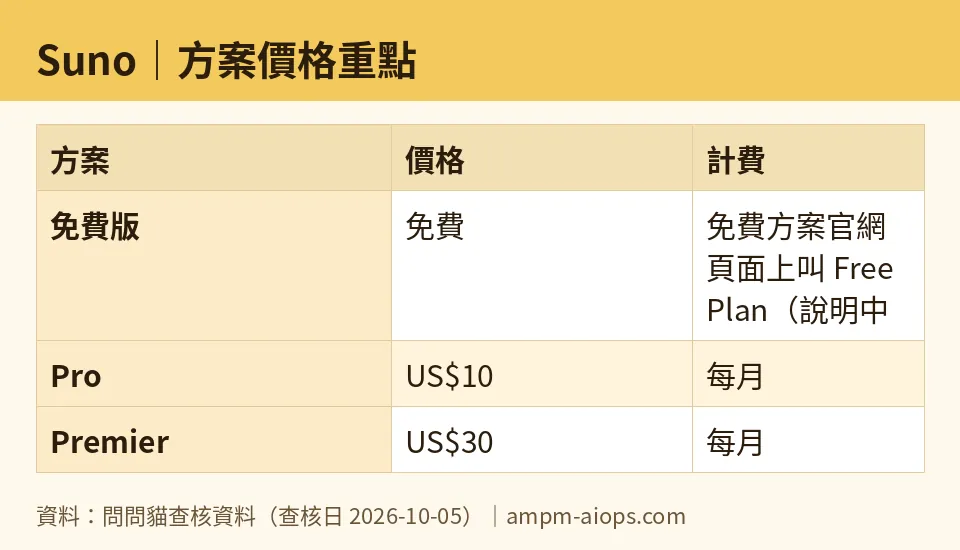
Figure: compiled by AMPM from its verified data (last verified 2026-10-05).
🔍 AMPM exclusive check
The headline price you see first on Suno’s pricing page isn’t the price you’ll actually be charged unless you pick annual billing. Pro shows US$8 and Premier shows US$24 by default — both are the monthly-equivalent rate under annual billing, while the real monthly-billing price is US$10 for Pro and US$30 for Premier. That’s not deceptive exactly, but it’s easy to glance at the big number and sign up for a monthly plan expecting the smaller figure to show up on your card. It won’t — not unless you’re on the annual plan at US$96 or US$288 for the year.
We also pulled the pricing page’s embedded data for other currencies, and it’s worth flagging what it isn’t: those aren’t currency conversions of the US dollar price. Suno lists separate monthly rates — EUR 9, GBP 8, JPY 1,500, KRW 15,000, AUD 15, CAD 14 — as independent list prices in each currency, not math applied to US$10. If you’re paying in euros or yen, don’t assume you can back into the US$ number; the figures don’t move in lockstep.
One more thing the pricing page doesn’t say outright, but the help center does: it’s not just that free songs can’t be sold — Suno states it keeps the copyright on anything made with the free plan, with users only licensed to use it non-commercially. That’s a stronger claim than “no commercial use” alone suggests, and worth knowing before you build a portfolio of free-tier tracks you plan to monetize later.
Nothing else differed from the official page this time — the credit counts, model gating, queue sizes, and upload limits all matched what’s published, checked 2026-10-05.
☀️ AMO, the budget-minded cat

AMO only cares about one question: is free enough, or is paying actually worth it? For Suno, the free tier is unusually workable for casual use — 50 fresh credits every single day beats most competitors’ monthly caps, and four songs running at once covers a weekend hobby easily. If you’re making songs for friends, for fun, or to test an idea, you may genuinely never need to pay, since the meter refills daily with no way to run it dry long-term.
But AMO also notices where free quietly boxes you in. The model you’re stuck with, v4.5-all, is explicitly the lowest tier Suno offers — the newer v5 and v5.5 models, which is what most people mean when they praise Suno’s sound quality online, require Pro at US$10/month or Premier at US$30/month. And the ownership rule is the real wall: free songs stay copyrighted by Suno, usable only non-commercially, so anyone wanting to sell a track, use one in an ad, or license it anywhere needs a paid plan regardless of how many free credits are left unused. AMO’s take: stay free if you’re making music for the joy of it, but the moment a song needs to earn money, free isn’t a cheaper option — it’s not an option at all.
Verdict: who should use it, who should skip it
Use the free plan if you’re writing songs for fun, testing lyrics against a beat, or making something for personal or non-commercial use — 50 credits reset daily is a real, usable amount, and four concurrent generations is enough for casual tinkering. Skip it, and go straight to Pro, if you want to sell, license, or monetize anything you make, since commercial rights only exist on paid plans; Pro’s 2,500 monthly credits and priority queue also matter if you’re making content regularly rather than occasionally. Go Premier only if you need Suno Studio’s deeper editing tools or the extra stem-separation mode, and you’re generating enough volume that 10,000 monthly credits justifies US$30 a month over Pro’s US$10.
Written: 2026-10-05 Price last verified: 2026-10-05 Tool last health-checked: 2026-10-05
🔗 Related on AMPM
📎 Sources
All prices and quotas in this article come from AMPM’s verified dataset for Suno (last verified 2026-10-05); primary sources:
🐾 Meet the cats: AMO and PIMI

AMPM is a Taiwan-based AI-tool pricing watchdog. Our motto: ask before you subscribe. Two cats argue every tool from two sides:
- ☀️ AMO — the budget-minded cat. Always asks: is the free tier enough, and is paying actually worth it?
- 🌙 PIMI — the performance-minded cat. Cares about whether it works well, fast, and gets your job done.

When they are done arguing, you know whether to pay. Every number is checked by us, with the verification date at the end.
🐾 Our sister sites also checked
Let's take a look at these
- Suno Comprehensive Introduction: Pricing, Features, and Actual Limitations
- Suno Is the free quota enough?
- Suno Alternatives
- Comprehensive Free Quota List for All Tools
More verified articles on this tool
- [Verified] Suno free tier: is 50 daily credits enough? Real limits and when paying starts making sense
- Suno v6 Is Here: Free Users Only Get v6-mini, All Older Models Are Being Retired, and Download Caps Already Apply
- Can You Publish Songs Made on Suno's Free Plan? Downloads, Commercial Use and How to Spend 50 Daily Credits (2026)