[Pitfalls] Suno's Free Tier Resets Daily, and the Pricing Page Doesn't Show What You'll Actually Pay
- Free tier: Yes
- Cheapest paid plan: US$10/mo and up
- Free quota: 50 credits reset every day on the US$0/month free plan, which the …
- Last checked: 2026-10-24
Article last updated: 2026-10-12


Suno lets you type a few lines of lyrics and a style description, and it hands back a finished song — vocals, instruments, the works. The free tier sounds generous on paper: 50 credits a day, no credit card required. But three things on Suno’s own pricing page are easy to misread, and all three cost people money or songs they can’t legally use. This piece covers Suno’s free tier limits, the real monthly pricing, and what actually resets, renews, or disappears.
The daily reset nobody reads to the bottom of the page
Suno’s free plan — officially called the Free Plan now, though the help center still sometimes calls it “Basic” — costs US$0 a month. You get 50 credits, which is the unit Suno spends every time you generate a song. Most AI tools that give you a free quota work on a monthly cycle: use it or lose it once a month. Suno doesn’t. The 50 credits reset every single day.

Illustration: Free daily points vanish entirely overnight and cannot be saved up for future use.
That sounds like more free usage, and it is — up to 1,500 credits a month if you use all 50 daily. The trap is in the fine print at the bottom of the pricing page: credits don’t carry over, day to day or month to month. Skip a day and the unused 50 credits are just gone. There’s no banking, no rollover, no “save them for the weekend.” If you only write songs occasionally, a chunk of that daily allowance evaporates every single day you don’t log in.
The free plan also caps you to one model, called v4.5-all, which Suno’s own page labels as “the best free model” — a nudge that better models exist elsewhere, which they do: v4, v4.5, v4.5+, v5, and v5.5 are paid-only. Free generations also share a queue — the line of requests waiting to be processed — capped at 4 songs running at once, versus 10 with priority handling on a paid plan. And uploaded audio you want Suno to work from is capped at 8 minutes on free, versus 30 minutes on paid tiers.
How to avoid the trap: if you’re on free, generate something every day even if it’s throwaway, because unused credits don’t survive past midnight. Don’t assume you can stockpile a week’s worth for one big session.
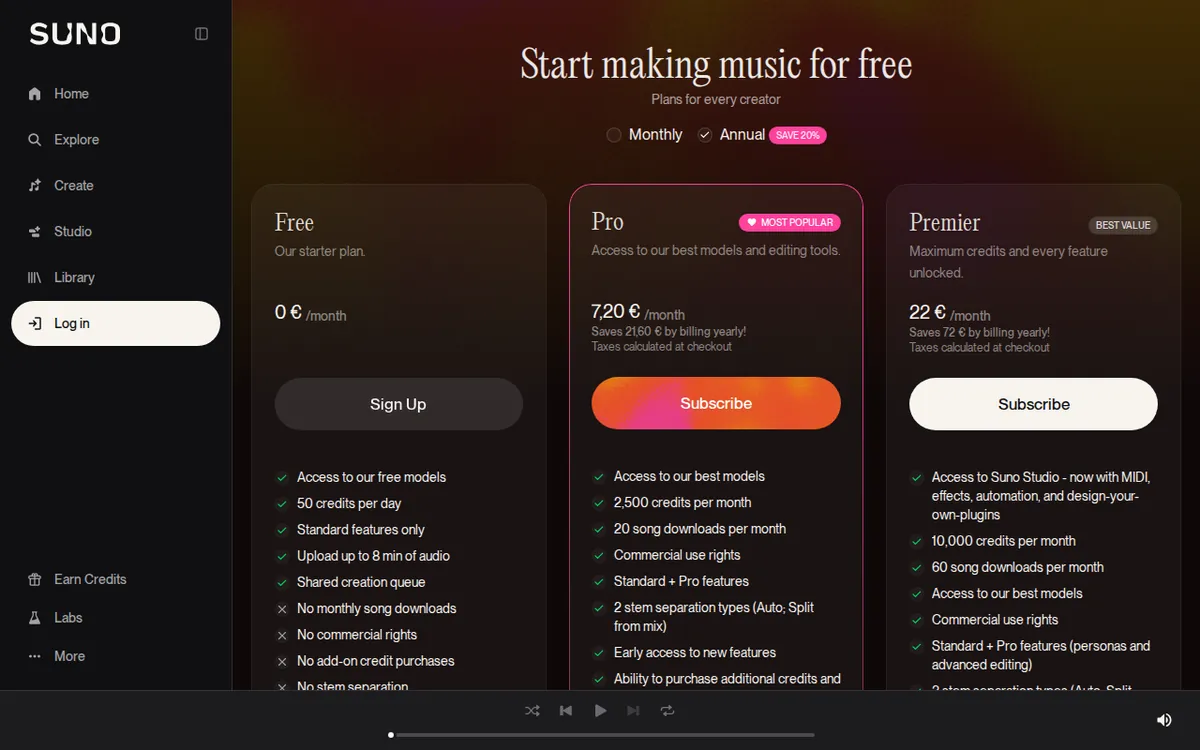
Figure: suno.com official pricing page, captured 2026-10-12.
The US$8 you see isn’t the US$10 you’ll pay
Suno’s pricing page defaults to showing annual billing, and it displays the Pro plan at US$8. That number only exists if you pay for a full year upfront. The actual monthly price — what you pay if you pick monthly billing, which is what most people click first — is US$10. We confirmed this by checking the pricing page’s own embedded data, which separately lists monthly_price_usd: 10 for Pro. The US$8 figure is the per-month average of an annual charge of US$96, not a separate cheaper monthly plan.
The same pattern repeats one tier up. Premier shows as US$24 on the page by default, but the actual monthly price is US$30. The US$24 figure is the monthly average of a US$288 annual charge.
Neither of these is hidden exactly — the word “annual” or “yearly savings” usually sits nearby — but the bigger, bolder number is the annual-equivalent one, and the actual monthly charge is secondary text. If you go to subscribe and pick “monthly” instead of “yearly,” expect the checkout to show US$10 or US$30, not the US$8 or US$24 you remembered from the page.
How to avoid the trap: before you click subscribe, check whether the toggle on the pricing page is set to “monthly” or “yearly.” If you want to pay monthly, read the smaller number, not the one anchoring the page.
Free songs: you can’t even use them for your own business
This is the trap with the least visibility and the most consequence. Suno’s pricing page says flatly: no commercial use on the free plan. The help center spells out what that means in practice — songs made on the Free Plan are copyrighted to Suno, not to you, and you’re only permitted to use them for non-commercial purposes.
That’s a different restriction from “you can’t resell the exact file.” It means a free-tier song can’t go in a YouTube video with ads, can’t be a jingle for your small business, can’t back a paid product demo — anything that counts as commercial use is off the table, full stop, regardless of how original the lyrics are. Paid plans — Pro and Premier both — include commercial use rights for new songs made under those plans.
How to avoid the trap: if there’s any chance a song will end up in something monetized, don’t make it on the free plan and try to “upgrade later.” The commercial rights attach to the plan you were on when you made the song, so free-tier songs stay non-commercial even if you subscribe afterward.
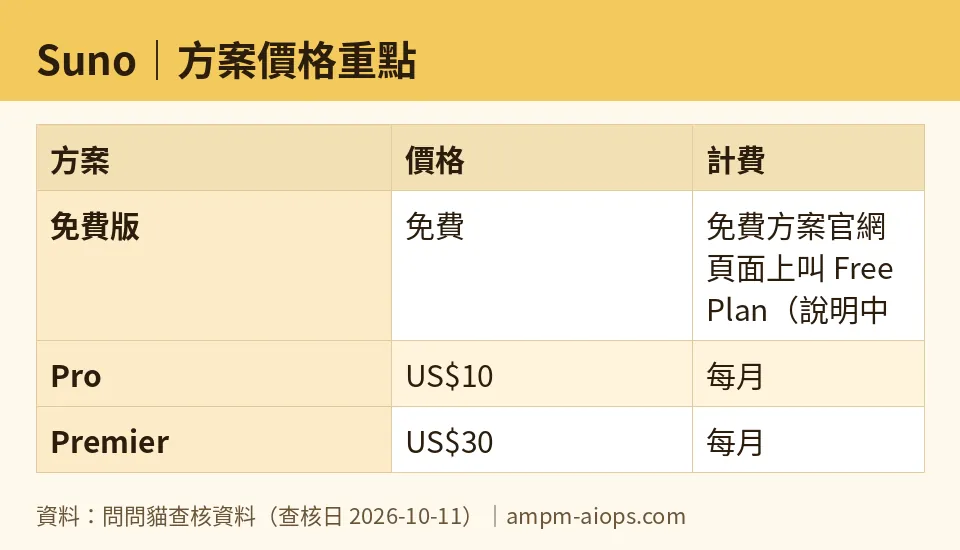
Figure: compiled by AMPM from its verified data (last verified 2026-10-11).
🔍 AMPM exclusive check
We went past the marketing copy and read the pricing page’s own embedded data (the JSON that actually drives the checkout), not just the headline numbers. Two things stood out that the page doesn’t make obvious at a glance: the Pro and Premier monthly prices are US$10 and US$30 respectively, while the big numbers shown by default — US$8 and US$24 — are annual-billing averages, confirmed directly against the monthly_price_usd fields of 10 and 30. The page doesn’t say “this number assumes a full year paid upfront” next to the headline figure; you have to notice the billing toggle.
We also checked whether Suno runs limited-time discounts or promo codes anywhere on the pricing page. It doesn’t, as of this check. The only standing discount is the regular 20% saved by choosing annual billing, and tax is calculated separately at checkout, on top of the listed price. One more thing worth flagging: the pricing page’s embedded data also carries prices in other currencies — EUR 9, GBP 8, JPY 1,500, KRW 15,000, AUD 15, CAD 14 per month — and these are set independently, not calculated by converting the US dollar price. If you’re billed in one of those currencies, don’t expect it to track the US$10 figure exactly.
☀️ AMO, the budget-minded cat

AMO only wants to know one thing: is the free version enough, or is paying actually worth it? For Suno, it depends entirely on how often you write. Free gives you 50 credits a day — up to 1,500 a month if you never skip a day — on the one model Suno calls its best free option, with a shared queue of 4 concurrent generations and an 8-minute cap on any audio you upload for reference. For casual, non-commercial use — making a birthday song, playing with a riff idea, testing whether the tool fits your style — that daily allowance is genuinely generous, and AMO would call it enough.
Where it stops being enough: the moment you need a song for anything with money attached — a video with ads, a business, a paid project — because free-tier output legally can’t be used that way regardless of quality. That’s the point where paying becomes less about quota and more about rights. Pro, at US$10 a month billed monthly (or US$96 a year), buys 2,500 credits a month, commercial use rights, priority queue access for up to 10 songs, and 30-minute uploads. For someone making songs purely for fun with no commercial angle, AMO’s take: stay free, and don’t let unused daily credits bother you — they were never going to add up to anything you could sell anyway.
Verdict: who should use it, who should skip it
Stick with free if you write songs casually, don’t need every day’s credits to carry over, and have zero plans to monetize what you make — the daily reset and non-commercial restriction won’t touch you. Move to Pro (US$10/month, or the discounted annual rate) if you want commercial rights, access to the newer models beyond v4.5-all, a priority queue, or longer audio uploads for reference tracks. Consider Premier (US$30/month) only if you need Suno Studio or the full three-way stem separation — splitting a finished track back into vocal and instrument layers — and genuinely burn through more than 2,500 credits some months. Skip any plan upgrade if your only goal is dodging the daily credit reset by banking unused credits — that’s not something any tier offers; credits simply don’t roll over on Suno, paid or free.
Written: 2026-10-12 Price last verified: 2026-10-11 Tool last health-checked: 2026-10-12
🔗 Related on AMPM
📎 Sources
All prices and quotas in this article come from AMPM’s verified dataset for Suno (last verified 2026-10-11); primary sources:
🐾 Meet the cats: AMO and PIMI

AMPM is an independent AI-tool pricing watchdog tracking official prices worldwide. Our motto: ask before you subscribe. Two cats argue every tool from two sides:
- ☀️ AMO — the budget-minded cat. Always asks: is the free tier enough, and is paying actually worth it?
- 🌙 PIMI — the performance-minded cat. Cares about whether it works well, fast, and gets your job done.

When they are done arguing, you know whether to pay. Every number is checked by us, with the verification date at the end.
🐾 Our sister sites also checked
Read next
- Suno Full breakdown: pricing, features and real-world limits
- Suno Is the free quota enough?
- Suno Alternatives
- Free plan limits for every AI tool we track
More verified articles on this tool
- [Use cases] Suno Free vs Paid: Who Should Actually Upgrade in 2026?
- [Review] Suno Free vs Paid: The Daily Reset Nobody Reads Twice
- [Special] Suno's Free Tier Resets Every Day, and None of the Songs Are Yours to Sell