[News] DoorDash Says AI Agents Placed Only 'Several Hundred' Orders: Should Taskade Users Care?
- Free tier: Yes
- Cheapest paid plan: US$10/mo and up
- Free quota: Free tier includes 1 user, up to 3 AI apps, one-time 6,000 AI credits …
- Last checked: 2026-10-29
Article last updated: 2026-11-01


AI agents were supposed to be the next big way people buy things. DoorDash has now said that, so far, they have placed only “several hundred” orders on its platform. That is a small number for a company of its size. Our angle: this says little about whether agent tools like Taskade are useful, but it says a lot about which kind of agent is actually working today.
What happened
On 30 October 2026, TechCrunch reported that DoorDash said it has received only “several hundred” orders from AI agents. Ars Technica covered the same story. Two independent outlets carried it, which is why we are treating it as a real data point and not a rumor.
An AI agent, in plain terms, is software that takes actions for you instead of only answering questions. In this case, the idea is that you tell an assistant “order me dinner” and it goes to a delivery app and does it, without you tapping through menus.
The headline claim is simple. DoorDash has been open to this idea, and the volume of orders arriving that way is tiny. “Several hundred” is DoorDash’s own phrasing, as quoted in the reports. We are not adding figures of our own, and we are not restating details from the full reports beyond that headline. If you want the full context, the links are in the Sources section below.
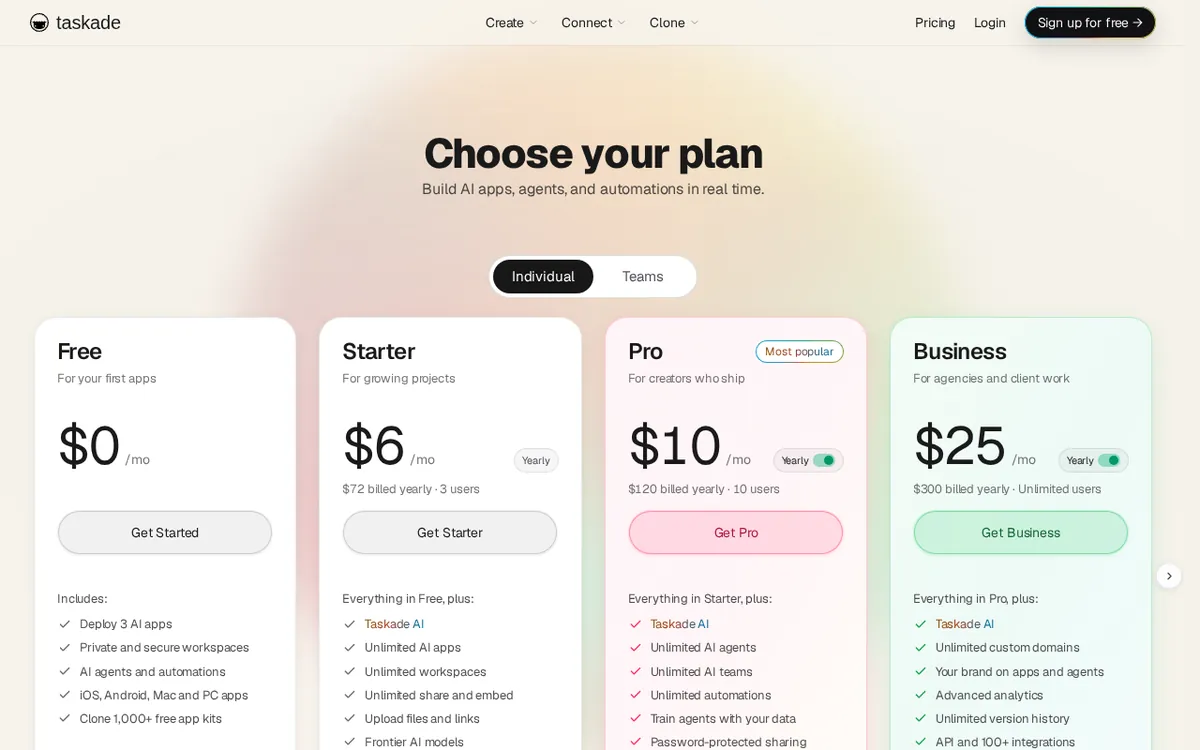
Figure: taskade.com official pricing page, captured 2026-11-01.
How AMPM sees it
The number is small, but it is hard to read
A small count can mean several different things. Everything in this section is inference, not reporting.
- Demand may be low. People may not yet trust an assistant to spend their money and pick their food.
- Supply may be low. Few assistants may be able to place orders on a delivery platform at all, so there is little to count.
- Friction may be high. Payment, login, address and substitution problems are hard for software to handle. Failed attempts would not show up as orders.
- Both sides may be early. If the tools and the platforms are still being wired together, a low count is what you would expect.
The report gives us the count, not the reason. Anyone who tells you it proves agents are hype, or proves they are about to take off, is going further than the evidence.
Who is actually affected
If you use Taskade, nothing changes today. We have no indication that this story touches Taskade’s product, and nothing in the reports mentions it. Taskade is on our radar because it sells AI agents, and readers ask whether that category is worth building a workflow around.
The key difference is where the agent works.
Agents that buy things from outside businesses. This is the DoorDash case. The agent has to deal with someone else’s app, someone else’s rules, and your money. Many parties must cooperate, and any one of them can block it.
Agents that work inside your own workspace. This is closer to what Taskade describes. It is a workspace for projects and team collaboration, with custom AI agents, AI automations, and an app generator. Per our verified data, it also offers background agents that run on a schedule and an API and webhooks for connecting to other tools. An agent that drafts a task list, summarizes notes, or moves items through a board only needs access to your own data. There is no checkout, no delivery address, and no third party to say no.
Our inference: the second kind of agent is easier to make work, so a weak result for the first kind does not transfer neatly to the second. A low order count at DoorDash is a statement about consumer purchasing agents. It is not a test of project-management agents.
Privacy and safety angles
The story is a useful reminder of what you hand over when you let software act for you.
- Spending authority. An agent that can order food can, in principle, spend money. Check what limits and confirmation steps exist before you grant that.
- Account access. To act inside another service, an agent usually needs your login or a token that stands in for it. That is a real exposure if the tool is compromised.
- Data sharing. Your address, order history, and habits would pass through whatever company runs the agent.
These are general risks of the category, not findings about any named product. They are also a reason the inside-your-workspace use case is the lower-risk one: less money, less outside access.
Where this fits in the industry
Agent announcements have run well ahead of agent usage for a while. Vendors show demos of an assistant booking, buying, and scheduling. Then the usage numbers arrive and they are modest. DoorDash putting a figure on it, even a vague one, is useful because most companies do not. We would read it as a sign that the consumer-buying version of agents is at an early stage. We would not read it as a sign the whole category is failing.
Our second inference: the agents that find real users first will be the boring ones. They are the ones that handle repeated, low-stakes work where a mistake costs little, like sorting tasks, drafting updates, and running a routine automation. That is where tools like Taskade are aiming.
What to watch next
- Follow-up numbers. Does DoorDash, or any other platform, publish a later count? One “several hundred” figure is a snapshot. A trend is what matters.
- Platform stance. Whether delivery and shopping platforms build official routes for agents, or push them away, will decide a lot.
- Failure reports. If agents place wrong orders or get charged incorrectly, expect tighter rules.
- Your own use. If you are trying an agent tool, track what it actually completes for you in a week. Your own count tells you more than any industry headline.
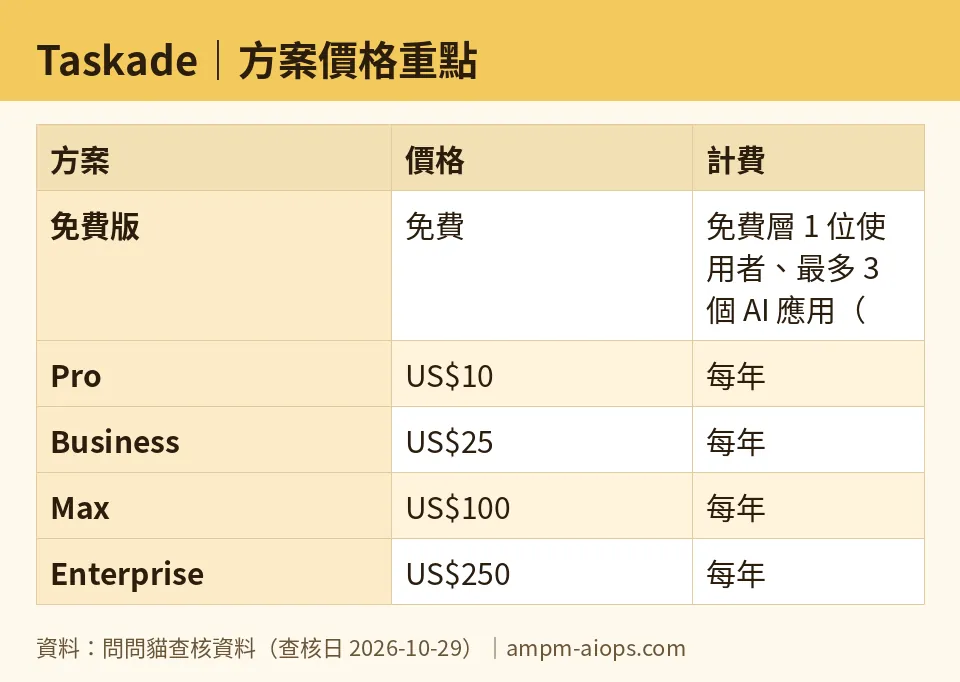
Figure: compiled by AMPM from its verified data (last verified 2026-10-29).
🔍 AMPM exclusive check
We checked what this story does and does not say about Taskade. Our records, last updated 31 October 2026, show Taskade’s official site and pages describing AI agents, automations, and an app generator. None of that material mentions DoorDash, ordering, or agent-driven purchases. The link between the two comes from us, not from either company. That is why we treat the story as context for the category and not as news about the product.
Verdict: who should use it, who should skip it
Reading this as a reason to keep or drop Taskade: don’t. Nothing in the DoorDash report changes what Taskade does or how well it does it. If a workspace with built-in agents and automations suited you last week, it suits you today.
Worth trying if you want agents that work on your own projects and notes, where the stakes are low and you stay in control of the data.
Skip it, or wait, if what you really want is an assistant that buys things and runs errands for you in the outside world. The DoorDash figure suggests that part of the market is still early, and no workspace tool changes that.
For everyone: be cautious about handing any agent payment access or account logins until you know what limits and confirmation steps it has.
Sources
- TechCrunch, “DoorDash said it’s only received ‘several hundred’ orders from AI agents”, 30 October 2026: https://techcrunch.com/2026/10/30/doordash-said-its-only-received-several-hundred-orders-from-ai-agents/
- Ars Technica, coverage of the same DoorDash statement: arstechnica.com
- Taskade, official site: https://www.taskade.com
Written: 2026-11-01 Price last verified: 2026-10-29 Tool last health-checked: 2026-10-31
🔗 Related on AMPM
📎 Sources
All prices and quotas in this article come from AMPM’s verified dataset for Taskade (last verified 2026-10-29); primary sources:
🐾 Meet the cats: AMO and PIMI

AMPM is a Taiwan-based AI-tool pricing watchdog. Our motto: ask before you subscribe. Two cats argue every tool from two sides:
- ☀️ AMO — the budget-minded cat. Always asks: is the free tier enough, and is paying actually worth it?
- 🌙 PIMI — the performance-minded cat. Cares about whether it works well, fast, and gets your job done.

When they are done arguing, you know whether to pay. Every number is checked by us, with the verification date at the end.
🐾 Our sister sites also checked
Read next
- Taskade Full breakdown: pricing, features and real-world limits
- Taskade Is the free quota enough?
- Taskade Alternatives
- Free plan limits for every AI tool we track
More verified articles on this tool
- [How-to] Taskade's Free Tier: Why Part of Your AI Credits Must Be Earned First
- [Verified] Taskade's Free Credits Don't Renew: Is Paying Worth It?
- Taskade's Real Credit Price: Which Plan Is Cheapest per Credit, and One That Costs More Than Pro