Ask Cat › AI Tool Summary › Udio
[Special] Udio's Free Tier Looks Generous — Until You Hit the 3-Song Daily Cap
- Free tier: There is
- Cheapest paid plan: US$10/mo and up
- Free quota: The free version offers 10 points per day + 100 points per month …
- Last checked: 2026-10-02
Article last updated: 2026-10-04



Udio’s free tier advertises 10 credits a day and 100 a month to make AI-generated songs. Credits are the usage currency Udio charges per generation — you spend them whether the track is a keeper or garbage, and on the free tier they don’t roll over, so leftover credits vanish at the end of each day. Ten a day sounds workable for casual songwriting. But the number that actually controls your day isn’t the credit count. It’s a separate, harder limit: you can only create 3 full-length (130-second, so about 2 minutes 10 seconds) songs per day, no matter how many credits you’re sitting on.
That distinction matters because it changes how you should read “free tier” claims. A lot of AI tools cap you by credits alone — run out, and you wait. Udio stacks two caps on top of each other, and the second one is easy to miss if you only skim the pricing page.
What the free plan actually gives you
No credit card is required to start, which is the normal low-friction setup for freemium AI tools. Once you’re in, the free account gives you:
- 10 credits per day, 100 credits per month (not cumulative — unused daily or monthly credits don’t carry forward)
- Up to 4 songs generating at the same time
- A hard limit of 3 full-length (130-second) songs per day
Those 100 monthly credits work out to roughly 1 to 3 songs a day depending on length and how many retries you burn, according to Udio’s own figures. For someone dabbling — a jingle here, a birthday song there — that’s enough to get a feel for the tool without paying anything.
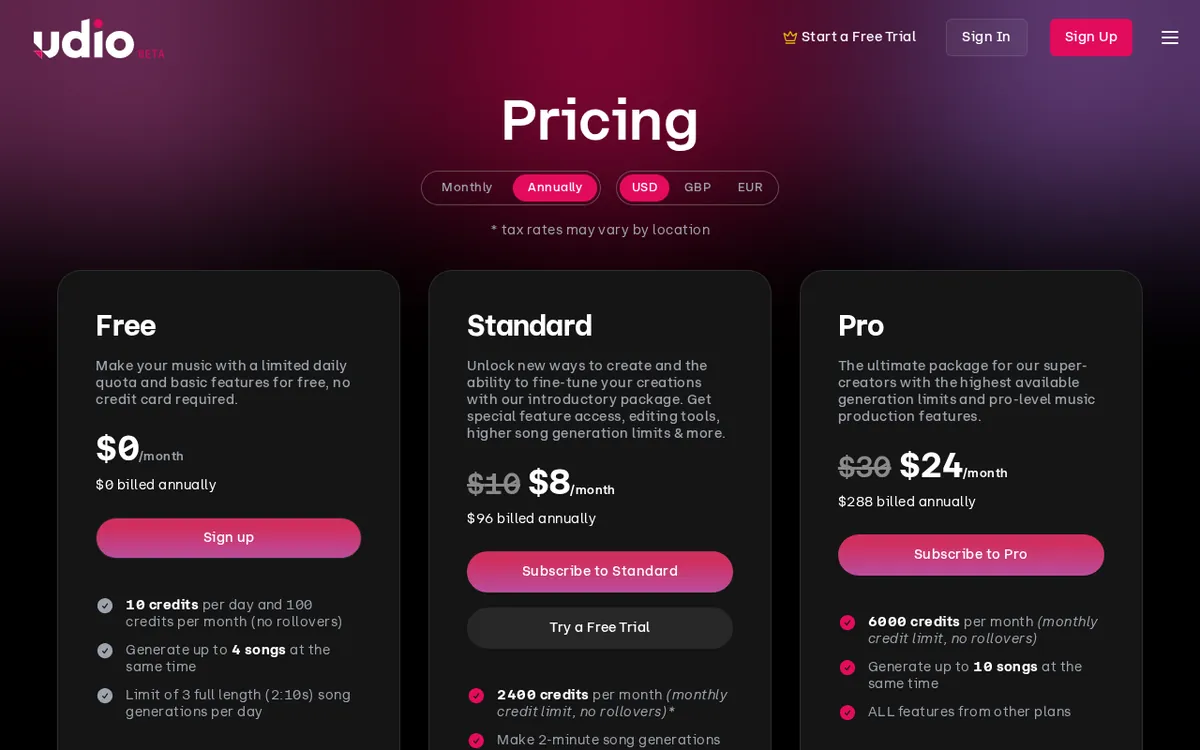
Figure: udio.com official pricing page, captured 2026-10-04.
Where the cap bites: credits vs. song slots
Here’s the part that trips people up. Credits measure usage. The 3-song cap measures something else: how many full-length tracks you’re allowed to finish in a day, independent of your credit balance. You could, in theory, still have credits left after your third full song and still be blocked from making a fourth. The two systems run in parallel, and the song cap is the tighter of the two for anyone trying to produce more than a handful of finished tracks daily.

Illustration: Daily full-length tracks run out fast for iterative creators, hitting an immovable ceiling before the workday even ends.
This is also where the free tier’s generosity is more about letting you experiment — short clips, retries, variations within your 4-slot simultaneous generation limit — than about letting you finish multiple complete songs a day. If your goal is one polished track to share, 3 a day is plenty. If you’re trying to build out an album’s worth of material, you’ll hit the ceiling fast.
What changes when you pay
Udio has two paid tiers, both billed in US dollars, charged monthly by default:
- Standard: US$10/month, or about US$8/month if billed annually (US$96/year, with no stated end date on that annual discount). It includes 2,400 credits a month, and — critically — removes the 3-song-a-day restriction entirely. You can still make 130-second songs, just not capped at three of them daily. Standard also adds Voice Control, lyric and music editing, generating songs from uploaded audio, using an existing song as a style reference, uploading custom cover art, and running up to 6 simultaneous generations (up from 4 on free).
- Pro: US$30/month, or about US$24/month billed annually (US$288/year, also with no stated discount end date). It comes with 6,000 credits a month and a higher generation quota than Standard, aimed at people producing at volume.
The jump from free to Standard isn’t just “more credits.” It’s removing the daily song cap that’s the actual bottleneck for anyone making more than casual one-offs.
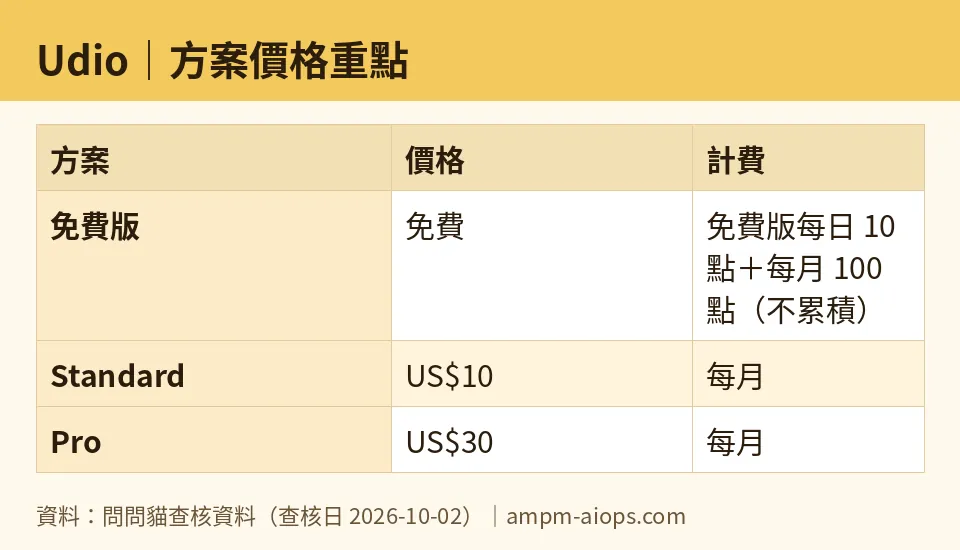
Figure: compiled by AMPM from its verified data (last verified 2026-10-02).
🔍 AMPM exclusive check
The vendor’s pricing page lists the credit numbers clearly — 10/day, 100/month on free, 2,400/month on Standard, 6,000/month on Pro. What it does not spell out prominently is that the free tier’s real constraint isn’t the credit math at all — it’s the separate 3-full-song-per-day limit, confirmed directly against Udio’s own feature breakdown rather than inferred from the credit allowance. Someone doing the credit math alone (100 credits ÷ 10 a day = plenty of room) would reasonably expect more output than they’ll actually get, because the song cap overrides the credit balance. We also confirmed no credit card is required to open a free account, and that free and monthly credits explicitly do not carry over — both details that are easy to miss on a first skim. Everything else — the US$10 and US$30 monthly prices, the roughly 20% annual discount bringing those to about US$8 and US$24 a month, and the 2,400/6,000 monthly credit figures for Standard and Pro — matches Udio’s own pricing page as checked on 2026-10-02. No undisclosed fees or hidden quota changes turned up.
☀️ AMO, the budget-minded cat

AMO only cares about one thing: is the free version enough, or is paying actually worth it. For Udio, the honest answer depends entirely on how many finished songs you need per day, not how many credits you have. The free tier’s 10-credits-a-day, 100-a-month allowance is generous on paper, but the 3-full-song daily cap is the real wall — and it’s a wall that bites regardless of leftover credits. If you’re making one song every day or two, just to mess around, free is genuinely enough: you’ll rarely bump into the 3-song ceiling, and you’re not paying a credit card to find that out. But if you’re a working musician or content creator who needs 4, 5, 6+ complete tracks a day, free stops working fast, and the math tips toward Standard at US$10/month (or US$8/month paid yearly, US$96/year total). Standard’s 2,400 monthly credits and the removal of the daily song cap are the two things actually worth paying for — not extra credits for their own sake. Pro’s US$30/month (US$24/month annually, US$288/year) only makes sense once Standard’s 2,400 credits and higher-volume ceiling are the thing running out, not before.
Verdict: who should use it, who should skip it
Use the free tier if you want to try AI songwriting without commitment, you’re fine with a 3-song-a-day ceiling, and you don’t need lyric editing, audio uploads, or style-reference tools. It costs nothing, needs no credit card, and lets you test Udio’s actual output quality before spending anything.
Skip straight to Standard (US$10/month, or US$8/month annually) if you’re producing more than a few finished songs a week and the 3-song daily cap is the thing stopping you — not a lack of credits. The feature list that comes with it — voice control, lyric editing, audio-to-song generation, style references, custom cover art — is aimed at people treating this as an actual workflow, not a toy.
Only go to Pro (US$30/month, or US$24/month annually) once Standard’s 2,400 monthly credits are consistently running dry. For most casual and semi-regular users, Standard is the plan that actually removes the limit that matters.
Written: 2026-10-04 Price last verified: 2026-10-02 Tool last health-checked: 2026-10-04
🔗 Related on AMPM
📎 Sources
All prices and quotas in this article come from AMPM’s verified dataset for Udio (last verified 2026-10-02); primary sources:
🐾 Meet the cats: AMO and PIMI

AMPM is a Taiwan-based AI-tool pricing watchdog. Our motto: ask before you subscribe. Two cats argue every tool from two sides:
- ☀️ AMO — the budget-minded cat. Always asks: is the free tier enough, and is paying actually worth it?
- 🌙 PIMI — the performance-minded cat. Cares about whether it works well, fast, and gets your job done.

When they are done arguing, you know whether to pay. Every number is checked by us, with the verification date at the end.
🐾 Our sister sites also checked
Let's take a look at these
- Udio Comprehensive Introduction: Pricing, Features, and Actual Limitations
- Udio Is the free quota enough?
- Udio Alternatives
- Comprehensive Free Quota List for All Tools