[Pricing] v0 Pricing: How Far the Free Tier Goes, and Is the Plus Plan Worth It?
- Free tier: Yes
- Cheapest paid plan: US$30/mo and up
- Free quota: The free plan is US$0/month, with a quota that is a dual limit of …
- Last checked: 2026-10-23
Article last updated: 2026-10-08


v0 is Vercel’s text-to-UI tool — you describe a web page or app in plain English and it generates working front-end code. The free tier looks generous until you read the fine print: it isn’t one limit, it’s two, and they rarely run out at the same time. And once you move to paid plans, the jump from Plus to Business isn’t buying you more usage at all — it’s buying something else entirely. Here’s what the free tier, Plus, and Business actually include, verified against v0’s own pricing and docs pages on 2026-10-05.
The free tier’s real ceiling: two limits, not one
Free costs US$0 a month, but v0 caps you two different ways, and whichever you hit first stops you:
- US$5 of monthly credits. Credits are a prepaid usage balance — v0 bills by “tokens,” which are the chunks of text a model reads and writes. Every prompt you send and every response you get back draws down your credit balance based on which model you used and how much text moved through it.
- 7 messages a day, full stop, regardless of how much of your US$5 you’ve spent.
How fast the US$5 disappears depends entirely on which model answers you. v0 publishes per-model token prices: v0 Mini costs US$1 per million input tokens and US$5 per million output tokens; v0 Pro is US$3 and US$15; v0 Max is US$5 and US$25; v0 Max Fast is US$10 and US$50. Run the math on the most expensive tier, v0 Max, and your US$5 of free credit is worth roughly 200,000 output tokens — a few substantial generations, not a week of daily prototyping.
Two things make this less brutal than it sounds. First, unused credit rolls over to your next billing cycle — it doesn’t vanish on day one of the month. Second, it does eventually vanish: v0’s docs put the expiry at 65 days. Third, and this is the part the pricing page doesn’t shout about: free users cannot buy extra credits even if they want to. Add-on credit purchases are restricted to paid plans. Hit US$0, or hit 7 messages, and you wait for the reset — there’s no “just pay US$5 more” button on the free tier.
What free does still include, no asterisks: deploying your generated app straight to Vercel, visual editing through Design Mode, GitHub sync, and basic usage analytics. For a one-off prototype or a “can this tool even do what I need” test, that’s a genuinely usable free tier — you’re just boxed in by whichever wall you hit first.
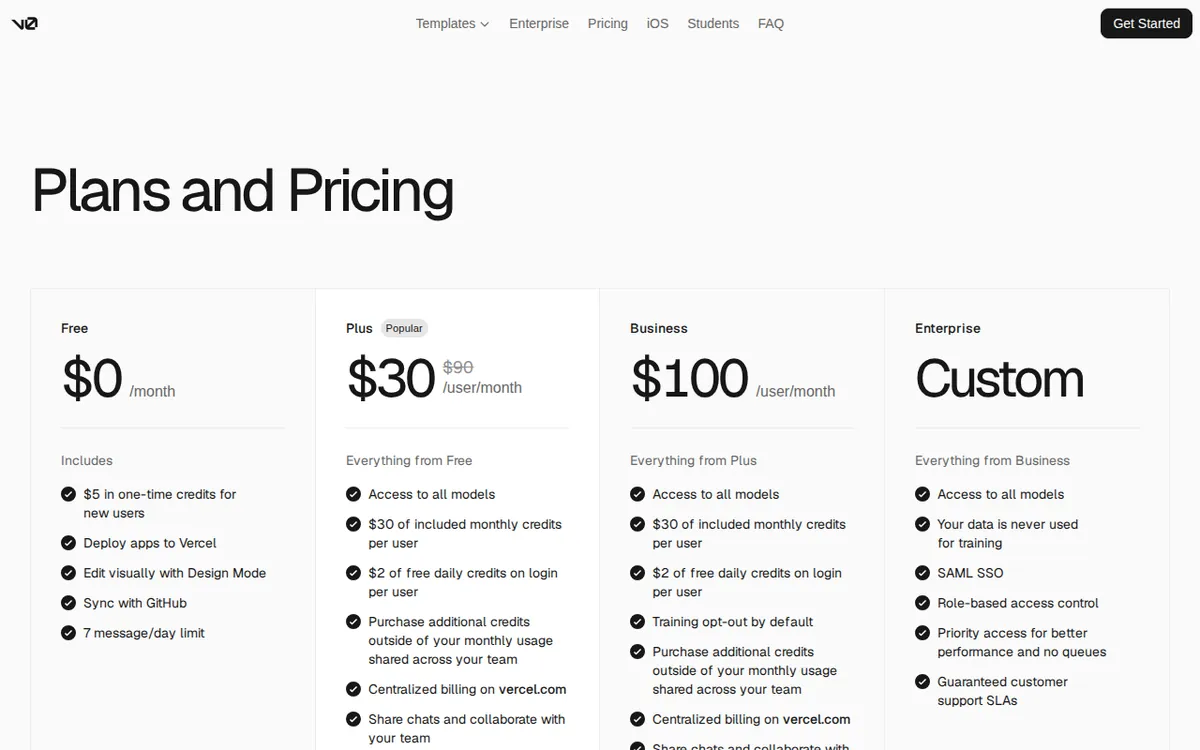
Figure: v0.app official pricing page, captured 2026-10-08.
Plus at US$30: what your money actually buys
The only paid entry point is Plus, at US$30 per seat per month — “seat” meaning one paid user license; v0 has no household or unlimited-user pricing, you pay per person. That US$30 converts directly into US$30 of monthly credit for that person, plus a US$2 credit top-up every day they log in. Stack the daily logins across a full month and that’s meaningfully more running room than the free tier’s US$5, on top of the higher message ceiling implied by not being capped at 7/day in the same way.
Plus also unlocks access to every model (not just whichever ones free users get routed to), lets a team pool and share any extra credits they buy, centralizes billing through vercel.com if you’re already a Vercel customer, and adds shared chats and basic team collaboration.
There’s no annual option anywhere on v0’s pricing page — Plus and Business are both month-to-month only, so there’s no discount to chase by committing for a year, and nothing to calculate there.
Business at US$100: same credits, different product
This is the part worth slowing down on. Business costs US$100 per seat per month — more than triple Plus — but each Business seat still gets exactly US$30 of monthly credit and the same US$2-per-login daily bonus as a Plus seat. The usage budget per person does not go up when you pay more.

Illustration: The Business plan costs significantly more than Plus, yet provides the exact same monthly allowance without extra credits.
What Business actually adds is a policy switch and a label: training opt-out is on by default, meaning v0 won’t use your team’s prompts and generated code to train its models, without you having to configure anything. Plus doesn’t have that default — your data situation on Plus is the standard setting, not opt-out-by-default. Business keeps every other Plus feature (all models, shared credit pool, centralized billing, shared chats).
So the honest read on Business is: you’re not paying US$70 extra for more AI usage. You’re paying for a compliance default that matters if your legal or security team cares where prototype code and prompts end up — and that’s the entire differentiator. If that’s not a concern for your team, Business has no usage advantage over Plus at a third of the price.
Above both sits Enterprise, which has no listed price — it’s quote-only — and adds SAML single sign-on, role-based access control, a stronger guarantee that data is never used for training, priority compute access (no queue), and a support SLA.
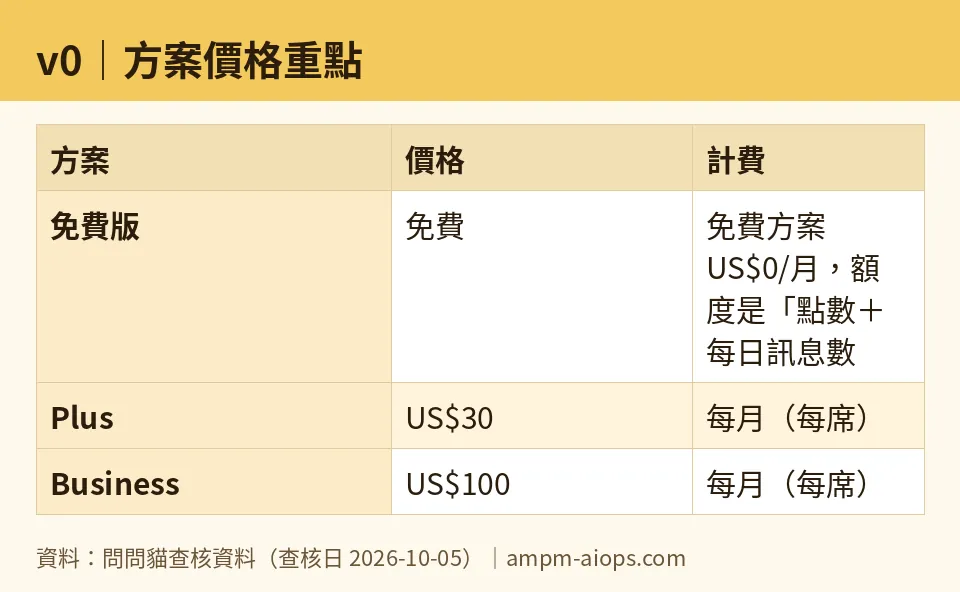
Figure: compiled by AMPM from its verified data (last verified 2026-10-05).
🔍 AMPM exclusive check
The one thing v0’s pricing page states plainly but easily gets skimmed past: the free tier has no credit top-up option at all. Our check of the docs confirms the add-on purchase feature — buying more credit mid-cycle — is gated to paid tiers only, not available to free users under any circumstance. A free user who burns through US$5 of v0 Max usage, or who simply opens the app eight times in a day, is stopped cold until the daily or monthly reset, with no “pay a little more to keep going” path. That’s a harder stop than most token-metered free tiers offer, and it’s not emphasized as a distinct rule on the pricing page itself — it shows up only in the supporting docs. Beyond that one gap, nothing differed from the official page this time; every number above — the US$5 free credit, the 7-message cap, the per-model token rates, the US$30 Plus price, the US$30-credit-plus-US$2-daily structure on both Plus and Business, and the US$100 Business price — matches v0’s own pricing and documentation pages, checked 2026-10-05.
☀️ AMO, the budget-minded cat

AMO’s question is always the same: is free enough, and if not, is paying actually worth it? For v0, free is enough only for light, occasional use — a US$5 credit ceiling and a 7-message daily cap mean you’re testing the tool, not building on it day after day. If you’re mocking up one landing page a week and staying on cheaper models like v0 Mini, free can realistically last you a while, since US$5 goes much further at US$1/US$5 per million tokens than it does on v0 Max’s US$5/US$25 rates. The moment you want v0 Max–level output regularly, or you’re hitting that 7-message wall before your credit even runs dry, free stops being workable and Plus’s US$30/month — which buys you US$30 of credit plus a daily US$2 top-up — is the realistic next step, not a luxury. What AMO would flag as money wasted: paying for Business specifically to get more usage. Business’s US$100/month buys the exact same US$30 credit allowance as the US$30 Plus plan — the extra US$70 buys a training-data opt-out default, nothing more. Unless that default matters to your legal team, Business is US$70/month for a feature switch, not more room to build.
Verdict: who should use it, who should skip it
Stick with free if you’re kicking the tires on v0 or only need a prototype here and there — just know you’ll hit either the US$5 credit or the 7-message daily cap, whichever comes first, and there’s no way to buy past it on the free tier. Move to Plus (US$30/seat/month) the moment free’s limits start blocking real work; it’s the only paid entry point and it meaningfully raises both the credit budget and the daily ceiling. Skip Business unless you specifically need the training-data opt-out as a default — it costs more than triple Plus for the identical US$30 monthly credit per seat, so paying for it purely to “get more v0” is a waste. Enterprise is a different conversation entirely, reserved for teams that need SSO, RBAC, guaranteed no-training-use, and an SLA — talk to v0’s sales team for that price, since nothing is published.
Written: 2026-10-08 Price last verified: 2026-10-05 Tool last health-checked: 2026-10-08
🔗 Related on AMPM
📎 Sources
All prices and quotas in this article come from AMPM’s verified dataset for v0 (last verified 2026-10-05); primary sources:
🐾 Meet the cats: AMO and PIMI

AMPM is an independent AI-tool pricing watchdog tracking official prices worldwide. Our motto: ask before you subscribe. Two cats argue every tool from two sides:
- ☀️ AMO — the budget-minded cat. Always asks: is the free tier enough, and is paying actually worth it?
- 🌙 PIMI — the performance-minded cat. Cares about whether it works well, fast, and gets your job done.

When they are done arguing, you know whether to pay. Every number is checked by us, with the verification date at the end.
🐾 Our sister sites also checked
Read next
- v0 Full breakdown: pricing, features and real-world limits
- v0 Is the free quota enough?
- v0 Alternatives
- Free plan limits for every AI tool we track
More verified articles on this tool
- Vercel Flat Rate CDN Hits GA for Pro: Traffic Spikes Stop Becoming Surprise Bills — Should You Switch?
- Vercel Made Production Deployment Protection Free: What Changed, and the Setup Steps
- Vercel Sandbox Domain Lookups Got Dramatically Faster: How It Works, and Which Regions Gain Most