[News] Outside AI Agents Brought DoorDash Only Hundreds of Orders: What That Tells Vapi-Style Voice Builders
- Free tier: Yes
- Cheapest paid plan: US$0/mo and up
- Free quota: As of 2026-09-16 the official pricing page has been restructured into …
- Last checked: 2026-11-02
Article last updated: 2026-11-01


Vapi builds voice agents: software that answers or places phone calls and talks like a person. This week’s agent news didn’t come from Vapi. It came from DoorDash, and from a fleet-tech company called Netradyne. Our angle is simple: when a big platform reports that outside AI agents have produced only a few hundred orders, it is a useful reality check for anyone planning to buy voice-agent infrastructure on hype alone.
One caveat first. The material we have for this piece is the Ars Technica headline and link, a short summary, and the fact that a second outlet, Fleet Equipment, covered a related story. We have not seen the full text of either report. Everything below that goes beyond those facts is labeled as our inference.
What happened
Ars Technica reported that DoorDash says outside AI agents have so far led to only hundreds of orders. “Outside” here means agents built by other companies, which can browse and order on a user’s behalf, as opposed to DoorDash’s own app. The story’s headline frames the number as small.
Hundreds is a tiny figure for a delivery platform of that size. We don’t have the exact count, the time window, or which agents were involved. The headline gives only the scale.
A second outlet, Fleet Equipment, covered a different company: Netradyne, which sells safety and video tools for commercial fleets. Its headline describes an “agent ecosystem” that lets fleets build their own AI agents. Our data tags this item as a cross-source match to the DoorDash story. It lists two independent outlets, arstechnica.com and fleetequipmentmag.com. We don’t know how closely the two stories relate beyond that tag. We also have no evidence that either report names Vapi.
So the news, as far as we can verify, is two data points about the same trend:
- A large consumer platform says agent-driven demand from third parties is still very small.
- An industrial software vendor is nonetheless opening a platform for customers to build their own agents.
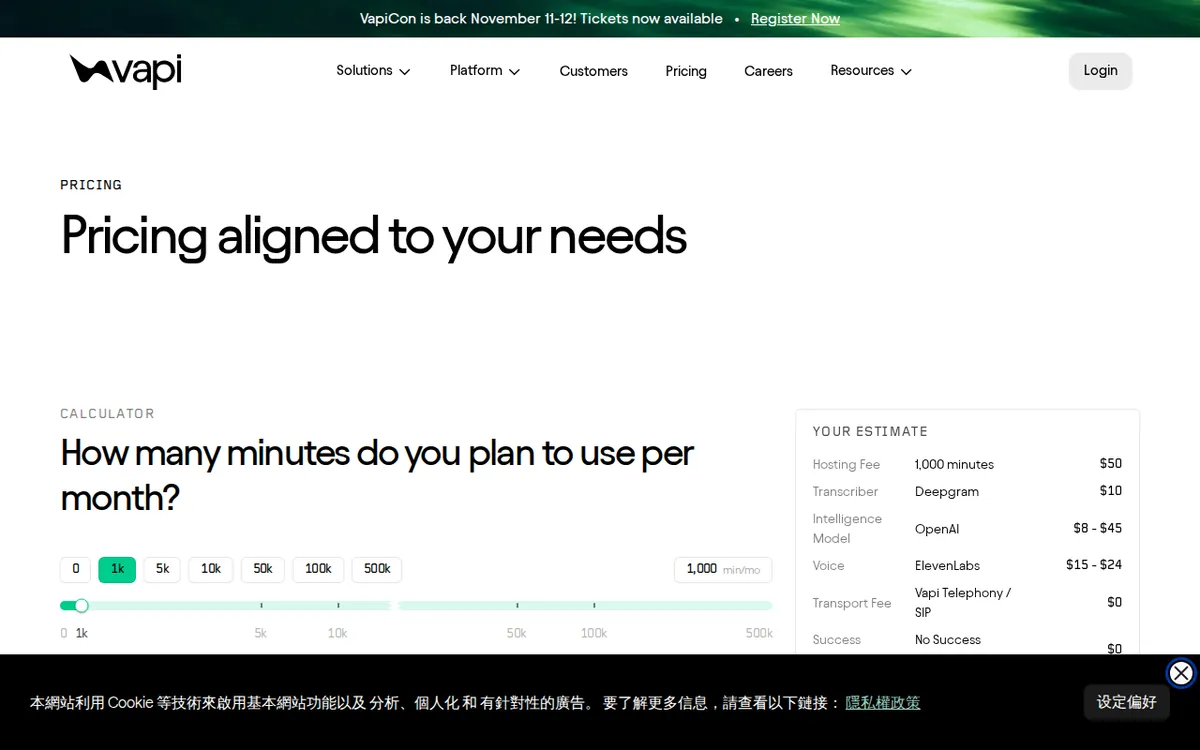
Figure: vapi.ai official pricing page, captured 2026-11-01.
How AMPM sees it
Why a Vapi page carries a DoorDash story
Vapi sells infrastructure. In plain terms, it is the plumbing that lets a developer or company assemble a voice bot: speech recognition, a language model, a synthetic voice, and a phone line, wired together. Customers build their own agent on top.
That puts Vapi one step away from consumer-facing agent stories like DoorDash’s. But the business logic is the same. Vapi’s value depends on companies actually deploying agents that real people talk to. If outside agents are barely moving orders at a major platform, that is a signal about how fast agent usage is growing in the real world. (Inference: the signal is about demand, not about Vapi’s product quality.)
What the DoorDash number does and doesn’t say
It says: third-party agents are not yet a meaningful sales channel for at least one large platform. A few hundred orders won’t change anyone’s revenue.
It doesn’t say:
- That agents don’t work. Low volume can come from awkward ordering flows, weak trust, missing payment hooks, or users simply not knowing the option exists.
- That voice agents specifically are failing. The report, as headlined, is about outside agents ordering from a platform. Phone-call automation for customer service or appointment booking is a different job.
- That agent builders are in trouble. We have no data on that.
Our reading (inference): agents are easier to demo than to get people to use. Plenty of impressive agent demos exist. Fewer exist where a stranger hands over a task, a card number, and trust. DoorDash’s figure is a rare public number on how big that gap is.
The Netradyne contrast
Netradyne’s move points the other way, but on closer reading it is the same lesson. A fleet company doesn’t need millions of consumers to adopt an agent. It needs a dispatcher, a safety manager, or a driver-coaching team to use one. The users are known, the task is narrow, and the data already lives in one system.
Our inference: agents are likely to take hold first where the user base is small, the workflow is repeatable, and someone inside the company is responsible for making it work. They are likelier to stall where they depend on the general public discovering them and trusting them with money.
Voice-agent infrastructure fits the first pattern better than the second. A business that uses a tool like Vapi to answer its own inbound calls controls both ends of the experience. It doesn’t need a platform like DoorDash to cooperate.
Concerns worth keeping in mind
Three issues apply to any company building on agents, whatever the vendor:
- Who is accountable when an agent gets it wrong. If an agent places a wrong order or says something false on a call, the business that deployed it usually answers for it. Check contract terms before you rely on any vendor’s promise.
- Recorded calls and personal data. Voice agents handle audio, names, and sometimes payment or health details. Ask where recordings are stored, for how long, and who can access them. Vapi’s own documentation covers retention settings. Read it for your plan before going live.
- Disclosure. Rules on telling callers they are speaking to an AI vary by country and by state. Treat disclosure as a default, not an afterthought.
What to watch next
- The real counts. If DoorDash or others publish order volumes over time, that shows whether outside-agent traffic is growing or flat.
- Platform support. Watch for official agent interfaces from big marketplaces. Without them, outside agents depend on fragile workarounds.
- Vertical platforms like Netradyne’s. If they report customers actually building and keeping agents, that supports the idea that narrow, in-house use cases come first.
- Vapi’s own announcements. Nothing in our material suggests Vapi changed anything because of these stories. If that changes, we’ll update this piece.
Does this change a decision?
If you were about to build a voice agent for your own phone line, no. Your use case does not depend on how many orders strangers’ agents send to DoorDash.
If your plan depended on millions of consumers soon using agents to buy things from you, slow down. The one public number we have points to early, thin adoption.
Sources
- Ars Technica, “DoorDash says outside AI agents have only led to hundreds of orders so far”: https://arstechnica.com/ai/2026/10/doordash-says-outside-ai-agents-have-only-led-to-hundreds-of-orders-so-far/
- Fleet Equipment (fleetequipmentmag.com), coverage of the Netradyne agent ecosystem. Our records give the outlet but no direct link.
Written: 2026-11-01 Price last verified: 2026-10-31 Tool last health-checked: 2026-11-01
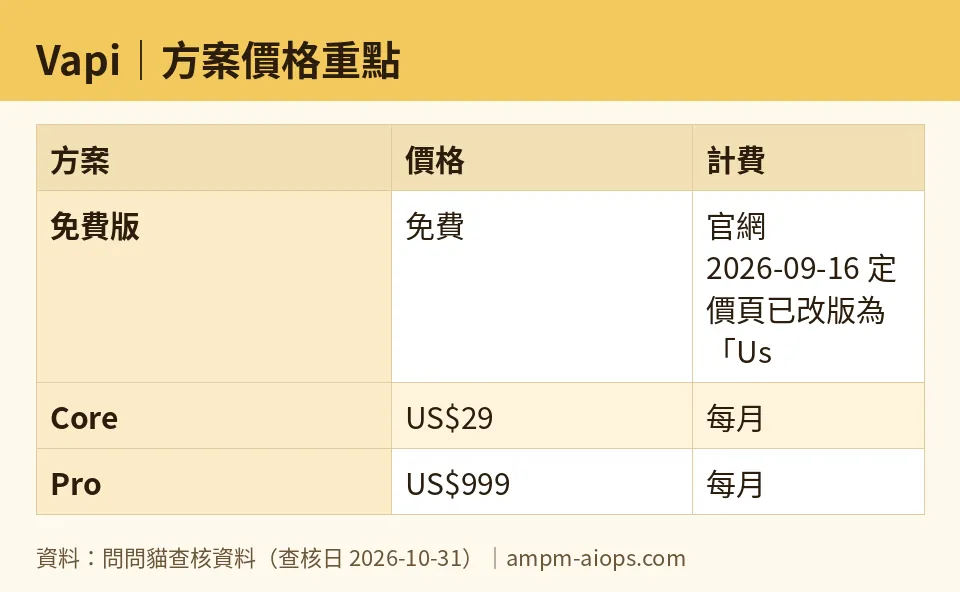
Figure: compiled by AMPM from its verified data (last verified 2026-10-31).
🔗 Related on AMPM
📎 Sources
All prices and quotas in this article come from AMPM’s verified dataset for Vapi (last verified 2026-10-31); primary sources:
🐾 Meet the cats: AMO and PIMI

AMPM is a Taiwan-based AI-tool pricing watchdog. Our motto: ask before you subscribe. Two cats argue every tool from two sides:
- ☀️ AMO — the budget-minded cat. Always asks: is the free tier enough, and is paying actually worth it?
- 🌙 PIMI — the performance-minded cat. Cares about whether it works well, fast, and gets your job done.

When they are done arguing, you know whether to pay. Every number is checked by us, with the verification date at the end.
🐾 Our sister sites also checked
Read next
- Vapi Full breakdown: pricing, features and real-world limits
- Vapi Is the free quota enough?
- Vapi Alternatives
- Free plan limits for every AI tool we track
More verified articles on this tool
- [Pricing] Vapi Pricing 2026: The Free Credit Shrank, and the Per-Minute Math Behind It
- What a Vapi Voice Agent Really Costs per Minute (2026): The Platform Fee Is Only the Start