[Pricing] Vapi Pricing 2026: The Free Credit Shrank, and the Per-Minute Math Behind It
- Free tier: Yes
- Cheapest paid plan: US$0/mo and up
- Free quota: As of 2026-09-16 the official pricing page has been restructured into …
- Last checked: 2026-10-24
Article last updated: 2026-10-08


Vapi sells infrastructure for building AI voice agents — the software layer that lets a company wire up a phone bot that can take calls, transcribe speech, think through a conversation flow, and talk back. It’s not a chatbot widget; it’s the plumbing other teams build voice products on top of, billed by the minute. And as of a pricing page rebuild on 2026-09-16, the free tier that used to hand new users 60-plus free minutes and US$10 in credit now hands out US$5 instead. If you’re checking Vapi pricing before committing engineering time to it, that cut — and what US$0.05 a minute actually adds up to once you stack a transcription, a language model and a voice on top of it — is the first thing to understand.
What the free tier actually gives you
Vapi’s free signup credit is US$5. That’s not minutes, it’s prepaid dollars that get drawn down against Vapi’s own hosting fee of US$0.05 per minute, plus whatever the underlying AI providers charge for transcription, the language model, and the synthesized voice. Those provider costs are pass-through — Vapi charges you exactly what the provider charges Vapi, no markup on top.

Illustration: Free credits are halved and once depleted, the service suspends immediately.
That US$5 buys you access to the full platform rather than a stripped demo: the complete model catalog, 4 concurrent calls (meaning your agent can handle four live phone conversations at once before a fifth gets blocked), 2 organizations (separate workspaces, useful if you’re testing for two different clients or projects), 1 included Vapi phone number, and 14 days of raw call data retention. Support is Discord community only, plus email with no service-level agreement — meaning no promised response time.
The catch: once that US$5 credit hits zero and you haven’t turned on auto-reload (automatic top-up when the balance runs low), Vapi’s own documentation says the account freezes. You can’t start new calls until you add funds. That’s a harder wall than “free tier slows down” — it’s a full stop.
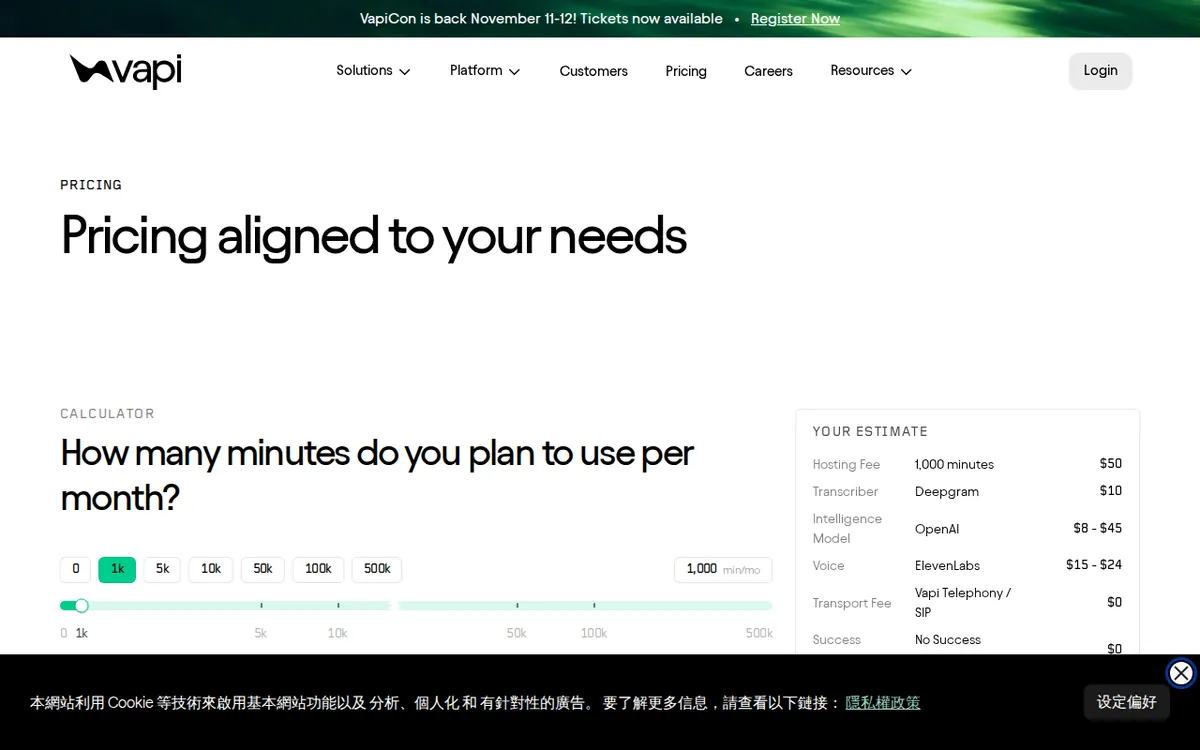
Figure: vapi.ai official pricing page, captured 2026-10-08.
The paid tiers, plan by plan
Usage only (No Success Package) is the account you’re already on once the free credit runs out and you start topping up manually. There’s no monthly fee — you pay US$0.05 a minute for Vapi hosting plus the same pass-through provider costs, pre-paid as you go. Limits stay the same as the free tier: 4 concurrent calls, 2 organizations, 1 included phone number, 14-day data retention. No response SLA, no uptime SLA.
Core is US$29 a month, prepaid and auto-renewing, on top of usage fees — this is the cheapest upgrade path once pay-as-you-go stops being enough. It raises concurrent calls to 10, included phone numbers to 5, organizations to 2, and data retention to 30 days. It adds “ZDR” (zero data retention — an option to have call data not stored at all, useful for privacy-sensitive use cases), email support, and a 2-business-day response SLA — the first tier with any promised response window.
Pro changes the billing shape entirely: instead of a flat fee, you pay 10% of your Vapi hosting spend, with a US$999-a-month floor. Model, voice and transcription costs aren’t part of that 10% calculation — they’re billed separately at the same pass-through rates. In exchange you get 10 organizations, 10 phone numbers, 30 concurrent calls, 180-day retention, role-based access control (RBAC — letting you set who on your team can do what) plus ZDR, a dedicated Slack channel alongside email, a 1-business-day response SLA, and a 99% uptime SLA — the first tier that promises the platform itself will actually stay up.
Premier is custom-quoted and sold only through direct sales — no listed price. It covers organizations, concurrency, retention and phone number counts as negotiated, plus a named support team (an “Agent Strategist” and “FDE Advisor,” along with onboarding help), a 1-hour response SLA for the most severe incidents, 99.9% uptime, custom RBAC plus ZDR plus SSO (single sign-on, for centralized company logins), and dedicated SIP — a private telephony connection rather than shared infrastructure.
What US$0.05 a minute turns into in practice
Vapi’s own cost calculator, run at 1,000 minutes a month on the Usage-only tier, breaks a real build down like this: Vapi hosting comes to US$50 (that’s the US$0.05/minute rate), a Deepgram transcriber adds US$10, an OpenAI intelligence model adds US$8 to US$45 depending on which model you pick, ElevenLabs voice adds US$15 to US$24, and Vapi’s own telephony/SIP transport is US$0. The calculator’s own estimated total for that mix: US$82 to US$129 a month. Vapi doesn’t publish that as a single per-minute rate — it’s a monthly total built from five separate line items, and the spread exists because the model and voice choice move the price more than the hosting fee does.
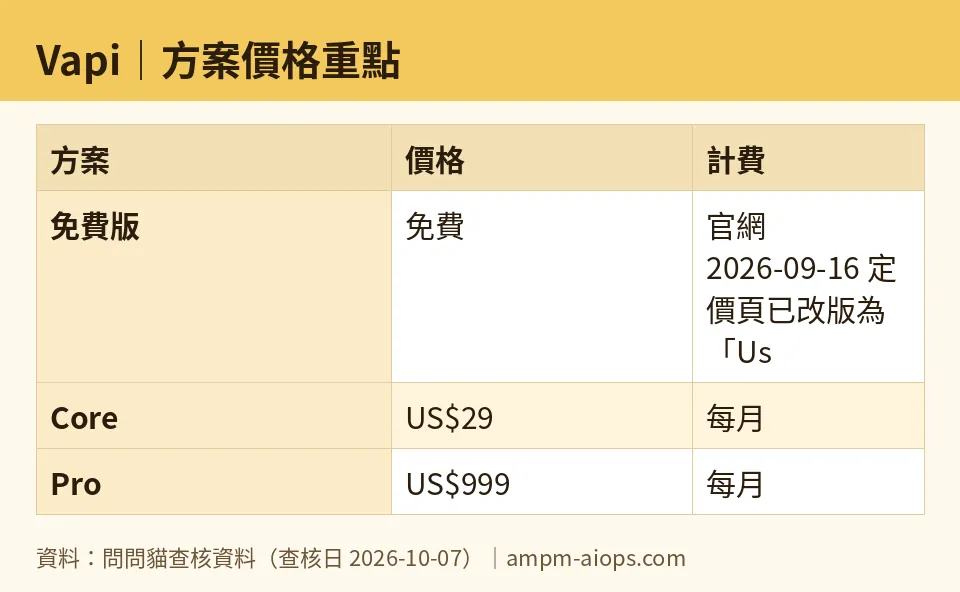
Figure: compiled by AMPM from its verified data (last verified 2026-10-07).
🔍 AMPM exclusive check
We read vapi.ai/pricing and docs.vapi.ai directly rather than relying on the figures still circulating from before the September rebuild. Two things worth flagging. First, the old numbers — “60+ minutes included,” “10 concurrent calls” on the entry tier, and a US$10 starting credit — no longer appear anywhere on the live pricing page; the site now runs strictly on the US$5-credit, 4-concurrent-call structure described above. Second, a widely repeated “enterprise plan: US$40,000–70,000 a year” figure for Vapi also does not appear on the official pricing page at all — it’s a secondhand estimate, not something Vapi has published, and we’re not carrying it forward. The one practical gotcha the pricing page itself doesn’t spell out clearly: the balance-to-zero account freeze is documented on Vapi’s separate billing docs page, not on the pricing page where a new signer-up would actually see it.
☀️ AMO, the budget-minded cat

I run the numbers before I run the call. US$5 in free credit, split across Vapi’s own US$0.05-a-minute hosting fee plus whatever the transcriber, model and voice provider charge on top — that’s not a lot of runway. Based on the official calculator’s own 1,000-minute example, where the full stack lands between US$82 and US$129 a month, US$5 covers well under an hour of a real, fully-loaded call before you’re topping up. If you’re just poking at the API (the interface your code uses to send and receive data from Vapi) to see if the latency and voice quality are good enough, the free credit answers that question fast and cheaply. But treat it as a taste test, not a pilot budget.
Is paying worth it? The jump to Core at US$29 a month plus usage is worth it the moment you need more than 4 concurrent calls or more than 14 days of call history — that’s a real functional ceiling, not a convenience tier. But Pro’s US$999-a-month floor is a different animal: that’s a production-scale commitment, and the 10%-of-hosting billing model means your bill scales with you, which is fair, but US$999 a month is real money to commit to before you know your usage is going to clear that floor. I’d stay on Usage-only or Core until the concurrency and retention limits are actually blocking something, not before.
Verdict: who should use it, who should skip it
Solo developers and small teams prototyping a voice agent should use the free US$5 credit to test quality, then expect to move to pay-as-you-go (Usage only) fast — there’s no monthly commitment there, which matches early-stage uncertainty. Teams putting a real product behind Vapi, with more than a handful of simultaneous callers, should budget for Core’s US$29/month floor as the first real upgrade, since it’s the cheapest tier with any support SLA at all. Skip Pro until your hosting spend alone would clear US$999 a month — paying that floor earlier just to get RBAC or Slack support is not a good trade unless uptime SLA coverage is a hard requirement for your launch. Skip Premier entirely unless you’re already negotiating SSO, dedicated SIP, or sub-hour incident response with a sales rep — it has no public price for a reason.
Written: 2026-10-08 Price last verified: 2026-10-07 Tool last health-checked: 2026-10-08
🔗 Related on AMPM
📎 Sources
All prices and quotas in this article come from AMPM’s verified dataset for Vapi (last verified 2026-10-07); primary sources:
🐾 Meet the cats: AMO and PIMI

AMPM is an independent AI-tool pricing watchdog tracking official prices worldwide. Our motto: ask before you subscribe. Two cats argue every tool from two sides:
- ☀️ AMO — the budget-minded cat. Always asks: is the free tier enough, and is paying actually worth it?
- 🌙 PIMI — the performance-minded cat. Cares about whether it works well, fast, and gets your job done.

When they are done arguing, you know whether to pay. Every number is checked by us, with the verification date at the end.
🐾 Our sister sites also checked
Read next
- Vapi Full breakdown: pricing, features and real-world limits
- Vapi Is the free quota enough?
- Vapi Alternatives
- Free plan limits for every AI tool we track