Ask Cat › AI Tool Summary › Veo
[Pitfalls] Veo Pricing: the Free Tier's 50-Point Daily Limit, a Quiet Rename, and the US$0.40-a-Second API Bill
- Free tier: There is
- Cheapest paid plan: US$4.99/mo and up
- Free quota: Google Flow has a daily quota of 50 points (with regional …
- Last checked: 2026-10-05
Article last updated: 2026-10-08



Google’s Veo video generator runs on a points system that changes shape three times before you’ve even picked a plan. We checked the free tier, the subscription names, and the pay-by-the-second API pricing against the official pages — here’s where the free tier limit actually bites, and what else trips people up before they pay for Veo.
The free tier’s 50-point catch
Veo’s free access runs through Google Flow, Google’s video-creation front end. You get 50 points a day, reset every 24 hours. Points are Google’s spending unit for AI generation — each video render draws down your point balance, and when you run out, you wait for the next reset or upgrade.
Two catches sit inside that one number. First, the 50-point daily allowance is region-limited — it’s not available the same way everywhere, and Google’s official subscription page doesn’t display this number directly; it’s been tracked through secondary sources rather than a clear line on the pricing page itself. Second, Google AI Studio (the developer-facing tool for building with Veo) runs its own, separate free quota. A free Flow account and a free AI Studio account are two different allowances. Using up one doesn’t touch the other, but assuming they’re the same pool is an easy way to get a surprise “quota exceeded” message.
Avoid it: track your Flow points and your AI Studio limits separately, and don’t expect the vendor page to spell out the daily number — confirm it inside your own account dashboard, since regional caps can mean your real limit differs from what you read online.
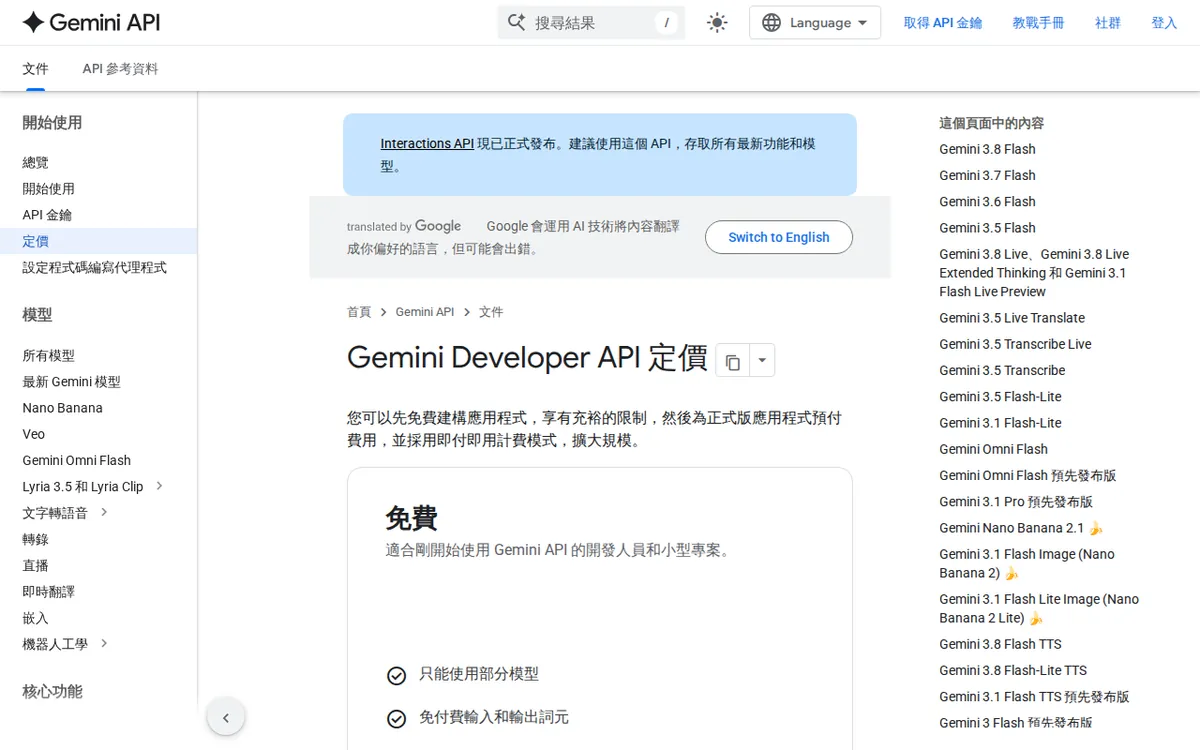
Figure: ai.google.dev official pricing page, captured 2026-10-08.
Same button, new name: Pro’s identity swap
Google AI Pro is not a new product — it’s Google One AI Premium wearing a different label. If you subscribed under the old name and haven’t looked closely, you’re paying US$19.99 a month for the same 1,000 Google Flow points, 4x the free-tier usage allowance, Gemini 3.1 Pro access, and 5TB of storage that Google One AI Premium used to offer. Nothing about the product changed except the sign on the door.
The entry-level plan went through a quieter version of the same thing. Google AI Plus dropped from US$7.99 to US$4.99 a month in June 2026. Google calls this a permanent price cut, not a limited-time promo — but auto-renewal doesn’t automatically retroactively notify you of a price change in a way everyone reads carefully. If you set up the subscription before that cut and never checked again, there’s no built-in prompt reminding you the sticker price moved. Plus now gets you 200 Flow points a month (2x the free tier) plus access to Gemini 3.1.
Avoid it: when a subscription renews automatically, re-check the current official price and plan name against what you’re actually being charged — a rename or a price cut doesn’t always travel with a notification into your inbox.
The API meter nobody mentions
Subscription points and Veo’s API (the programmatic interface developers use to call Veo directly from code instead of through the Flow website) are two separate billing systems, and the difference matters more than it sounds. Your 200, 1,000, 10,000, or 25,000 monthly points from a Flow subscription do not apply to API calls. If you build something that calls Veo’s API, you’re billed by the second, not by the point.
Specifically: Veo 3.1 Lite at 720p resolution runs US$0.05 per second of generated video. Veo 3.1 Standard at 1080p runs US$0.40 per second — eight times the Lite rate for the higher resolution. A short handful of 1080p test clips during development can add up fast if nobody’s watching the meter, because there’s no “free points” cushion on the API side the way there is in Flow.
Avoid it: if you’re building on the API rather than using the Flow web app, budget by seconds of output at the per-second rate above, not by assuming any subscription points carry over. Lite and Standard are priced eight times apart, so picking resolution deliberately is worth the five minutes.
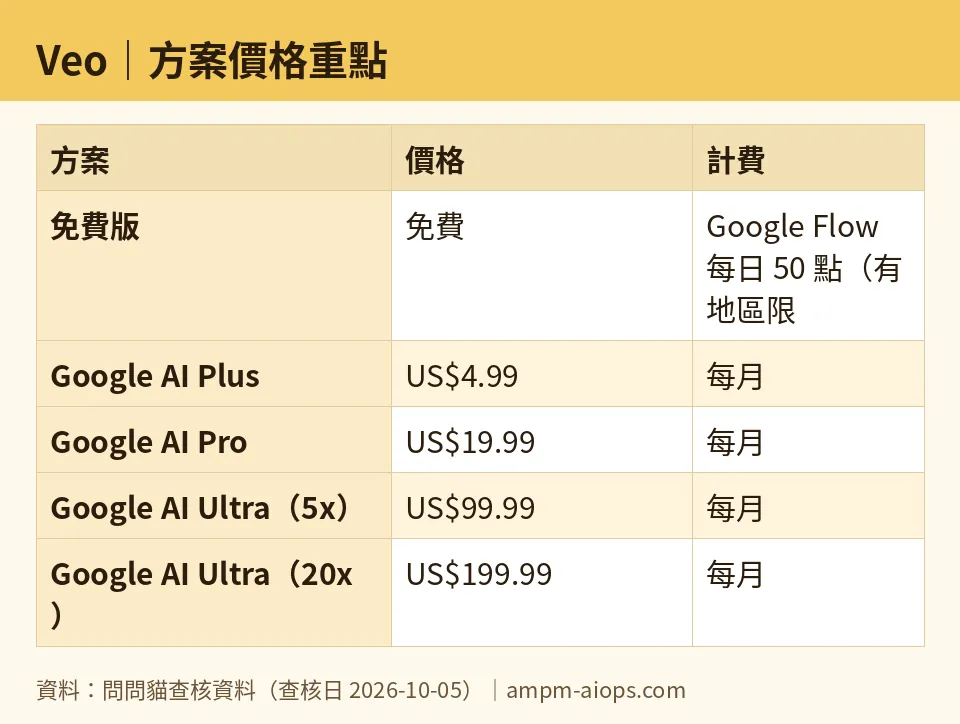
Figure: compiled by AMPM from its verified data (last verified 2026-10-05).
🔍 AMPM exclusive check
The official Google subscription pages (labs.google and gemini.google/subscriptions) clearly list the paid-plan prices and point allowances, and our check on 2026-08-27 and again on 2026-10-05 found those numbers consistent across both pages. Where the vendor page falls short is the free tier: the 50-points-a-day figure for Google Flow isn’t printed directly on the current subscription page — we’ve kept it flagged as sourced from secondary disclosure rather than a first-party line item, because Google’s own pricing page doesn’t spell it out plainly where a new user would look.
We also checked the gap between the two Ultra tiers. Google AI Ultra at US$99.99/month (10,000 points) and US$199.99/month (25,000 points) are listed side by side on the official page, but beyond the point allowance and the 5x-versus-20x usage multiplier, Google’s own page doesn’t list any additional feature difference between the two — no extra tool, no extra storage tier, nothing beyond more points. If you’re deciding between the two Ultra prices, the entire decision is points per dollar, not features.
One more plain fact worth stating since the vendor page buries it in terms rather than the pricing table: Veo’s free-tier output carries a visible watermark and isn’t cleared for commercial use. If your plan is to use free-tier clips in anything you sell or publish commercially, that’s blocked regardless of how many of your 50 daily points you have left.
☀️ AMO, the budget-minded cat

AMO looks at this one and asks the only question that matters: is 50 free points a day enough, or is it worth paying US$4.99? For someone making one or two short test clips a day, 50 points a day is probably fine — you’re not maxing out a daily reset that comes back every 24 hours. The problem is the watermark and the no-commercial-use rule riding along with the free tier. If you need a clip without a watermark for anything public-facing, free isn’t really an option regardless of how many points you have.
That’s where the US$4.99/month AI Plus plan earns its keep for light users: 200 points a month and 2x the free-tier usage rate, plus Gemini 3.1 access, for less than the price of a coffee. It’s the permanent price (cut from US$7.99 in June 2026), not a trial rate. AMO’s math: if you’re making more than a handful of clips a week and the watermark is a dealbreaker, US$4.99 clears that bar easily. But if you’re an occasional, non-commercial user who’s fine with a watermark, the free 50-points-a-day tier covers that use case without spending anything. Where AMO would hold off is the US$19.99 Pro tier or either Ultra tier — those only pay off if you’re regularly burning through hundreds or thousands of points a month, not just testing the tool out.
Verdict: who should use it, who should skip it
Use Veo’s free tier if you’re experimenting, don’t need commercial rights, and can live with a watermark and the region restriction. Step up to AI Plus (US$4.99/month) if you want double the free quota and don’t mind the entry price Google permanently cut in June 2026. Go Pro (US$19.99/month) or Ultra (US$99.99 or US$199.99/month) only if you’re burning through points fast enough that 1,000, 10,000, or 25,000 a month actually gets used — otherwise you’re paying for headroom you won’t touch.
Skip it, or watch it closely, if you’re building on the API: the per-second billing (US$0.05 for Lite, US$0.40 for Standard) has no free cushion and no connection to your subscription points, so unmonitored testing is the fastest way to an unexpected bill. And if you already subscribed under the old Google One AI Premium name, check what you’re actually on now — the product renamed itself to AI Pro without necessarily flagging that to existing subscribers.
Written: 2026-10-08 Price last verified: 2026-10-05 Tool last health-checked: 2026-10-08
🔗 Related on AMPM
📎 Sources
All prices and quotas in this article come from AMPM’s verified dataset for Veo (last verified 2026-10-05); primary sources:
🐾 Meet the cats: AMO and PIMI

AMPM is a Taiwan-based AI-tool pricing watchdog. Our motto: ask before you subscribe. Two cats argue every tool from two sides:
- ☀️ AMO — the budget-minded cat. Always asks: is the free tier enough, and is paying actually worth it?
- 🌙 PIMI — the performance-minded cat. Cares about whether it works well, fast, and gets your job done.

When they are done arguing, you know whether to pay. Every number is checked by us, with the verification date at the end.
🐾 Our sister sites also checked
Let's take a look at these
- Veo Comprehensive Introduction: Pricing, Features, and Actual Limitations
- Veo Is the free quota enough?
- Veo Alternatives
- Comprehensive Free Quota List for All Tools