[News] Yelp, Delta and Banks Start Blocking AI Agents — Does Wispr Flow Get Caught in It?
- Free tier: Yes
- Cheapest paid plan: US$15/mo and up
- Free quota: Free version transcription character limit: 2,000 characters/week on …
- Last checked: 2026-10-22
Article last updated: 2026-10-18


The headlines this week make it sound like the walls are going up on AI. Yelp, Delta and several banks have moved to block “AI agents” from acting on their sites. If you dictate into Wispr Flow every day, the obvious question is whether your tool just lost access to anything. My short answer: this news is about a different category of software, and the gap matters.
What happened
The Verge reported on 2026-10-18 that a growing list of companies — including Yelp, Delta and some banks — are moving to restrict AI agents from operating on their services. The story was picked up across multiple outlets, so this is not a single-site rumor.
The key word is “agent.” An AI agent is software that acts on your behalf — it logs into sites, clicks around, fills forms, books things, pulls data. Think of a bot that opens a travel site, searches flights and tries to complete a booking without you touching the keyboard. That is what these companies are pushing back on. They cite reasons like fraud risk, scraping of their data, server load, and losing control over how customers interact with them.
The reports frame this as an early fight over who gets to use the open web in an agent-driven era. Companies that depend on direct customer relationships — airlines, review platforms, financial services — are the first to draw lines. The coverage does not single out any one consumer app as a target, and it does not mention Wispr Flow.
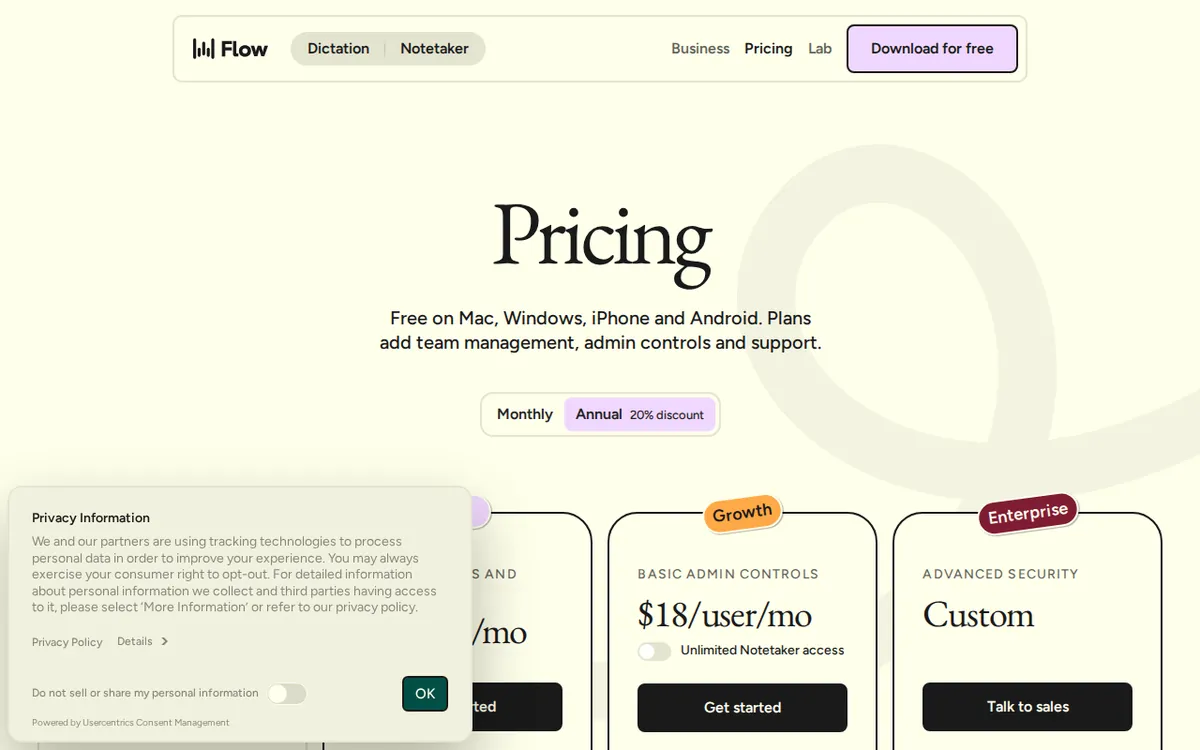
Figure: wisprflow.ai official pricing page, captured 2026-10-18.
How AMPM sees it
This is the distinction that the panic skips over.

Illustration: Dictation tools converting voice to text pass freely, while autonomous agents operating accounts are held back by service barriers.
Wispr Flow is a voice dictation tool. You speak, and it types the words into whatever app you already have open — an email, a chat box, a document. It does not browse Yelp for you. It does not log into your bank. It does not open Delta’s site and book a flight. It turns your voice into text on your own screen, inside apps you are already signed into as yourself.
The companies in this story are blocking automated software that visits their sites and takes actions. That is a fundamentally different job from transcription. So on the plain reading of what was reported, Wispr Flow is not the kind of product these restrictions aim at. Nothing in the sources suggests dictation is affected.
That is the headline takeaway. But it is worth being precise about where the two worlds could eventually brush against each other, because “not today” is not the same as “never.”
Where it could matter later (this is my inference, not something the sources state):
If voice tools keep expanding beyond typing — into “do this for me” territory where you speak a command and the software goes off and completes a task on a website — then they start to look like agents, and they could run into the same walls. Today Wispr Flow’s described job is dictation: it writes what you say into the field in front of you. As long as that is the job, the agent-blocking wave does not apply. The moment any voice tool starts navigating sites and acting on your behalf, it inherits the agent problem. I have no evidence Wispr Flow is heading there; I am flagging the category line, not predicting a move.
Who should actually pay attention to this news:
- People who rely on autonomous agents to book travel, pull account data from banks, or scrape listings. Those workflows are the ones getting squeezed.
- Developers building agent products on top of third-party sites. The ground is shifting under you, and access you had last month may not be there next month.
- Everyone else — including most dictation users — can treat this as industry weather, not a personal outage.
The privacy angle worth separating out.
The companies in the story are partly reacting to not knowing who or what is hitting their servers. That is their privacy and control concern, pointed outward at bots. It is a different question from your privacy when you use a voice tool. Any dictation product sends your speech somewhere to be turned into text, and that is the question you should ask of Wispr Flow directly — what happens to your audio — regardless of this news. The agent-blocking story does not change that calculus either way. I raise it only so readers do not merge two separate privacy conversations into one.
Where this fits in the industry.
This is the opening round of a long argument: the web was built for humans with browsers, and now a chunk of traffic is software acting for humans. Big sites want to decide which software gets in. Expect more companies to publish agent policies, more technical blocks, and eventually some standard for “this bot is acting for a verified, consenting user.” For a tool that simply types your spoken words into your own open apps, none of that plumbing is in the path today. That is the whole reason the distinction is worth drawing clearly instead of letting the word “AI” blur it.
What to watch next:
- Whether the blocked list grows from review sites, airlines and banks into categories that touch everyday productivity apps.
- Whether any voice tool — Wispr Flow included — announces agent-style “act for me” features. That is the trigger that would move it out of the safe lane.
- Whether a verification standard emerges that lets legitimate, user-authorized software through. That would define the rules dictation tools would have to follow if they ever cross into agent work.
For now, nothing here forces you to change a decision about a dictation tool. If you were weighing Wispr Flow on how well it types your voice and whether the free weekly word allowance covers you, this news does not touch that. Judge it on the dictation job, not on a headline about booking bots.
🔍 AMPM exclusive check
We separated two things the coverage lets readers blur: “AI agent” (software that navigates and acts on sites) and “AI dictation” (software that types your speech into your own apps). The reports are about the first. Wispr Flow, by its own description, does the second. No source in this story names Wispr Flow or says dictation tools are blocked — so the link between this news and your dictation workflow is one readers are drawing, not one the reporting makes. We checked the sources on 2026-10-18 and found no mention of Wispr Flow in them.
Sources
- The Verge, “Yelp, Delta and banks restrict AI agents on their services” (2026-10-18): https://www.theverge.com/ai-artificial-intelligence/1013195/ai-agents-blocked-web
- Additional coverage: theverge.com, ua.news (cross-reported, 2026-10-18)
Verdict: who should use it, who should skip it
If you use Wispr Flow to dictate into your apps, this news is not your fire. The agent-blocking move targets software that acts on other companies’ sites, which is not what a dictation tool does. Keep using it, and judge it on transcription quality and whether the free weekly word allowance fits your volume.
Pay attention — and maybe rethink your setup — only if you depend on autonomous agents that log into banks, airlines or review sites for you, or if you build on top of those sites. Those are the workflows under pressure right now.
And keep one eye on feature announcements. The day any voice tool starts doing things for you on the open web instead of just typing what you say, it joins the agent conversation, and these restrictions become its problem too. That day is not today.
Written: 2026-10-18 Price last verified: 2026-10-17 Tool last health-checked: 2026-10-18
🔗 Related on AMPM
📎 Sources
All prices and quotas in this article come from AMPM’s verified dataset for Wispr Flow (last verified 2026-10-17); primary sources:
🐾 Meet the cats: AMO and PIMI

AMPM is a Taiwan-based AI-tool pricing watchdog. Our motto: ask before you subscribe. Two cats argue every tool from two sides:
- ☀️ AMO — the budget-minded cat. Always asks: is the free tier enough, and is paying actually worth it?
- 🌙 PIMI — the performance-minded cat. Cares about whether it works well, fast, and gets your job done.

When they are done arguing, you know whether to pay. Every number is checked by us, with the verification date at the end.
🐾 Our sister sites also checked
Read next
- Wispr Flow Full breakdown: pricing, features and real-world limits
- Wispr Flow Is the free quota enough?
- Wispr Flow Alternatives
- Free plan limits for every AI tool we track
More verified articles on this tool
- [Pricing] Wispr Flow pricing: the free tier's word limit depends on which device you use
- Wispr Flow's Free Tier Depends on Your Device: Is Pro Worth It? (Checked Sept 2026)
- How to Get the Most Out of Wispr Flow's Free Weekly Words, and the Device Where It's Unlimited