Ask Cat › AI Tool Summary › Zed
[How-to] Zed's Free Tier Gives You 2,000 AI Edit Predictions Before the US$10 Pro Wall
- Free tier: There is
- Cheapest paid plan: US$10/mo and up
- Free quota: Personal: 2,000 accepted edit predictions; the official pricing page …
- Last checked: 2026-10-07
Article last updated: 2026-10-08



Zed is a code editor built in Rust (a programming language prized for speed) with an AI coding agent and real-time collaboration built in. If you’re trying to figure out whether its free tier is enough to actually code with, or whether you need to pay, here’s what the free tier covers and what changes once you hit the US$10 Pro plan.
The short version: Zed’s Personal plan — free — gives you 2,000 “accepted edit predictions.” That’s Zed’s term for AI-suggested code edits you actually accept, not just see on screen. Once you’ve used those 2,000, the official pricing page doesn’t say when or whether that counter resets. If you want AI edit predictions without a ceiling, Zed’s Pro plan is US$10 a month and removes the cap. There’s also a workaround that skips the whole quota system: bring your own API key (a personal access credential for an AI provider like Anthropic or OpenAI) or wire in an external agent like Claude Agent or Codex CLI, and your usage runs on your own account instead of Zed’s quota.
What the free tier actually includes
Zed’s Personal tier is free and includes 2,000 accepted edit predictions. The important nuance: these are AI suggestions that get counted only when you accept them, not every suggestion the editor shows you as you type. So a session where Zed proposes ten edits and you take three only burns three against your 2,000.

Illustration: Plugging an external key into the bypass valve frees the stream from a closed container, allowing limitless flow.
What Zed doesn’t say on its pricing page is how often that 2,000 refreshes — weekly, monthly, or not at all until you upgrade. If you’re a light user doing a few edits a day, 2,000 could realistically last you a long time. If you lean on AI predictions constantly during a big refactor, you could burn through it faster than you’d expect, with no stated date for when it comes back.
There’s a second way to get free, uncapped AI help inside Zed: connect your own API key, or hook up an external coding agent such as Claude Agent or Codex CLI. Zed’s documentation notes this path has no limit from Zed’s side — because the usage and billing happen on the provider’s account, not Zed’s. That means the “free” ceiling only applies if you’re using Zed’s own built-in prediction service; route around it with your own key and the 2,000 cap becomes irrelevant (though you’d then be paying whatever your API provider charges, separately from Zed).
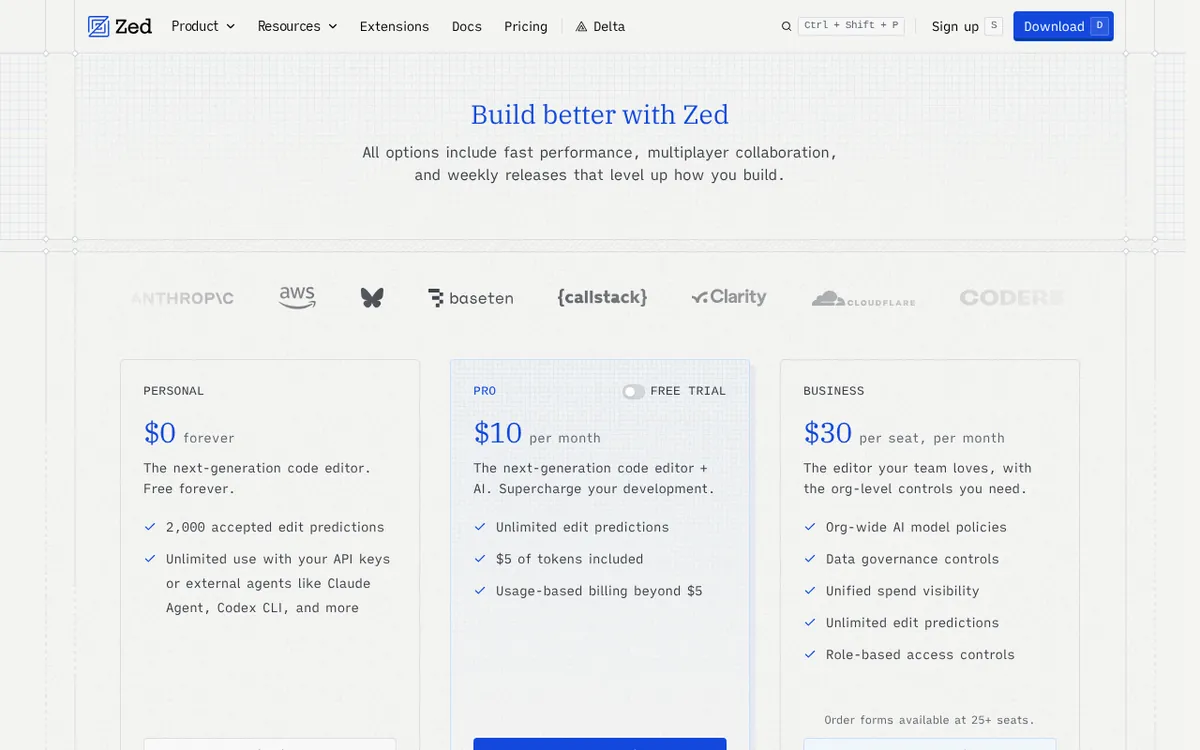
Figure: zed.dev official pricing page, captured 2026-10-08.
How the US$10 Pro plan actually bills you
Pro costs US$10 a month and removes the 2,000-prediction cap entirely — unlimited accepted edit predictions. But “unlimited” comes with a wrinkle worth knowing before you subscribe.
The US$10 includes US$5 worth of token credit. Tokens are the units AI models use to measure how much text they read and generate; every prompt and every response costs some number of tokens, and that’s what the credit is spent on. Once you’ve used that US$5 of credit, Zed doesn’t cut you off — it keeps billing you, at the underlying AI provider’s list price plus a 10% markup. So Pro isn’t a flat US$10-and-done plan if you’re a heavy AI user; it’s a US$10 floor with metered overage on top.
Zed settles that overage on a schedule: whichever comes first between the end of the month or your accumulated extra usage hitting US$10. So a developer who blows past their US$5 credit early in the month could see an additional charge mid-month once they’ve run up US$10 in overage, rather than waiting for the next billing date. If you’re budgeting for Pro, treat US$10 as a minimum, not a ceiling, unless you keep an eye on usage.
Is Business worth the jump from Pro
Zed’s Business plan is US$30 per seat per month (a “seat” is one paid user license — ten people needs ten seats). It adds things an individual developer doesn’t need but a team might: organization-wide model policies (controlling which AI models staff are allowed to use), data governance controls, a spend-review view so admins can see usage across the team, and role-based permissions. Organizations with 25 or more seats can go through a custom order form instead of self-service billing.
For a solo developer or a small team without compliance requirements, Business is almost certainly overkill — the US$20 jump per seat over Pro buys administrative controls, not more AI capability. It starts to make sense once you have a manager who needs to see what the team is spending, or a security team that needs to restrict which AI models employees can route code through.
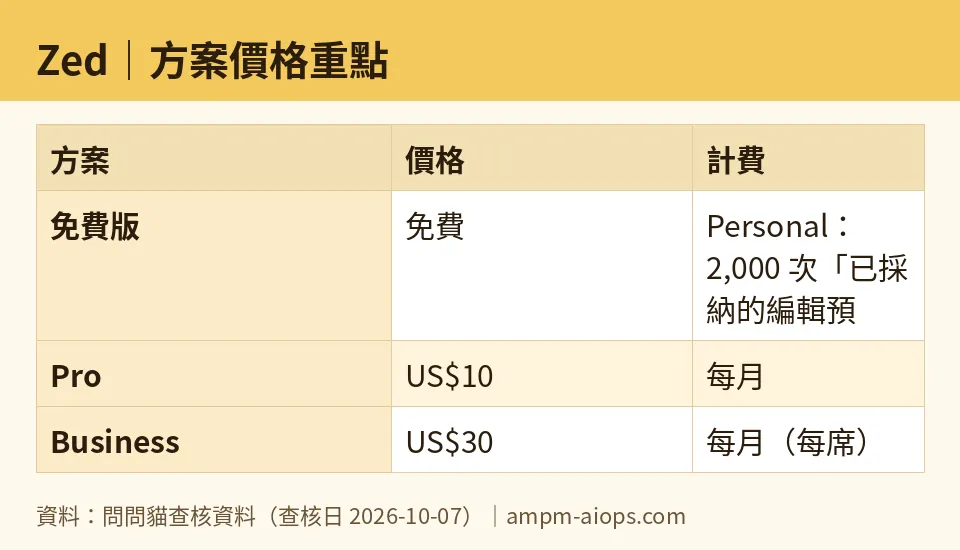
Figure: compiled by AMPM from its verified data (last verified 2026-10-07).
Getting started without hitting the wall early
A few practical steps to avoid burning through the free 2,000 predictions faster than necessary: let edit predictions do small, targeted completions rather than accepting broad AI rewrites for things you could type yourself quickly. Each acceptance counts the same whether it was a one-line fix or a multi-line rewrite, so predictions are worth more when you save them for genuinely tedious edits. If you already pay for Claude, OpenAI, or another provider elsewhere and have an API key, connecting that key in Zed’s settings from day one sidesteps the Personal-tier cap altogether, since Zed treats that usage as running on your own account rather than its built-in quota.
If you’re evaluating whether to upgrade, watch how fast you burn through the 2,000 in a normal week of work rather than guessing. Because Zed doesn’t publish a reset interval, the only reliable signal is your own usage pattern — if you’re regularly near the ceiling before the month is out, Pro’s US$10 floor is cheap insurance, with the overage terms above kept in mind.
🔍 AMPM exclusive check
We went to Zed’s own pricing page specifically to find the reset cycle for the free tier’s 2,000 accepted edit predictions — how often that count refreshes. It isn’t stated anywhere on the page. This isn’t a case where we found something the vendor hid; it’s a case where the vendor simply doesn’t publish that detail at all, on its official pricing page as of our check on 2026-10-07. Anyone signing up for Personal should know going in that there’s no public answer to “when do I get my 2,000 back” — you’d only learn that by using the product and watching your own count. Every dollar figure and quota we cited above — the 2,000 free predictions, the US$10 Pro price, the US$5 included credit, the 10% overage markup, and the US$30 per-seat Business price — matched what’s currently published on zed.dev/pricing when we checked.
Verdict: who should use it, who should skip it
If you’re a solo developer doing normal day-to-day coding, the free Personal tier with 2,000 accepted edit predictions is a reasonable way to try Zed’s AI features without paying anything — and if you already hold an API key for Claude, OpenAI, or another provider, you can skip the cap entirely by plugging that in. Upgrade to the US$10 Pro plan once you’re routinely running out of free predictions and want the built-in service rather than managing your own key; just budget for possible overage past the included US$5 credit, billed at list price plus 10%. Business, at US$30 per seat, is for teams that need spend visibility and model-policy controls — skip it if you’re working alone or in a small team with no governance requirements.
Written: 2026-10-08 Price last verified: 2026-10-07 Tool last health-checked: 2026-10-07
🔗 Related on AMPM
📎 Sources
All prices and quotas in this article come from AMPM’s verified dataset for Zed (last verified 2026-10-07); primary sources:
🐾 Meet the cats: AMO and PIMI

AMPM is a Taiwan-based AI-tool pricing watchdog. Our motto: ask before you subscribe. Two cats argue every tool from two sides:
- ☀️ AMO — the budget-minded cat. Always asks: is the free tier enough, and is paying actually worth it?
- 🌙 PIMI — the performance-minded cat. Cares about whether it works well, fast, and gets your job done.

When they are done arguing, you know whether to pay. Every number is checked by us, with the verification date at the end.
🐾 Our sister sites also checked
Let's take a look at these
- Zed Comprehensive Introduction: Pricing, Features, and Actual Limitations
- Zed Is the free quota enough?
- Zed Alternatives
- Comprehensive Free Quota List for All Tools
More verified articles on this tool
- [Verified] Zed editor: 2,000 free predictions, unlimited with your API key
- How Zed's Agent Sandbox Works: No Writes Outside the Project, No .git, No Network — Unless the Agent Asks
- Zed Pro Costs US$10 and Includes US$5 of Tokens — So What Is the Other US$5 Buying?